
Pulp Fiction, 1914 · page 44 of 228
Adventure, December 1914 — page 44: what you’re looking at
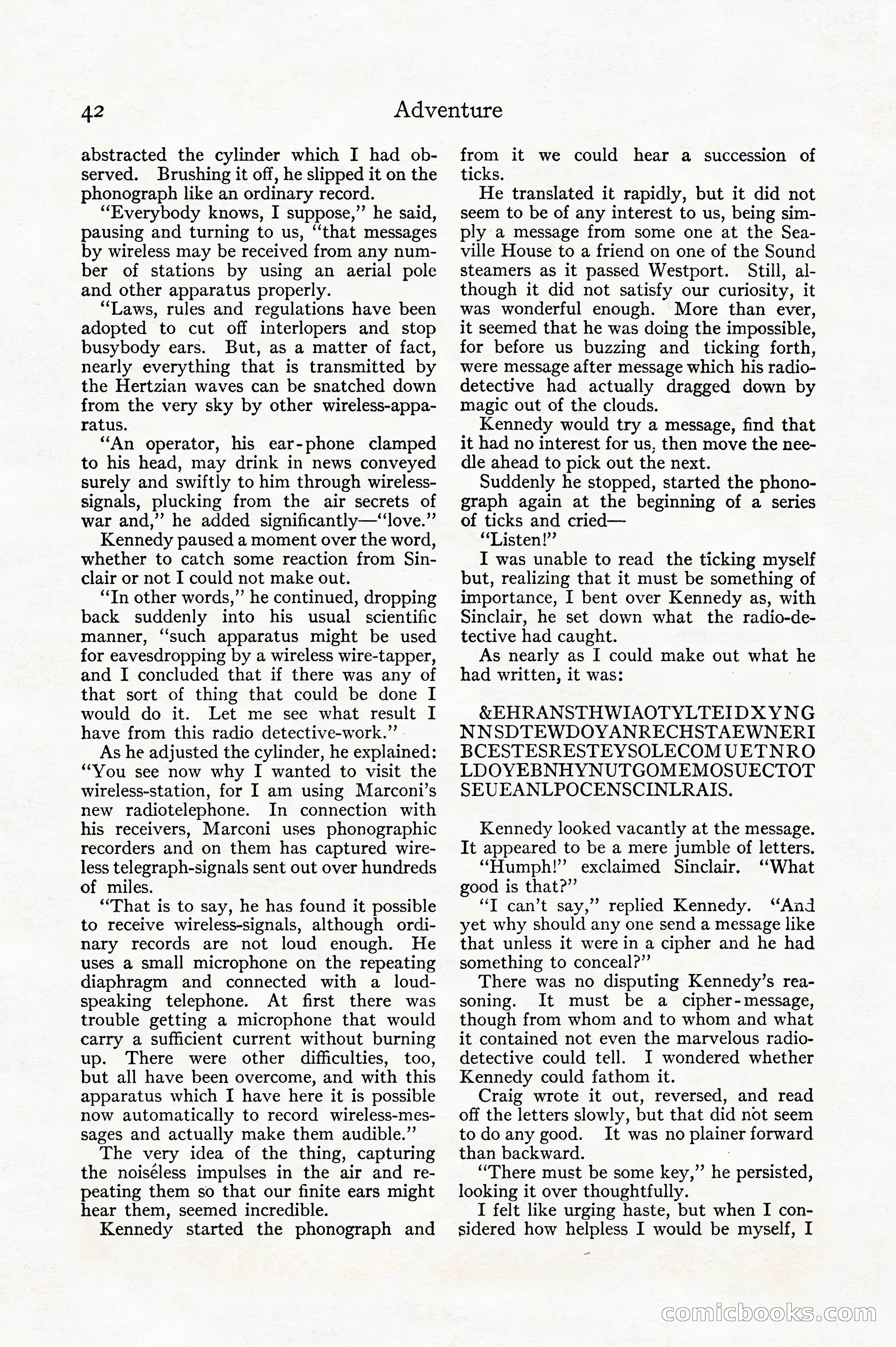
A restored page from Pulp Fiction, 1914. Page through the whole issue in the reader above.
📄 Transcribed text from this page (OCR, searchable)
Machine-transcribed from the original scan — historical spelling and the odd misread are preserved.
42 abstracted the cylinder which I had ob- served. Brushing it off, he slipped it on the phonograph like an ordinary record. “Everybody knows, I suppose,” he said, pausing and turning to us, “‘that messages by wireless may be received from any num- ber of stations by using an aerial pole and other apparatus properly. ““Laws, rules and regulations have been adopted to cut off interlopers and stop busybody ears. But, as a matter of fact, nearly everything that is transmitted by the Hertzian waves can be snatched down from the very sky by other wireless-appa- ratus. “An operator, his ear-phone clamped to his head, may drink in news conveyed surely and swiftly to him through wireless- signals, plucking from the air secrets of war and,” he added significantly—‘‘love.”’ Kennedy paused a moment over the word, whether to catch some reaction from Sin- clair or not I could not make out. “In other words,” he continued, dropping back suddenly into his usual scientific manner, ‘‘such apparatus might be used for eavesdropping by a wireless wire-tapper, and I concluded that if there was any of that sort of thing that could be done I would do it. Let me see what result I have from this radio detective-work.”’ | As he adjusted the cylinder, he explained: “You see now why I wanted to visit the wireless-station, for I am using Marconi’s new radiotelephone. In connection with his receivers, Marconi uses phonographic recorders and on them has captured wire- less telegraph-signals sent out over hundreds of miles. “That is to say, he has found it possible to receive wireless-signals, although ordi- nary records are not loud enough. He uses a small microphone on the repeating diaphragm and connected with a loud- speaking telephone. At first there was trouble getting a microphone that would carry a sufficient current without burning up. There were other difficulties, too, but all have been overcome, and with this apparatus which I have here it is possible now automatically to record wireless-mes- sages and actually make them audible.”’ The very idea of the thing, capturing the noiseless impulses in the air and re- peating them so that our finite ears might hear them, seemed incredible. Kennedy started the phonograph and Adventure from it we could hear a succession of ticks. He translated it rapidly, but it did not seem to be of any interest to us, being sim- ply a message from some one at the Sea- ville House to a friend on one of the Sound steamers as it passed Westport. Still, al- though it did not satisfy our curiosity, it was wonderful enough. More than ever, it seemed that he was doing the impossible, for before us buzzing and ticking forth, were message after message which his radio- detective had actually dragged down by magic out of the clouds. Kennedy would try a message, find that it had no interest for us, then move the nee- dle ahead to pick out the next. Suddenly he stopped, started the phono- graph again at the beginning of a series of ticks and cried— “Listen!” I was unable to read the ticking myself but, realizing that it must be something of importance, I bent over Kennedy as, with Sinclair, he set down what the radio-de- tective had caught. As nearly as I could make out what he had written, it was: | &EHRANSTHWIAOTYLTEIDXYNG NNSDTEWDOYANRECHSTAEWNERI BCESTESRESTEYSOLECOMUETNRO LDOYEBNHYNUTGOMEMOSUECTOT SEUEANLPOCENSCINLRAIS. Kennedy looked vacantly at the message. It appeared to be a mere jumble of letters. “Humph!” exclaimed Sinclair. ‘What good is that?” “T can’t say,” replied Kennedy. ‘And yet why should any one send a message like that unless it were in a cipher and he had something to conceal?”’ There was no disputing Kennedy’s rea- soning. It must be a cipher-message, though from whom and to whom and what it contained not even the marvelous radio- detective could tell. JI wondered whether Kennedy could fathom it. Craig wrote it out, reversed, and read off the letters slowly, but that did not seem to do any good. It was no plainer forward than backward. | ‘“‘There must be some key,” he persisted, looking it over thoughtfully. I felt like urging haste, but when I con- sidered how helpless I would be myself, I cCOmicloooks C@