
Pulp Fiction, 1914 · page 54 of 228
Adventure, December 1914 — page 54: what you’re looking at
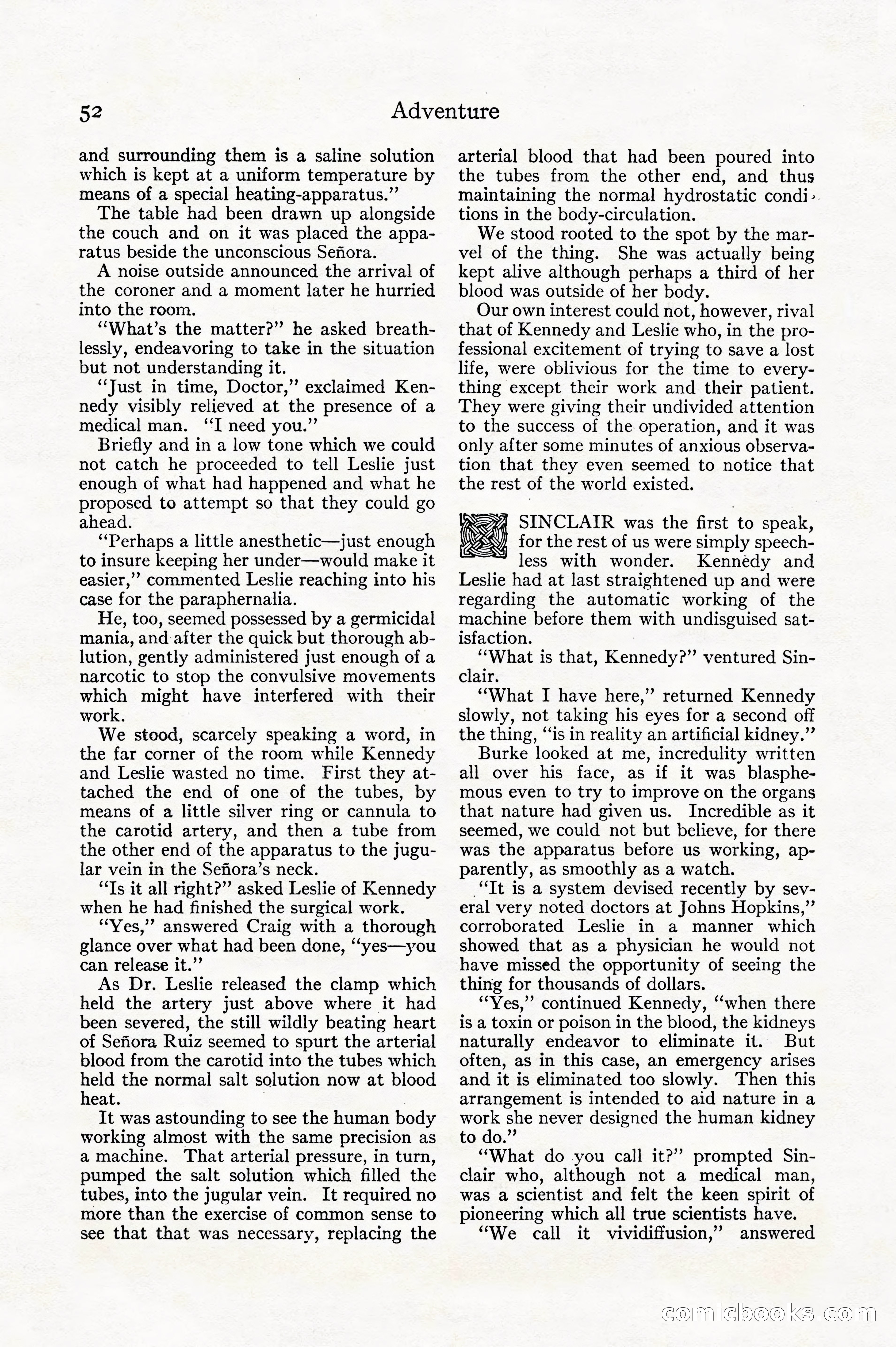
A restored page from Pulp Fiction, 1914. Page through the whole issue in the reader above.
📄 Transcribed text from this page (OCR, searchable)
Machine-transcribed from the original scan — historical spelling and the odd misread are preserved.
52 and surrounding them is a saline solution which is kept at a uniform temperature by means of a special heating-apparatus.”’ The table had been drawn up alongside the couch and on it was placed the appa- ratus beside the unconscious Sefiora. A noise outside announced the arrival of the coroner and a moment later he hurried into the room. ‘‘What’s the matter?” he asked breath- lessly, endeavoring to take in the situation but not understanding it. ‘*Just in time, Doctor,’’ exclaimed Ken- nedy visibly relieved at the presence of a medical man. ‘I need you.” Briefly and in a low tone which we could not catch he proceeded to tell Leslie just enough of what had happened and what he proposed to attempt so that they could go ahead. “Perhaps a little anesthetic—just enough to insure keeping her under—would make it easier,’ commented Leslie reaching into his case for the paraphernalia. He, too, seemed possessed by a germicidal mania, and after the quick but thorough ab- lution, gently administered just enough of a narcotic to stop the convulsive movements which might have interfered with their work. We stood, scarcely speaking a word, in the far corner of the room while Kennedy and Leslie wasted no time. First they at- tached the end of one of the tubes, by means of a little silver ring or cannula to the carotid artery, and then a tube from the other end of the apparatus to the jugu- lar vein in the Sefiora’s neck. “Ts it all right?” asked Leslie of Kennedy when he had finished the surgical work. “Yes,’’ answered Craig with a thorough glance over what had been done, “‘yes—you can release it.” As Dr. Leslie released the clamp which held the artery just above where it had been severed, the still wildly beating heart of Sefiora Ruiz seemed to spurt the arterial blood from the carotid into the tubes which held the normal salt solution now at blood heat. It was astounding to see the human body working almost with the same precision as a machine. That arterial pressure, in turn, pumped the salt solution which filled the tubes, into the jugular vein. It required no more than the exercise of common sense to see that that was necessary, replacing the Adventure arterial blood that had been poured into the tubes from the other end, and thus maintaining the normal hydrostatic condi- tions in the body-circulation. We stood rooted to the spot by the mar- vel of the thing. She was actually being kept alive although perhaps a third of her blood was outside of her body. Our own interest could not, however, rival that of Kennedy and Leslie who, in the pro- fessional excitement of trying to save a lost life, were oblivious for the time to every- thing except their work and their patient. They were giving their undivided attention to the success of the operation, and it was only after some minutes of anxious observa- tion that they even seemed to notice that the rest of the world existed. hs ma for the rest of us were simply speech- less with wonder. Kennedy and Leslie had at last straightened up and were regarding the automatic working of the machine before them with undisguised sat- isfaction. ‘What is that, feennedys? ventured Sin- clair. ‘“‘What I have here,” returned Kennedy slowly, not taking his eyes for a second off the thing, “‘is in reality an artificial kidney.” Burke looked at me, incredulity written all over his face, as if it was blasphe- mous even to try to improve on the organs that nature had given us. Incredible as it seemed, we could not but believe, for there was the apparatus before us working, ap- parently, as smoothly as a watch. “Tt is a system devised recently by sev- eral very noted doctors at Johns Hopkins,” corroborated Leslie in a manner which showed that as a physician he would not have missed the opportunity of seeing the thing for thousands of dollars. ‘““Yes,”’ continued Kennedy, “‘when there is a toxin or poison in the blood, the kidneys naturally endeavor to eliminate it. But often, as in this case, an emergency arises and it is eliminated too slowly. Then this arrangement is intended to aid nature in a work she never designed the human kidney to do.” “What do you call it?” prompted Sin- clair who, although not a medical man, was a scientist and felt the keen spirit of pioneering which all true scientists have. “We call it vividiffusion,’ answered % SINCLAIR was the first to speak, cComicloool< C@