
Pulp Fiction, 1914 · page 70 of 228
Adventure, December 1914 — page 70: what you’re looking at
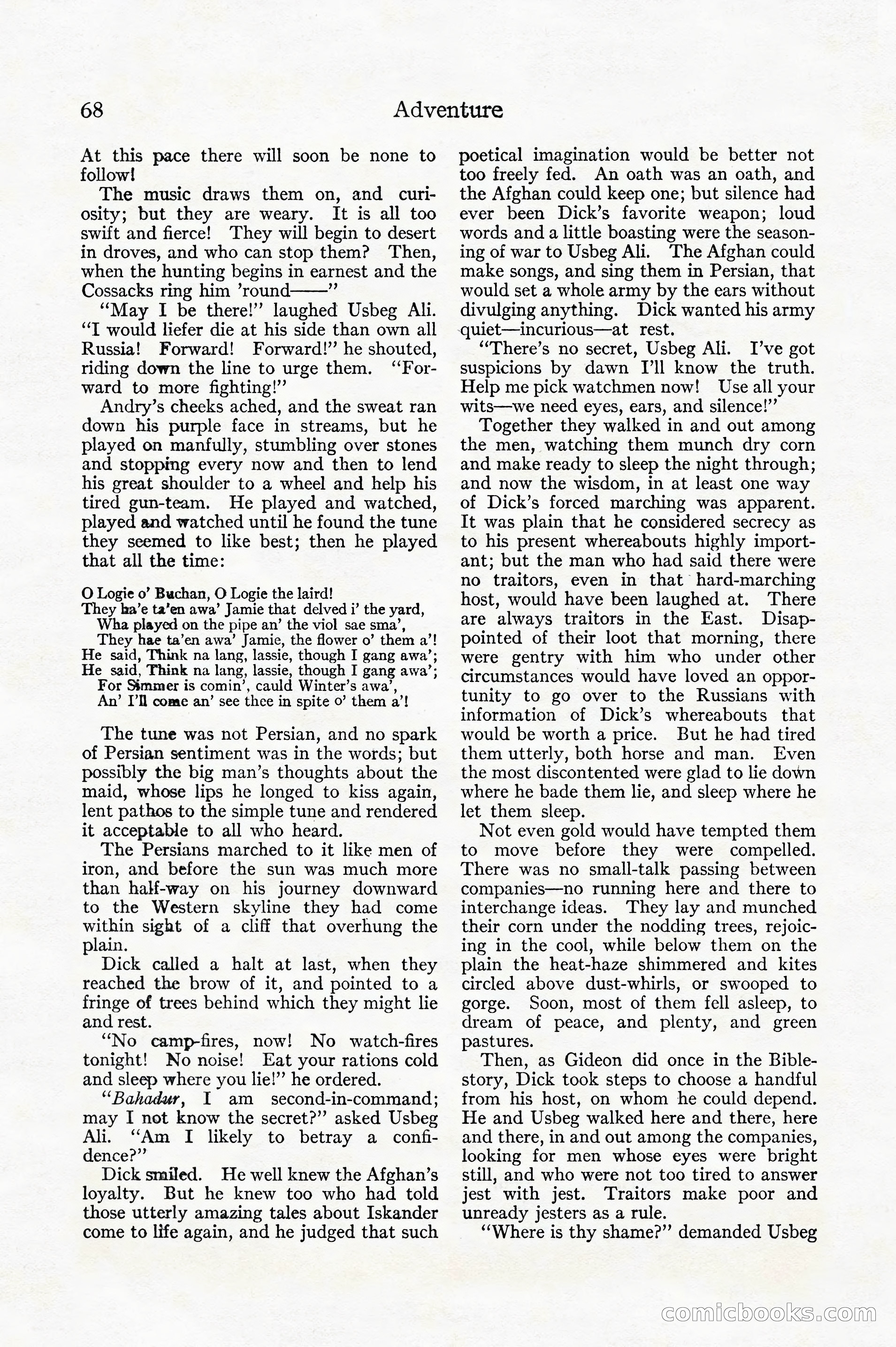
A restored page from Pulp Fiction, 1914. Page through the whole issue in the reader above.
📄 Transcribed text from this page (OCR, searchable)
Machine-transcribed from the original scan — historical spelling and the odd misread are preserved.
68 At this pace there will soon be none to follow! The music draws them on, and _ curi- osity; but they are weary. It is all too swift and fierce! They will begin to desert in droves, and who can stop them? Then, when the hunting begins in earnest and the Cossacks ring him ’roun 2 ‘““May I be there!’ laughed Usbeg Ali. “T would liefer die at his side than own all Russia! Forward! Forward!’ he shouted, riding down the line to urge them. ‘‘For- ward to more fighting!” Andry’s cheeks ached, and the sweat ran down his purple face in streams, but he played on manfully, stumbling over stones and stopping every now and then to lend his great shoulder to a wheel and help his tired gun-team. He played and watched, played and watched until he found the tune they seemed to like best; then he played that all the time: O Logie o’ Buchan, O Logie the laird! They ha’e ta’en awa’ Jamie that delved i’ the yard, Wha played on the pipe an’ the viol sae sma’, They hae ta’en awa’ Jamie, the flower o’ them a’! He said, Think na lang, lassie, though I gang awa’; He said, Think na lang, lassie, though I gang awa’; For Simmer is comin’, cauld Winter’s awa’, An’ I'll come an’ see thee in spite 0’ them a’! The tune was not Persian, and no spark of Persian sentiment was in the words; but possibly the big man’s thoughts about the maid, whose lips he longed to kiss again, lent pathos to the simple tune and rendered it acceptable to all who heard. The Persians marched to it like men of iron, and before the sun was much more than half-way on his journey downward to the Western skyline they had come within sight of a cliff that overhung the plain. Dick called a halt at last, when they reached the brow of it, and pointed to a fringe of trees behind which they might lie and rest. “No camp-fires, now! No watch-fires tonight! No noise! Eat your rations cold and sleep where you lie!’ he ordered. “Bahadur, I am _ second-in-command; may I not know the secret?” asked Usbeg Ali. “Am I likely to betray a_ conf- dence?” Dick smiled. He well knew the Afghan’s loyalty. But he knew too who had told those utterly amazing tales about Iskander come to life again, and he judged that such Adventure poetical imagination would be better not too freely fed. An oath was an oath, and the Afghan could keep one; but silence had ever been Dick’s favorite weapon; loud words and a little boasting were the season- ing of war to Usbeg Ali. The Afghan could make songs, and sing them in Persian, that would set a whole army by the ears without divulging anything. Dick wanted his army quiet—incurlous—at rest. ‘‘There’s no secret, Usbeg Ali. I’ve got suspicions by dawn I'll know the truth. Help me pick watchmen now! Use all your wits—we need eyes, ears, and silence!”’ Together they walked in and out among the men, watching them munch dry corn and make ready to sleep the night through; and now the wisdom, in at least one way of Dick’s forced marching was apparent. It was plain that he considered secrecy as to his present whereabouts highly import- ant; but the man who had said there were no traitors, even in that hard-marching host, would have been laughed at. There are always traitors in the East. Disap- pointed of their loot that morning, there were gentry with him who under other circumstances would have loved an oppor- tunity to go over to the Russians with information of Dick’s whereabouts that would be worth a price. But he had tired them utterly, both horse and man. Even the most discontented were glad to lie down where he bade them lie, and sleep where he let them sleep. Not even gold would have tempted them to move before they were compelled. There was no small-talk passing between companies—no running here and there to interchange ideas. ‘They lay and munched their corn under the nodding trees, rejoic- ing in the cool, while below them on the plain the heat-haze shimmered and kites circled above dust-whirls, or swooped to gorge. Soon, most of them fell asleep, to dream of peace, and plenty, and green pastures. Then, as Gideon did once in the Bible- story, Dick took steps to choose a handful from his host, on whom he could depend. He and Usbeg walked here and there, here and there, in and out among the companies, looking for men whose eyes were bright still, and who were not too tired to answer jest with jest. Traitors make poor and unready jesters as a rule. ‘“‘Where is thy shame?”’ demanded Usbeg Gomiicorook (©