
Pulp Fiction, 1914 · page 9 of 228
Adventure, December 1914 — page 9: what you’re looking at
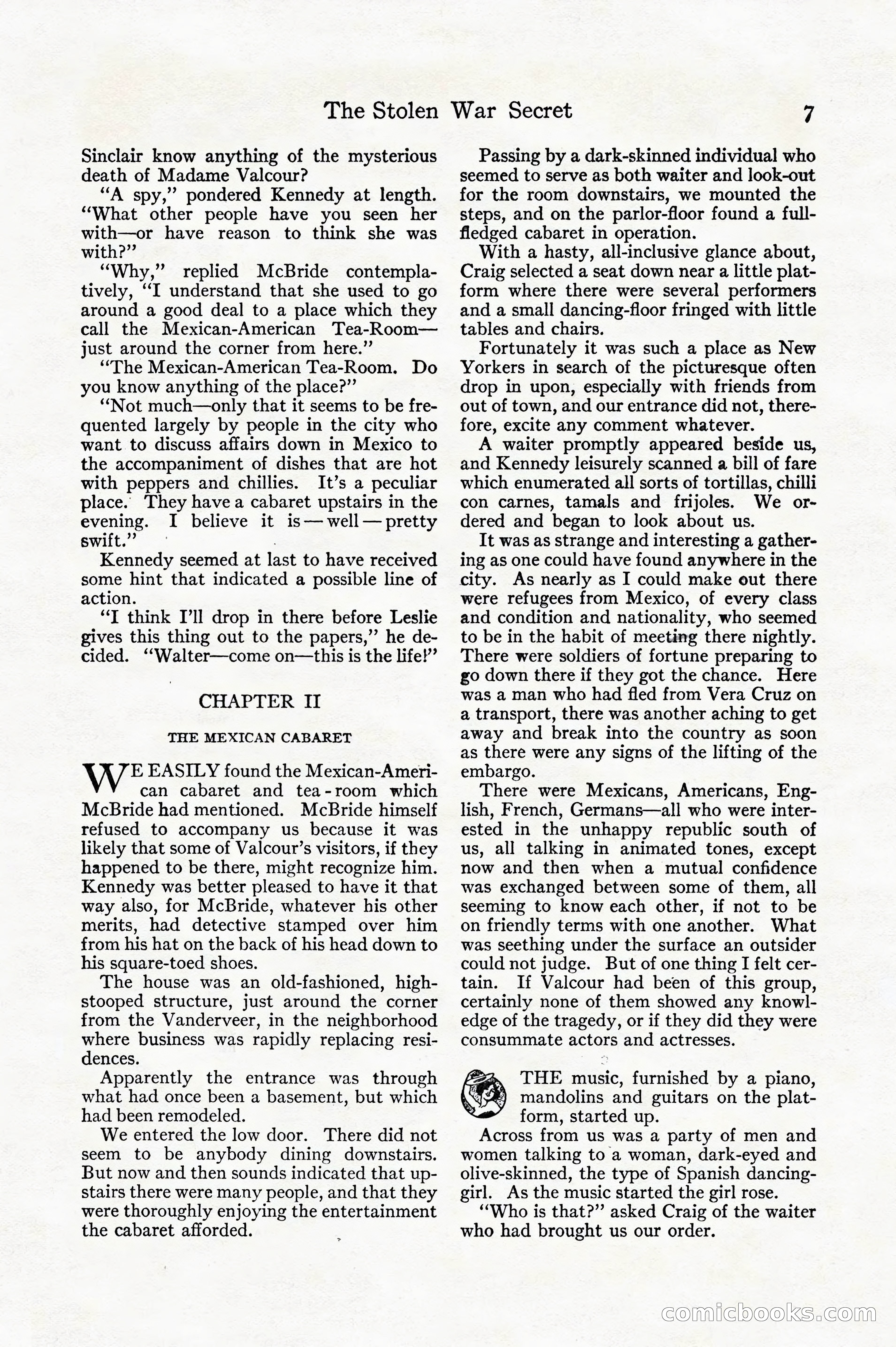
A restored page from Pulp Fiction, 1914. Page through the whole issue in the reader above.
📄 Transcribed text from this page (OCR, searchable)
Machine-transcribed from the original scan — historical spelling and the odd misread are preserved.
The Stolen Sinclair know anything of the mysterious death of Madame Valcour? “A spy,’ pondered Kennedy at length. ‘“‘What other people have you seen her with—or have reason to think she was with?” “Why,” replied McBride contempla- tively, “I understand that she used to go around a good deal to a place which they call the Mexican-American Tea-Room— just around the corner from here.” “The Mexican-American Tea-Room. Do you know anything of the place?” ‘‘Not much—only that it seems to be fre- quented largely by people in the city who want to discuss affairs down in Mexico to the accompaniment of dishes that are hot with peppers and chillies. It’s a peculiar place. They havea cabaret upstairs in the evening. I believe it is— well— pretty swift.” , Kennedy seemed at last to have received some hint that indicated a possible line of action. “T think I’ll drop in there before Leslie gives this thing out to the papers,”’ he de- cided. ‘‘Walter—come on—this is the life!’ CHAPTER II THE MEXICAN CABARET E EASILY found the Mexican-Ameri- can cabaret and tea-room which McBride had mentioned. McBride himself refused to accompany us because it was likely that some of Valcour’s visitors, if they happened to be there, might recognize him. Kennedy was better pleased to have it that way also, for McBride, whatever his other merits, had detective stamped over him from his hat on the back of his head down to his square-toed shoes. The house was an old-fashioned, high- stooped structure, just around the corner from the Vanderveer, in the neighborhood where business was rapidly replacing resi- dences. Apparently the entrance was through what had once been a basement, but which had been remodeled. We entered the low door. There did not seem to be anybody dining downstairs. But now and then sounds indicated that up- stairs there were many people, and that they were thoroughly enjoying the entertainment the cabaret afforded. War Secret 7 Passing by a dark-skinned individual who seemed to serve as both waiter and look-out for the room downstairs, we mounted the steps, and on the parlor-floor found a full- fledged cabaret in operation. With a hasty, all-inclusive glance about, Craig selected a seat down near a little plat- form where there were several performers and a small dancing-floor fringed with little tables and chairs. Fortunately it was such a place as New Yorkers in search of the picturesque often drop in upon, especially with friends from out of town, and our entrance did not, there- fore, excite any comment whatever. A waiter promptly appeared beside us, and Kennedy leisurely scanned a bill of fare which enumerated all sorts of tortillas, chilli con carnes, tamals and frijoles. We or- dered and began to look about us. It was as strange and interesting a gather- ing as one could have found anywhere in the city. As nearly as I could make out there were refugees from Mexico, of every class and condition and nationality, who seemed to be in the habit of meeting there nightly. There were soldiers of fortune preparing to go down there if they got the chance. Here was a man who had fled from Vera Cruz on a transport, there was another aching to get away and break into the country as soon as there were any signs of the lifting of the embargo. There were Mexicans, Americans, Eng- lish, French, Germans—all who were inter- ested in the unhappy republic south of us, all talking in animated tones, except now and then when a mutual confidence was exchanged between some of them, all seeming to know each other, if not to be on friendly terms with one another. What was seething under the surface an outsider could not judge. But of one thing I felt cer- tain. If Valcour had been of this group, certainly none of them showed any knowl- edge of the tragedy, or if they did they were consummate actors and actresses. (2 ‘THE music, furnished by a piano, gs mandolins and guitars on the plat- : form, started up. Across from us was a party of men and women talking to a woman, dark-eyed and olive-skinned, the type of Spanish dancing- girl. As the music started the girl rose. ‘“Who is that?” asked Craig of the waiter who had brought us our order. MICLOOOLK C©