
Pulp Fiction, 1916 · page 101 of 228
Adventure Magazine Cover, April 1916 — page 101: what you’re looking at
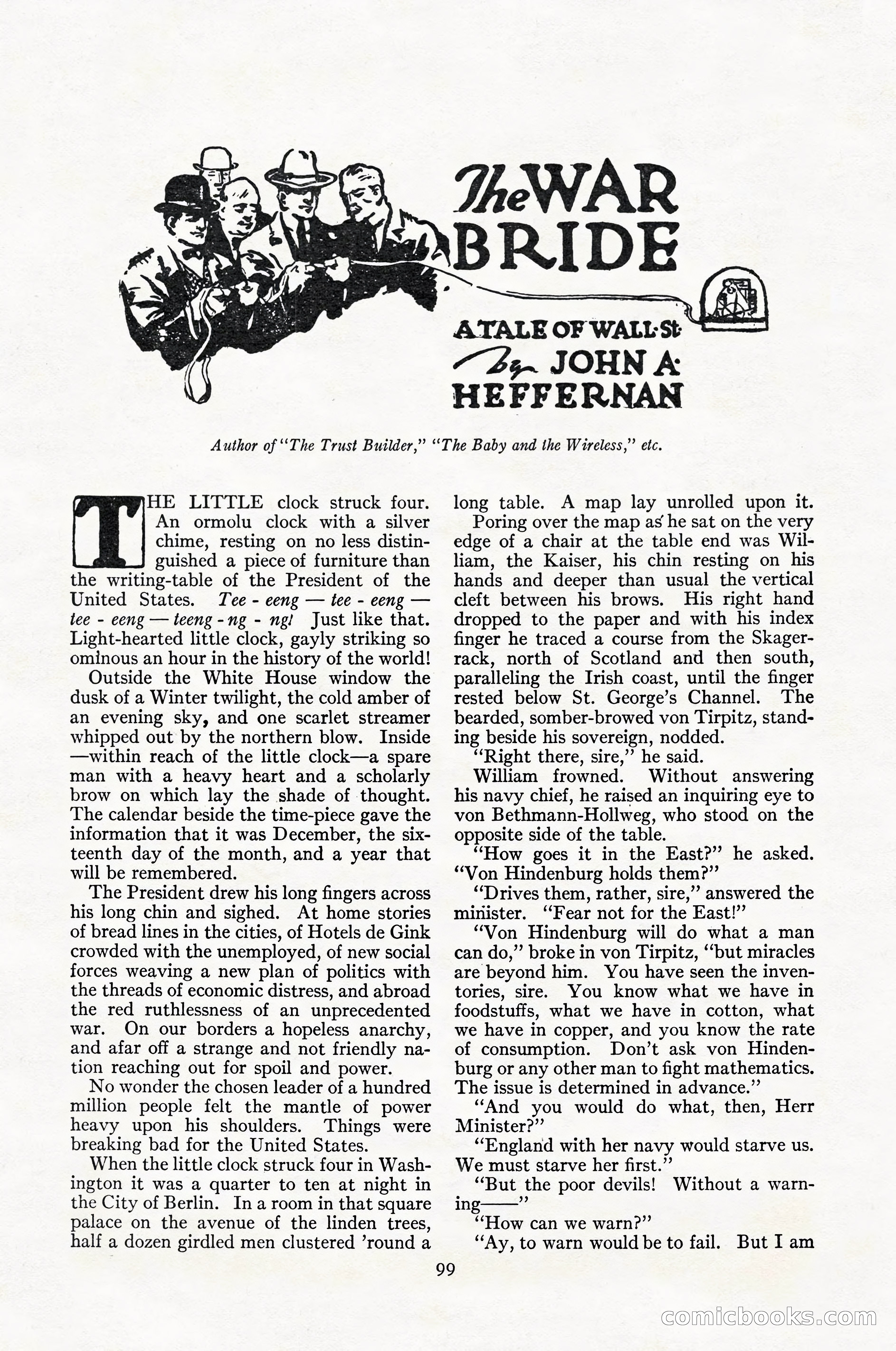
A restored page from Pulp Fiction, 1916. Page through the whole issue in the reader above.
📄 Transcribed text from this page (OCR, searchable)
Machine-transcribed from the original scan — historical spelling and the odd misread are preserved.
“oN ThANAR ABRIDE ATALE —— (£3) ~ £5~ JOHN A HEFFERNAN Author of ‘The Trust Builder,” ‘‘The Baby and the Wireless,” etc HE LITTLE clock struck four. An ormolu clock with a silver chime, resting on no less distin- guished a piece of furniture than the writing-table of the President of the United States. Tee - eeng — tee - eeng — lee - eeng — leeng-ng - ng! Just like that. Light-hearted little clock, gayly striking so ominous an hour in the history of the world! Outside the White House window the dusk of a Winter twilight, the cold amber of an evening sky, and one scarlet streamer whipped out by the northern blow. Inside —within reach of the little clock—a spare man with a heavy heart and a scholarly brow on which lay the shade of thought. The calendar beside the time-piece gave the information that it was December, the six- teenth day of the month, and a year that will be remembered. The President drew his long fingers across his long chin and sighed. At home stories of bread lines in the cities, of Hotels de Gink crowded with the unemployed, of new social forces weaving a new plan of politics with the threads of economic distress, and abroad the red ruthlessness of an unprecedented war. On our borders a hopeless anarchy, and afar off a strange and not friendly na- tion reaching out for spoil and power. No wonder the chosen leader of a hundred million people felt the mantle of power heavy upon his shoulders. Things were breaking bad for the United States. When the little clock struck four in Wash- ington it was a quarter to ten at night in the City of Berlin. Ina room in that square palace on the avenue of the linden trees, half a dozen girdled men clustered ’round a long table. A map lay unrolled upon it. Poring over the map as he sat on the very edge of a chair at the table end was Wil- liam, the Kaiser, his chin resting on his hands and deeper than usual the vertical cleft between his brows. His right hand dropped to the paper and with his index finger he traced a course from the Skager- rack, north of Scotland and then south, paralleling the Irish coast, until the finger rested below St. George’s Channel. The bearded, somber-browed von Tirpitz, stand- ing beside his sovereign, nodded. “Right there, sire,’”’ he said. William frowned. Without answering his navy chief, he raised an inquiring eye to von Bethmann-Hollweg, who stood on the opposite side of the table. “How goes it in the East?” he asked. “Von Hindenburg holds them?” ‘“‘Drives them, rather, sire,’”’ answered the minister. ‘Fear not for the East!’’ “Von Hindenburg will do what a man can do,” broke in von Tirpitz, ‘“but miracles are beyond him. You have seen the inven- tories, sire. You know what we have in foodstuffs, what we have in cotton, what we have in copper, and you know the rate of consumption. Don’t ask von Hinden- burg or any other man to fight mathematics. The issue is determined in advance.”’ “And you would do what, then, Herr Minister?” “England with her navy would starve us. We must starve her first.”’ “But the poor devils! ing >) ‘“‘How can we warne”’ Without a warn- 99 ‘Ay, to warn would be to fail. But I am COMmicloOoks CO