
Pulp Fiction, 1916 · page 142 of 228
Adventure Magazine Cover, April 1916 — page 142: what you’re looking at
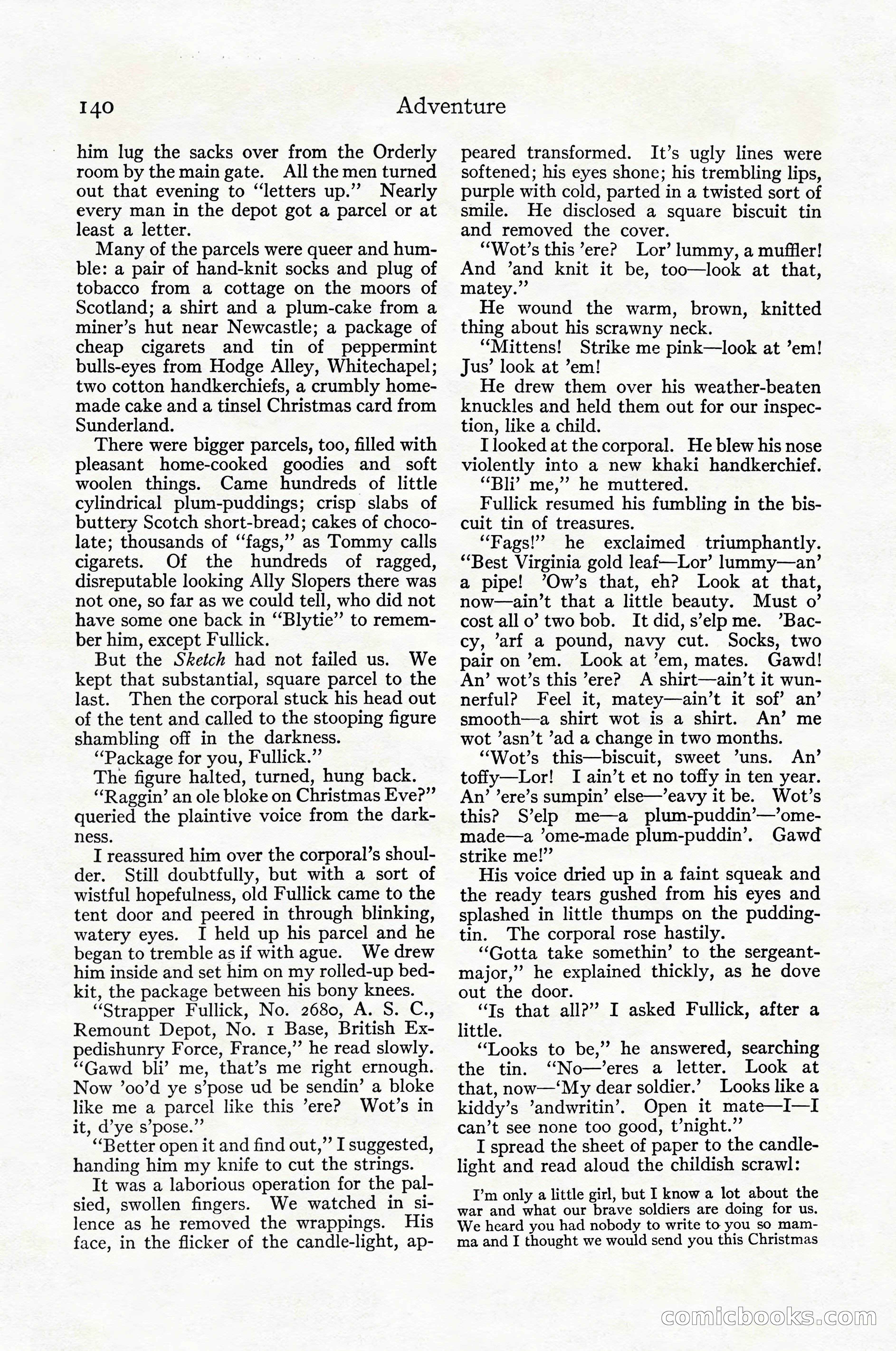
A restored page from Pulp Fiction, 1916. Page through the whole issue in the reader above.
📄 Transcribed text from this page (OCR, searchable)
Machine-transcribed from the original scan — historical spelling and the odd misread are preserved.
140 him lug the sacks over from the Orderly room by the main gate. All the men turned out that evening to “‘letters up.” Nearly every man in the depot got a parcel or at least a letter. Many of the parcels were queer and hum- ble: a pair of hand-knit socks and plug of tobacco from a cottage on the moors of Scotland; a shirt and a plum-cake from a miner’s hut near Newcastle; a package of cheap cigarets and tin of peppermint bulls-eyes from Hodge Alley, Whitechapel; two cotton handkerchiefs, a crumbly home- made cake and a tinsel Christmas card from Sunderland. There were bigger parcels, too, filled with pleasant home-cooked goodies and soft woolen things. Came hundreds of little cylindrical plum-puddings; crisp slabs of buttery Scotch short-bread; cakes of choco- late; thousands of ‘‘fags,’’ as Tommy calls cigarets. Of the hundreds of ragged, disreputable looking Ally Slopers there was not one, so far as we could tell, who did not have some one back in “Blytie”’ to remem- ber him, except Fullick. But the Sketch had not failed us. We kept that substantial, square parcel to the last. Then the corporal stuck his head out of the tent and called to the stooping figure shambling off in the darkness. “Package for you, Fullick.”’ The figure halted, turned, hung back. ‘“Raggin’ an ole bloke on Christmas Eve?” queried the plaintive voice from the dark- ness. I reassured him over the corporal’s shoul- der. Still doubtfully, but with a sort of wistful hopefulness, old Fullick came to the tent door and peered in through blinking, watery eyes. I held up his parcel and he began to tremble as if with ague. We drew him inside and set him on my rolled-up bed- kit, the package between his bony knees. “Strapper Fullick, No. 2680, A. S. C., Remount Depot, No. 1 Base, British Ex- pedishunry Force, France,” he read slowly. “Gawd bli’? me, that’s me right ernough. Now ’oo’d ye s’pose ud be sendin’ a bloke like me a parcel like this ’ere? Wot’s in it, d’ye s’pose.”’ “Better open it and find out,” I suggested, handing him my knife to cut the strings. It was a laborious operation for the pal- sied, swollen fingers. We watched in si- lence as he removed the wrappings. His face, in the flicker of the candle-light, ap- Adventure peared transformed. It’s ugly lines were softened; his eyes shone; his trembling lips, purple with cold, parted in a twisted sort of smile. He disclosed a square biscuit tin and removed the cover. ““Wot’s this ere? Lor’ lummy, a muffler! And ’and knit it be, too—look at that, matey.” He wound the warm, brown, knitted thing about his scrawny neck. “Mittens! Strike me pink—look at ’em! Jus’ look at ’em! He drew them over his weather-beaten knuckles and held them out for our inspec- tion, like a child. I looked at the corporal. He blew his nose violently into a new khaki handkerchief. ‘“‘Bli’ me,” he muttered. Fullick resumed his fumbling in the bis- cuit tin of treasures. “Fags!” he exclaimed triumphantly. “Best Virginia gold leaf—Lor’ lummy—an’ a pipe! ’Ow’s that, eh? Look at that, now—ain’t that a little beauty. Must o’ cost allo’? two bob. Itdid,s’elpme. ’Bac- cy, ’arf a pound, navy cut. Socks, two pair on ’em. Look at ’em, mates. Gawd! An’ wot’s this ’ere? A shirt—ain’t it wun- nerful? Feel it, matey—ain’t it sof’ an’ smooth—a shirt wot is a shirt. An’ me wot ’asn’t ’ad a change in two months. ‘“Wot’s this—biscuit, sweet ’uns. An’ toffy—Lor! I ain’t et no toffy in ten year. An’ ’ere’s sumpin’ else—’eavy it be. Wot’s this? S’elp me—a _ plum-puddin’—’ome- made—a ’ome-made plum-puddin’. Gawd strike me!” His voice dried up in a faint squeak and the ready tears gushed from his eyes and splashed in little thumps on the pudding- tin. The corporal rose hastily. “Gotta take somethin’ to the sergeant- major,” he explained thickly, as he dove out the door. “Ts that all?” I asked Fullick, after a little. “Tooks to be,” he answered, searching the tin. ‘“‘No—’eres a letter. Look at that, now—‘My dear soldier.’ Looks like a kiddy’s ’andwritin’. Open it mate—I—I can’t see none too good, t’night.”’ I spread the sheet of paper to the candle- light and read aloud the childish scrawl: I’m only a little girl, but I know a lot about the war and what our brave soldiers are doing for us. We heard you had nobody to write to you so mam- ma and I thought we would send you this Christmas CoOMmMichoooks (©