
Pulp Fiction, 1916 · page 164 of 228
Adventure Magazine Cover, April 1916 — page 164: what you’re looking at
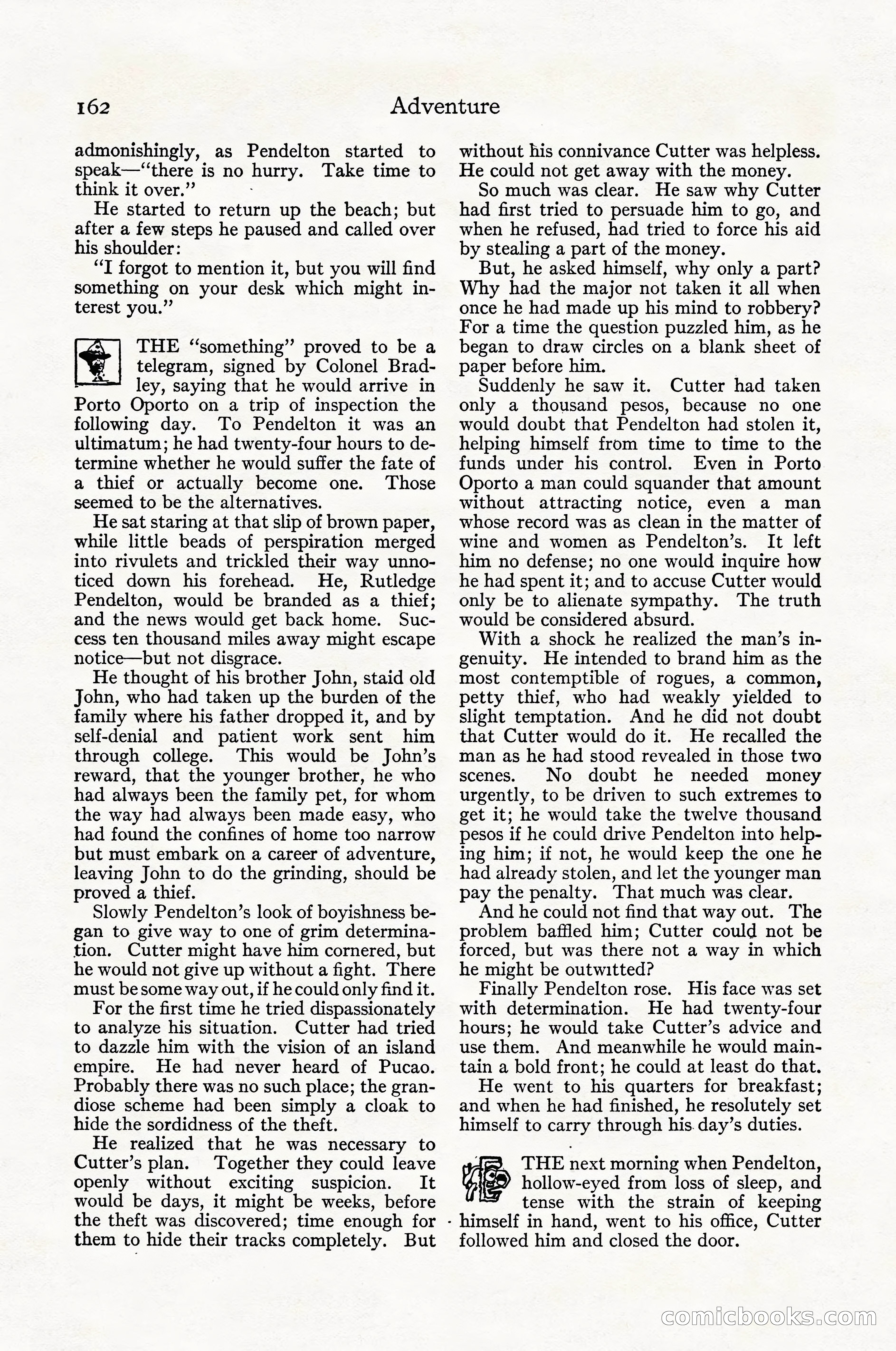
A restored page from Pulp Fiction, 1916. Page through the whole issue in the reader above.
📄 Transcribed text from this page (OCR, searchable)
Machine-transcribed from the original scan — historical spelling and the odd misread are preserved.
162 admonishingly, as Pendelton started to speak—“‘there is no hurry. Take time to think it over.” He started to return up the beach; but after a few steps he paused and called over his shoulder: “I forgot to mention it, but you will find something on your desk which might in- terest you.” Z| THE “something” proved to be a @ | telegram, signed by Colonel Brad- ley, saying that he would arrive in Porto Oporto on a trip of inspection the following day. To Pendelton it was an ultimatum; he had twenty-four hours to de- termine whether he would suffer the fate of a thief or actually become one. Those seemed to be the alternatives. He sat staring at that slip of brown paper, while little beads of perspiration merged into rivulets and trickled their way unno- ticed down his forehead. He, Rutledge Pendelton, would be branded as a thief; and the news would get back home. Suc- cess ten thousand miles away might escape notice—but not disgrace. He thought of his brother John, staid old John, who had taken up the burden of the family where his father dropped it, and by self-denial and patient work sent him through college. This would be John’s reward, that the younger brother, he who had always been the family pet, for whom the way had always been made easy, who had found the confines of home too narrow but must embark on a career of adventure, leaving John to do the grinding, should be proved a thief. Slowly Pendelton’s look of boyishness be- gan to give way to one of grim determina- tion. Cutter might have him cornered, but he would not give up without a fight. There must besome way out, if he could only find it. For the first time he tried dispassionately to analyze his situation. Cutter had tried to dazzle him with the vision of an island empire. He had never heard of Pucao. Probably there was no such place; the gran- diose scheme had been simply a cloak to hide the sordidness of the theft. He realized that he was necessary to Cutter’s plan. Together they could leave openly without exciting suspicion. It would be days, it might be weeks, before the theft was discovered; time enough for them to hide their tracks completely. But Adventure without his connivance Cutter was helpless. He could not get away with the money. So much was clear. He saw why Cutter had first tried to persuade him to go, and when he refused, had tried to force his aid by stealing a part of the money. But, he asked himself, why only a part? Why had the major not taken it all when once he had made up his mind to robbery? For a time the question puzzled him, as he began to draw circles on a blank sheet of paper before him. Suddenly he saw it. Cutter had taken only a thousand pesos, because no one would doubt that Pendelton had stolen it, helping himself from time to time to the funds under his control. Even in Porto Oporto a man could squander that amount without attracting notice, even a man whose record was as clean in the matter of wine and women as Pendelton’s. It left him no defense; no one would inquire how he had spent it; and to accuse Cutter would only be to alienate sympathy. The truth would be considered absurd. With a shock he realized the man’s in- genuity. He intended to brand him as the most contemptible of rogues, a common, petty thief, who had weakly yielded to slight temptation. And he did not doubt that Cutter would do it. He recalled the man as he had stood revealed in those two scenes. No doubt he needed money urgently, to be driven to such extremes to get it; he would take the twelve thousand pesos if he could drive Pendelton into help- ing him; if not, he would keep the one he had already stolen, and let the younger man pay the penalty. That much was clear. And he could not find that way out. The problem baffled him; Cutter could not be forced, but was there not a way in which he might be outwitted? Finally Pendelton rose. His face was set with determination. He had twenty-four hours; he would take Cutter’s advice and use them. And meanwhile he would main- tain a bold front; he could at least do that. He went to his quarters for breakfast; and when he had finished, he resolutely set himself to carry through his. day’s duties. hollow-eyed from loss of sleep, and ale THE next morning when Pendelton, tense with the strain of keeping - himself in hand, went to his office, Cutter followed him and closed the door. CoOMmicboooks (CO