
Pulp Fiction, 1916 · page 171 of 228
Adventure Magazine Cover, April 1916 — page 171: what you’re looking at
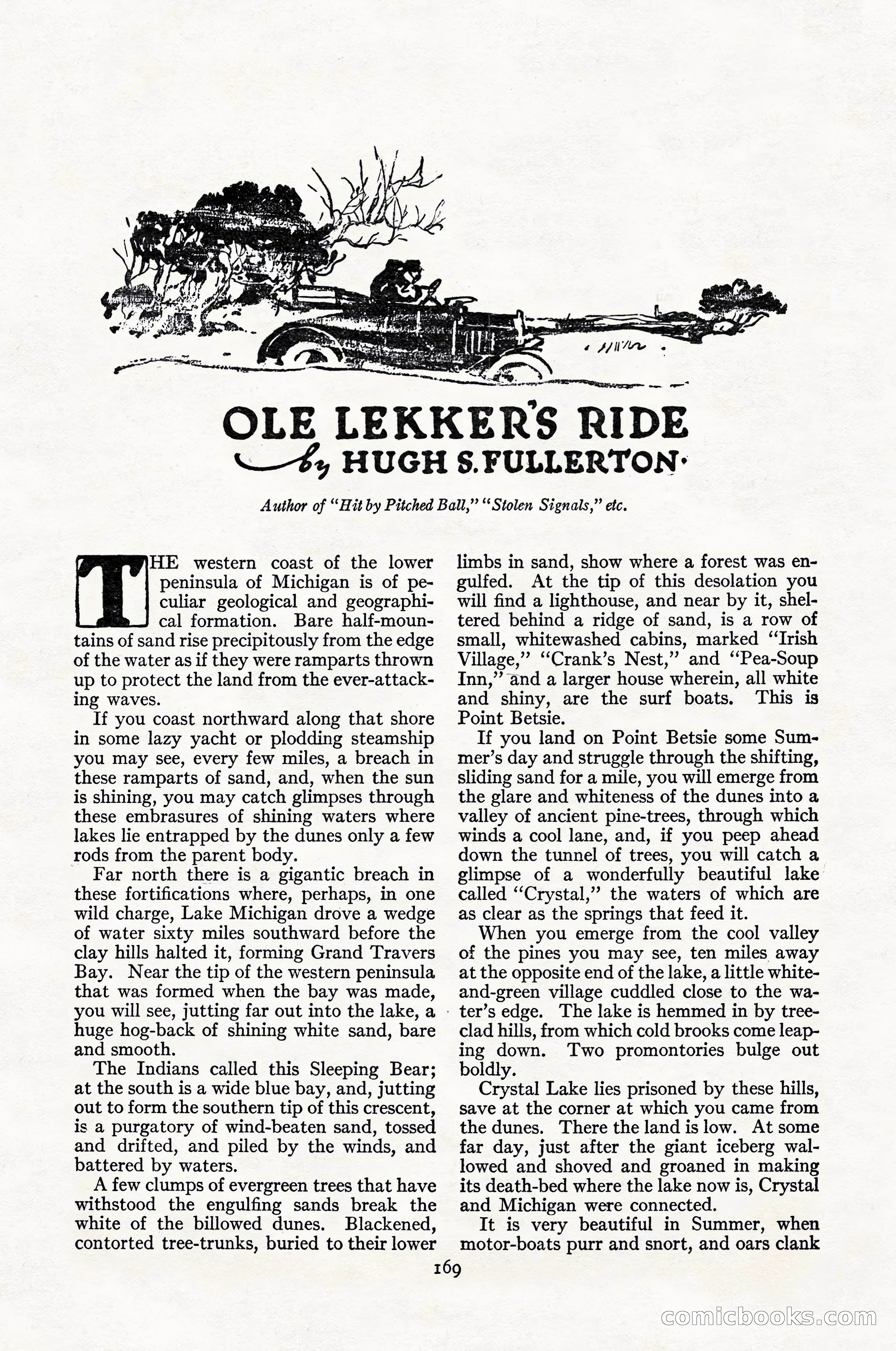
A restored page from Pulp Fiction, 1916. Page through the whole issue in the reader above.
📄 Transcribed text from this page (OCR, searchable)
Machine-transcribed from the original scan — historical spelling and the odd misread are preserved.
oe me 2. “ss syn & ont > . gin WT . BIT Srey aS ee > Aiiiive . —_— -—* OLE LEKKER’S RID , HUGH S.FULLERTON: Author of “Hit by Pitched Ball,” “Stolen Signals,” etc. HE western coast of the lower peninsula of Michigan is of pe- culiar geological and geographi- cal formation. Bare half-moun- tains of sand rise precipitously from the edge of the water as if they were ramparts thrown up to protect the land from the ever-attack- ing waves. If you coast northward along that shore in some lazy yacht or plodding steamship you may see, every few miles, a breach in these ramparts of sand, and, when the sun is shining, you may catch glimpses through these embrasures of shining waters where lakes lie entrapped by the dunes only a few rods from the parent body. Far north there is a gigantic breach in these fortifications where, perhaps, in one wild charge, Lake Michigan drove a wedge of water sixty miles southward before the clay hills halted it, forming Grand Travers Bay. Near the tip of the western peninsula that was formed when the bay was made, you will see, jutting far out into the lake, a huge hog-back of shining white sand, bare and smooth. The Indians called this Sleeping Bear; at the south is a wide blue bay, and, jutting out to form the southern tip of this crescent, is a purgatory of wind-beaten sand, tossed and drifted, and piled by the winds, and battered by waters. A few clumps of evergreen trees that have withstood the engulfing sands break the white of the billowed dunes. Blackened, contorted tree-trunks, buried to their lower limbs in sand, show where a forest was en- gulfed. At the tip of this desolation you will find a lighthouse, and near by it, shel- tered behind a ridge of sand, is a row of small, whitewashed cabins, marked “Trish Village,” ““Crank’s Nest,” and ‘‘Pea-Soup Inn,” and a larger house wherein, all white and shiny, are the surf boats. This is Point Betsie. If you land on Point Betsie some Sum- mer’s day and struggle through the shifting, sliding sand for a mile, you will emerge from the glare and whiteness of the dunes into a valley of ancient pine-trees, through which winds a cool lane, and, if you peep ahead down the tunnel of trees, you will catch a glimpse of a wonderfully beautiful lake called “Crystal,” the waters of which are as clear as the springs that feed it. When you emerge from the cool valley of the pines you may see, ten miles away at the opposite end of the lake, a little white- and-green village cuddled close to the wa- - ter’s edge. The lake is hemmed in by tree- clad hills, from which cold brooks come leap- ing down. Two promontories bulge out boldly. Crystal Lake lies prisoned by these hills, save at the corner at which you came from the dunes. There the land is low. At some far day, just after the giant iceberg wal- lowed and shoved and groaned in making its death-bed where the lake now is, Crystal and Michigan were connected. It is very beautiful in Summer, when motor-boats purr and snort, and oars clank 169 CoOMmichoooks CO