
Pulp Fiction, 1916 · page 191 of 228
Adventure Magazine Cover, April 1916 — page 191: what you’re looking at
A restored page from Pulp Fiction, 1916. Page through the whole issue in the reader above.
📄 Transcribed text from this page (OCR, searchable)
Machine-transcribed from the original scan — historical spelling and the odd misread are preserved.
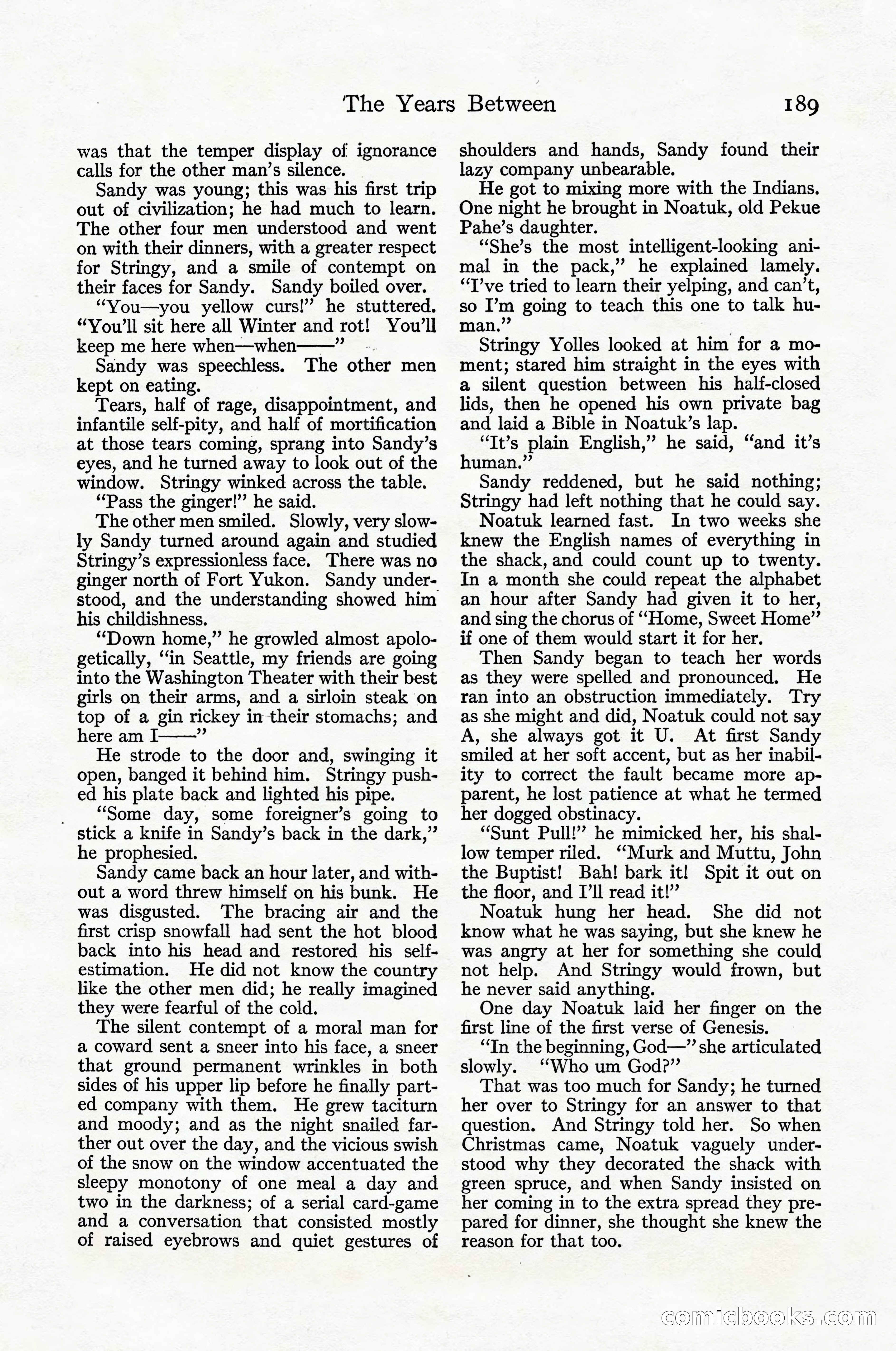
The Years Between was that the temper display of ignorance calls for the other man’s silence. Sandy was young; this was his first trip out of civilization; he had much to learn. The other four men understood and went on with their dinners, with a greater respect for Stringy, and a smile of contempt on their faces for Sandy. Sandy boiled over. “You—you yellow curs!’ he stuttered. “You'll sit here all Winter and rot! You'll keep me here when—when——”’ - Sandy was speechless. The other men kept on eating. Tears, half of rage, disappointment, and infantile self-pity, and half of mortification at those tears coming, sprang into Sandy’s eyes, and he turned away to look out of the window. Stringy winked across the table. ‘“‘Pass the ginger!”’ he said. The other men smiled. Slowly, very slow- ly Sandy turned around again and studied Stringy’s expressionless face. There was no ginger north of Fort Yukon. Sandy under- stood, and the understanding showed him his childishness. “Down home,” he growled almost apolo- getically, ‘‘in Seattle, my friends are going into the Washington Theater with their best girls on their arms, and a sirloin steak on top of a gin rickey in their stomachs; and here am I ss He strode to the door and, swinging it open, banged it behind him. Stringy push- ed his plate back and lighted his pipe. _ “Some day, some foreigner’s going to stick a knife in Sandy’s back in the dark,” he prophesied. Sandy came back an hour later, and with- out a word threw himself on his bunk. He was disgusted. ‘The bracing air and the first crisp snowfall had sent the hot blood back into his head and restored his self- estimation. He did not know the country like the other men did; he really imagined they were fearful of the cold. The silent contempt of a moral man for a coward sent a sneer into his face, a sneer that ground permanent wrinkles in both sides of his upper lip before he finally part- ed company with them. He grew taciturn and moody; and as the night snailed far- ther out over the day, and the vicious swish of the snow on the window accentuated the sleepy monotony of one meal a day and two in the darkness; of a serial card-game and a conversation that consisted mostly of raised eyebrows and quiet gestures of 189 shoulders and hands, Sandy found their lazy company unbearable. He got to mixing more with the Indians. One night he brought in Noatuk, old Pekue Pahe’s daughter. “She’s the most intelligent-looking ani- mal in the pack,” he explained lamely. “T’ve tried to learn their yelping, and can’t, so I’m going to teach this one to talk hu- man.” Stringy Yolles looked at him for a mo- ment; stared him straight in the eyes with a silent question between his half-closed lids, then he opened his own private bag and laid a Bible in Noatuk’s lap. “Tt’s plain English,” he said, “and it’s human.” Sandy reddened, but he said nothing; Stringy had left nothing that he could say. Noatuk learned fast. In two weeks she knew the English names of everything in the shack, and could count up to twenty. In a month she could repeat the alphabet an hour after Sandy had given it to her, and sing the chorus of ‘‘Home, Sweet Home’’ if one of them would start it for her. Then Sandy began to teach her words as they were spelled and pronounced. He ran into an obstruction immediately. Try as she might and did, Noatuk could not say A, she always got it U. At first Sandy smiled at her soft accent, but as her inabil- ity to correct the fault became more ap- parent, he lost patience at what he termed her dogged obstinacy. “Sunt Pull!’ he mimicked her, his shal- low temper riled. ‘‘Murk and Muttu, John the Buptist! Bah! bark it! Spit it out on the floor, and I’ll read it!’’ Noatuk hung her head. She did not know what he was saying, but she knew he was angry at her for something she could not help. And Stringy would frown, but he never said anything. One day Noatuk laid her finger on the first line of the first verse of Genesis. “In the beginning, God—” she articulated slowly. ‘Who um God?” That was too much for Sandy; he turned her over to Stringy for an answer to that question. And Stringy told her. So when Christmas came, Noatuk vaguely under- stood why they decorated the shack with green spruce, and when Sandy insisted on her coming in to the extra spread they pre- pared for dinner, she thought she knew the reason for that too. CoMmicboooks CO