
Pulp Fiction, 1916 · page 39 of 228
Adventure Magazine Cover, April 1916 — page 39: what you’re looking at
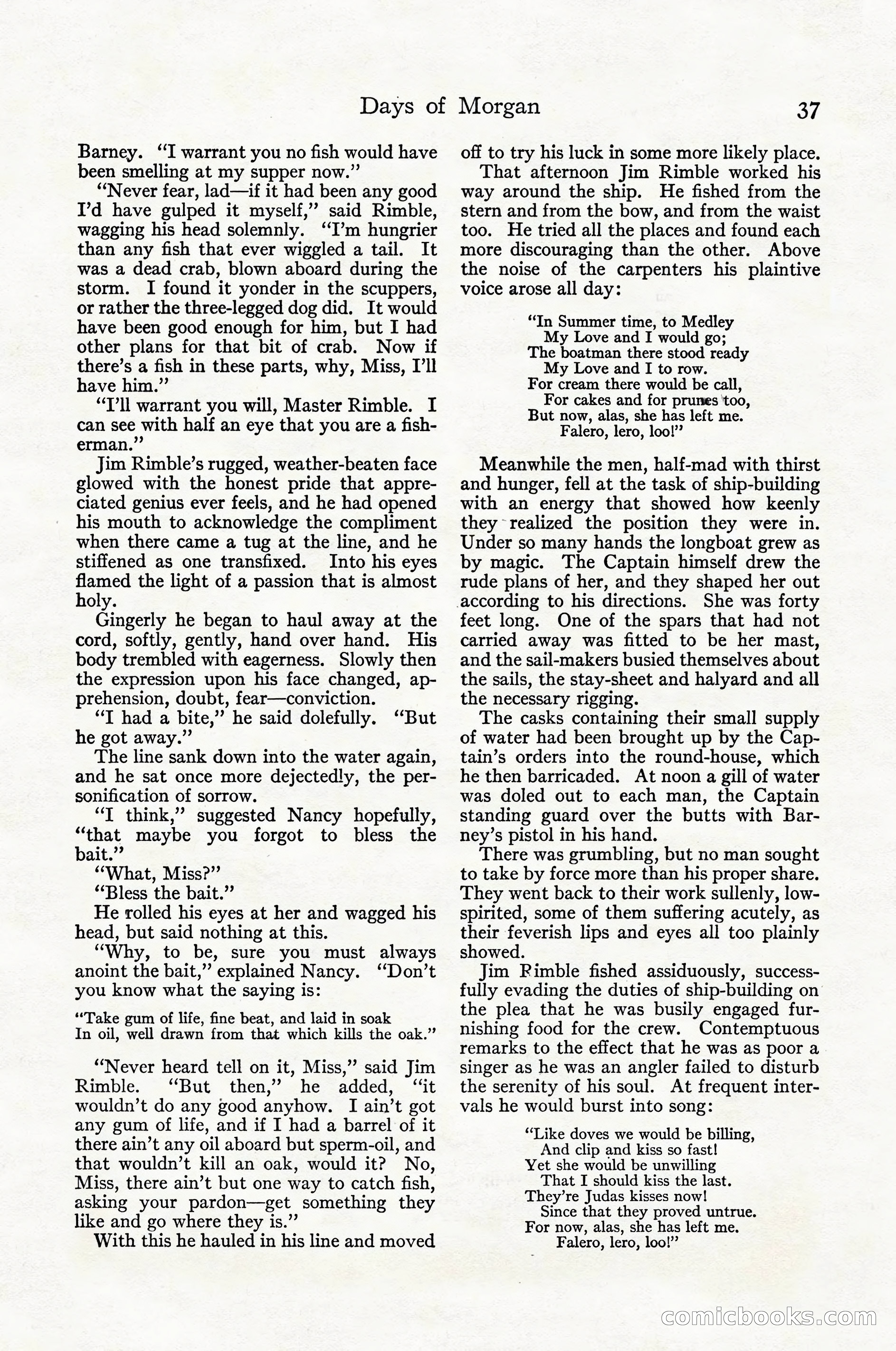
A restored page from Pulp Fiction, 1916. Page through the whole issue in the reader above.
📄 Transcribed text from this page (OCR, searchable)
Machine-transcribed from the original scan — historical spelling and the odd misread are preserved.
Days of Barney. “I warrant you no fish would have been smelling at my supper now.” ‘“‘Never fear, lad—if it had been any good I’d have gulped it myself,” said Rimble, wagging his head solemnly. ‘I’m hungrier than any fish that ever wiggled a tail. It was a dead crab, blown aboard during the storm. I found it yonder in the scuppers, or rather the three-legged dog did. It would have been good enough for him, but I had other plans for that bit of crab. Now if there’s a fish in these parts, why, Miss, I'll have him.” “Y’ll warrant you will, Master Rimble. I can see with half an eye that you are a fish- erman.”’ Jim Rimble’s rugged, weather-beaten face glowed with the honest pride that appre- clated genius ever feels, and he had opened his mouth to acknowledge the compliment when there came a tug at the line, and he stiffened as one transfixed. Into his eyes flamed the light of a passion that is almost holy. Gingerly he began to haul away at the cord, softly, gently, hand over hand. His body trembled with eagerness. Slowly then the expression upon his face changed, ap- prehension, doubt, fear—conviction. “T had a bite,’’ he said dolefully. he got away.” The line sank down into the water again, and he sat once more dejectedly, the per- sonification of sorrow. “IT think,” suggested Nancy hopefully, “that maybe you forgot to bless the bait.” ‘‘What, Miss?”’ “Bless the bait.” He rolled his eyes at her and wagged his head, but said nothing at this. “Why, to be, sure you must always anoint the bait,”’ explained Nancy. ‘Don’t you know what the saying is: “But ‘“‘Take gum of life, fine beat, and laid in soak In oil, well drawn from that which kills the oak.” “‘Never heard tell on it, Miss,” said Jim Rimble. “But then,” he added, “it wouldn’t do any good anyhow. I ain’t got any gum of life, and if I had a barrel of it there ain’t any oil aboard but sperm-oil, and that wouldn’t kill an oak, would it? No, Miss, there ain’t but one way to catch fish, asking your pardon—get something they like and go where they is.” With this he hauled in his line and moved according to his directions. Morgan 37 off to try his luck in some more likely place. That afternoon Jim Rimble worked his way around the ship. He fished from the stern and from the bow, and from the waist too. He tried all the places and found each more discouraging than the other. Above the noise of the carpenters his plaintive voice arose all day: “In Summer time, to Medley My Love and I would go; The boatman there stood ready My Love and I to row. For cream there would be call, For cakes and for prunes ‘too, But now, alas, she has left me. Falero, lero, loo!” Meanwhile the men, half-mad with thirst and hunger, fell at the task of ship-building with an energy that showed how keenly they realized the position they were in. Under so many hands the longboat grew as by magic. The Captain himself drew the rude plans of her, and they shaped her out She was forty feet long. One of the spars that had not carried away was fitted to be her mast, and the sail-makers busied themselves about the sails, the stay-sheet and halyard and all the necessary rigging. The casks containing their small supply of water had been brought up by the Cap- tain’s orders into the round-house, which he then barricaded. At noon a gill of water was doled out to each man, the Captain standing guard over the butts with Bar- ney’s pistol in his hand. There was grumbling, but no man sought to take by force more than his proper share. They went back to their work sullenly, low- spirited, some of them suffering acutely, as their feverish lips and eyes all too plainly showed. Jim Rimble fished assiduously, success- fully evading the duties of ship-building on the plea that he was busily engaged fur- nishing food for the crew. Contemptuous remarks to the effect that he was as poor a singer as he was an angler failed to disturb the serenity of his soul. At frequent inter- vals he would burst into song: ‘Like doves we would be billing, And clip and kiss so fast! Yet she would be unwilling That I should kiss the last. They’re Judas kisses now! Since that they proved untrue. For now, alas, she has left me. Falero, lero, loo!”’ CoOMmicboooks (CO