
Pulp Fiction, 1916 · page 58 of 228
Adventure Magazine Cover, April 1916 — page 58: what you’re looking at
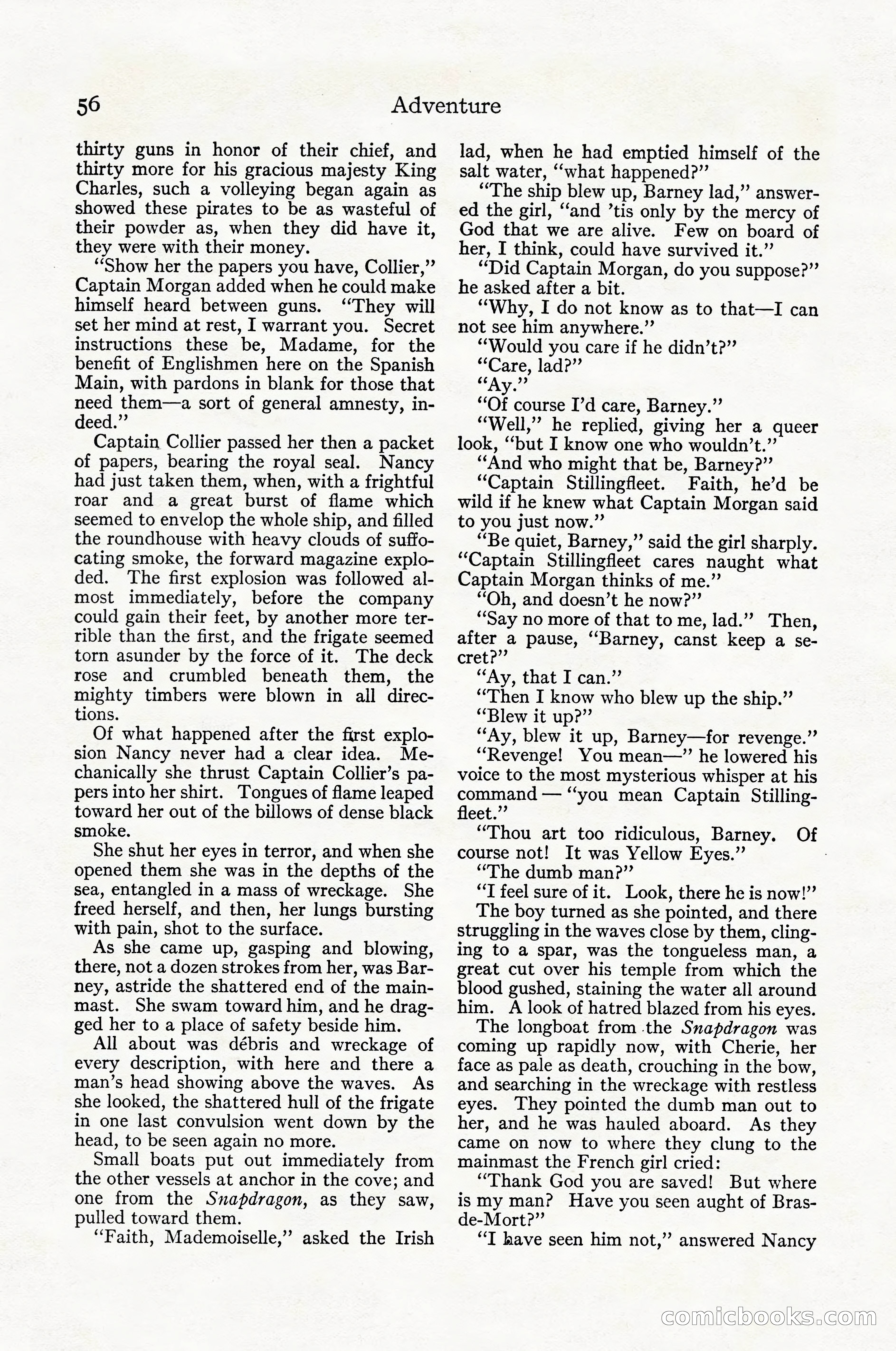
A restored page from Pulp Fiction, 1916. Page through the whole issue in the reader above.
📄 Transcribed text from this page (OCR, searchable)
Machine-transcribed from the original scan — historical spelling and the odd misread are preserved.
56 thirty guns in honor of their chief, and thirty more for his gracious majesty King Charles, such a volleying began again as showed these pirates to be as wasteful of their powder as, when they did have it, they were with their money. ‘Show her the papers you have, Collier,”’ Captain Morgan added when he could make himself heard between guns. ‘They will set her mind at rest, I warrant you. Secret instructions these be, Madame, for the benefit of Englishmen here on the Spanish Main, with pardons in blank for those that need them—a sort of general amnesty, in- deed.” Captain Collier passed her then a packet of papers, bearing the royal seal. Nancy had just taken them, when, with a frightful roar and a great burst of flame which seemed to envelop the whole ship, and filled the roundhouse with heavy clouds of suffo- cating smoke, the forward magazine explo- ded. The first explosion was followed al- most immediately, before the company could gain their feet, by another more ter- rible than the first, and the frigate seemed torn asunder by the force of it. The deck rose and crumbled beneath them, the mighty timbers were blown in all direc- tions. Of what happened after the first explo- sion Nancy never had a clear idea. Me- chanically she thrust Captain Collier’s pa- pers into her shirt. Tongues of flame leaped toward her out of the billows of dense black smoke. She shut her eyes in terror, and when she opened them she was in the depths of the sea, entangled in a mass of wreckage. She freed herself, and then, her lungs bursting with pain, shot to the surface. As she came up, gasping and blowing, there, not a dozen strokes from her, was Bar- ney, astride the shattered end of the main- mast. She swam toward him, and he drag- ged her to a place of safety beside him. All about was débris and wreckage of every description, with here and there a man’s head showing above the waves. As she looked, the shattered hull of the frigate in one last convulsion went down by the head, to be seen again no more. Small boats put out immediately from the other vessels at anchor in the cove; and one from the Swapdragon, as they saw, pulled toward them. “Faith, Mademoiselle,’”’ asked the Irish Adventure lad, when he had emptied himself of the salt water, ‘‘what happened?” ‘The ship blew up, Barney lad,’ answer- ed the girl, ‘‘and ’tis only by the mercy of God that we are alive. Few on board of her, I think, could have survived it.” “Did Captain Morgan, do you suppose?” he asked after a bit. “Why, I do not know as to that—I can not see him anywhere.” “Would you care if he didn’t?” ‘Care, lad?” PAY? “Of course I’d care, Barney.” “Well,” he replied, giving her a queer look, “‘but I know one who wouldn’t.”’ ‘“‘And who might that be, Barney?” “Captain Stillingfleet. Faith, he’d be wild if he knew what Captain Morgan said to you just now.” ‘‘Be quiet, Barney,” said the girl sharply. “Captain Stillingfleet cares naught what Captain Morgan thinks of me.” “Oh, and doesn’t he now?” “Say no more of that to me, lad.” Then, after a pause, “Barney, canst keep a se- cret?”’ “Ay, that I can.” ‘Then I know who blew up the ship.” “Blew it up?” “Ay, blew it up, Barney—for revenge.” “Revenge! You mean—” he lowered his voice to the most mysterious whisper at his command — “‘you mean Captain Stilling- fleet.” “Thou art too ridiculous, Barney. Of course not! It was Yellow Eyes.” “The dumb man?” “T feel sure of it. Look, there he is now!” The boy turned as she pointed, and there struggling in the waves close by them, cling- ing to a spar, was the tongueless man, a great cut over his temple from which the blood gushed, staining the water all around him. A look of hatred blazed from his eyes. The longboat from the Snapdragon was coming up rapidly now, with Cherie, her face as pale as death, crouching in the bow, and searching in the wreckage with restless eyes. They pointed the dumb man out to her, and he was hauled aboard. As they came on now to where they clung to the mainmast the French girl cried: “Thank God you are saved! But where is my man? Have you seen aught of Bras- de-Mort?”’ “I have seen him not,” answered Nancy COMmichoooks (CO