
Pulp Fiction, 1916 · page 68 of 228
Adventure Magazine Cover, April 1916 — page 68: what you’re looking at
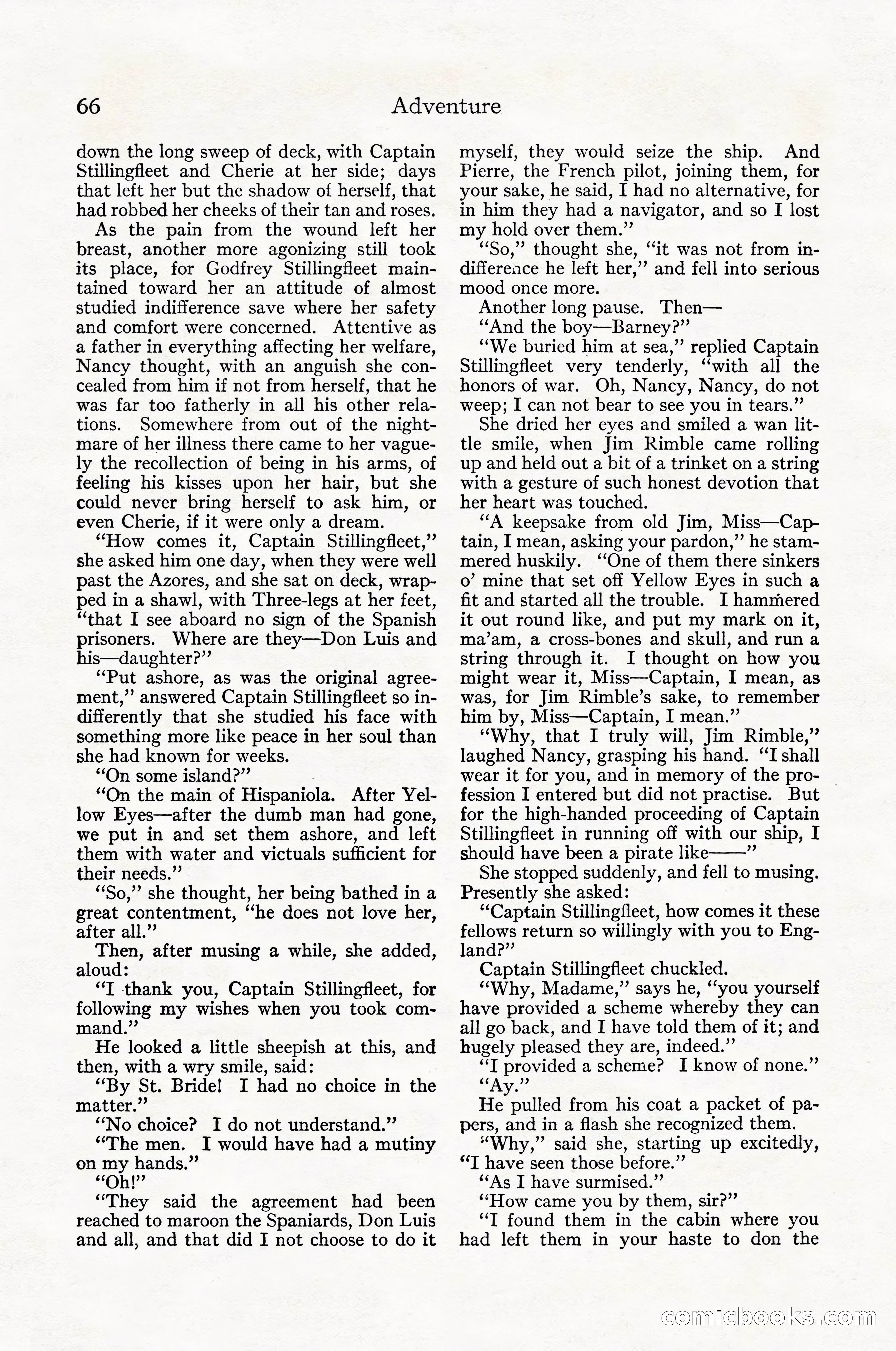
A restored page from Pulp Fiction, 1916. Page through the whole issue in the reader above.
📄 Transcribed text from this page (OCR, searchable)
Machine-transcribed from the original scan — historical spelling and the odd misread are preserved.
66 down the long sweep of deck, with Captain Stillingfleet and Cherie at her side; days that left her but the shadow of herself, that had robbed her cheeks of their tan and roses. As the pain from the wound left her breast, another more agonizing still took its place, for Godfrey Stillingfleet main- tained toward her an attitude of almost studied indifference save where her safety and comfort were concerned. Attentive as a father in everything affecting her welfare, Nancy thought, with an anguish she con- cealed from him if not from herself, that he was far too fatherly in all his other rela- tions. Somewhere from out of the night- mare of her illness there came to her vague- ly the recollection of being in his arms, of feeling his kisses upon her hair, but she could never bring herself to ask him, or even Cherie, if it were only a dream. “How comes it, Captain Stillingfleet,” she asked him one day, when they were well past the Azores, and she sat on deck, wrap- ped in a shawl, with Three-legs at her feet, “that I see aboard no sign of the Spanish prisoners. Where are they—Don Luis and his—daughter?”’ ‘Put ashore, as was the original agree- ment,”’ answered Captain Stillingfleet so in- differently that she studied his face with something more like peace in her soul than she had known for weeks. “On some island?” : “On the main of Hispaniola. After Yel- low Eyes—after the dumb man had gone, we put in and set them ashore, and left them with water and victuals sufficient for their needs.” “So,” she thought, her being bathed in a great contentment, “‘he does not love her, after all.” Then, after musing a while, she added, aloud: “IT thank you, Captain Stillingfleet, for following my wishes when you took com- mand.” He looked a little sheepish at this, and then, with a wry smile, said: ‘By St. Bride! I had no choice in the matter.” “No choice? I do not understand.” “The men. I would have had a mutiny on my hands.” “Oh!” “They said the agreement had been reached to maroon the Spaniards, Don Luis and all, and that did I not choose to do it Adventure myself, they would seize the ship. And Pierre, the French pilot, joining them, for your sake, he said, I had no alternative, for in him they had a navigator, and so I lost my hold over them.” *‘So,” thought she, “it was not from in- difference he left her,’’ and fell into serious mood once more. Another long pause. Then— “And the boy—Barney?” ‘We buried him at sea,” replied Captain Stillingfleet very tenderly, ‘“‘with all the honors of war. Oh, Nancy, Nancy, do not weep; I can not bear to see you in tears.” She dried her eyes and smiled a wan lit- tle smile, when Jim Rimble came rolling up and held out a bit of a trinket on a string with a gesture of such honest devotion that her heart was touched. ‘““A keepsake from old Jim, Miss—Cap- tain, I mean, asking your pardon,”’ he stam- mered huskily. ‘One of them there sinkers o’ mine that set off Yellow Eyes in such a fit and started all the trouble. I hammered it out round like, and put my mark on it, ma’am, a cross-bones and skull, and run a string through it. I thought on how you might wear it, Miss—Captain, I mean, as was, for Jim Rimble’s sake, to remember him by, Miss—Captain, I mean.” “Why, that I truly will, Jim Rimble,” laughed Nancy, grasping his hand. “T shall wear it for you, and in memory of the pro- fession I entered but did not practise. But | for the high-handed proceeding of Captain Stillingfleet in running off with our ship, I should have been a pirate like a She stopped suddenly, and fell to musing. Presently she asked: “Captain Stillingfleet, how comes it these fellows return so willingly with you to Eng- land?” Captain Stillingfleet chuckled. ‘““Why, Madame,” says he, “you yourself have provided a scheme whereby they can all go back, and I have told them of it; and hugely pleased they are, indeed.”’ “T provided a scheme? I know of none.” Ay He pulled from his coat a packet of pa- pers, and in a flash she recognized them. “Why,” said she, starting up excitedly, ‘‘T have seen those before.” ‘fAs I have surmised.” ‘How came you by them, sir?” “T found them in the cabin where you had left them in your haste to don the CoOMmichoooks (CO