
Pulp Fiction, 1924 · page 115 of 200
Adventure Magazine Cover — page 115: what you’re looking at
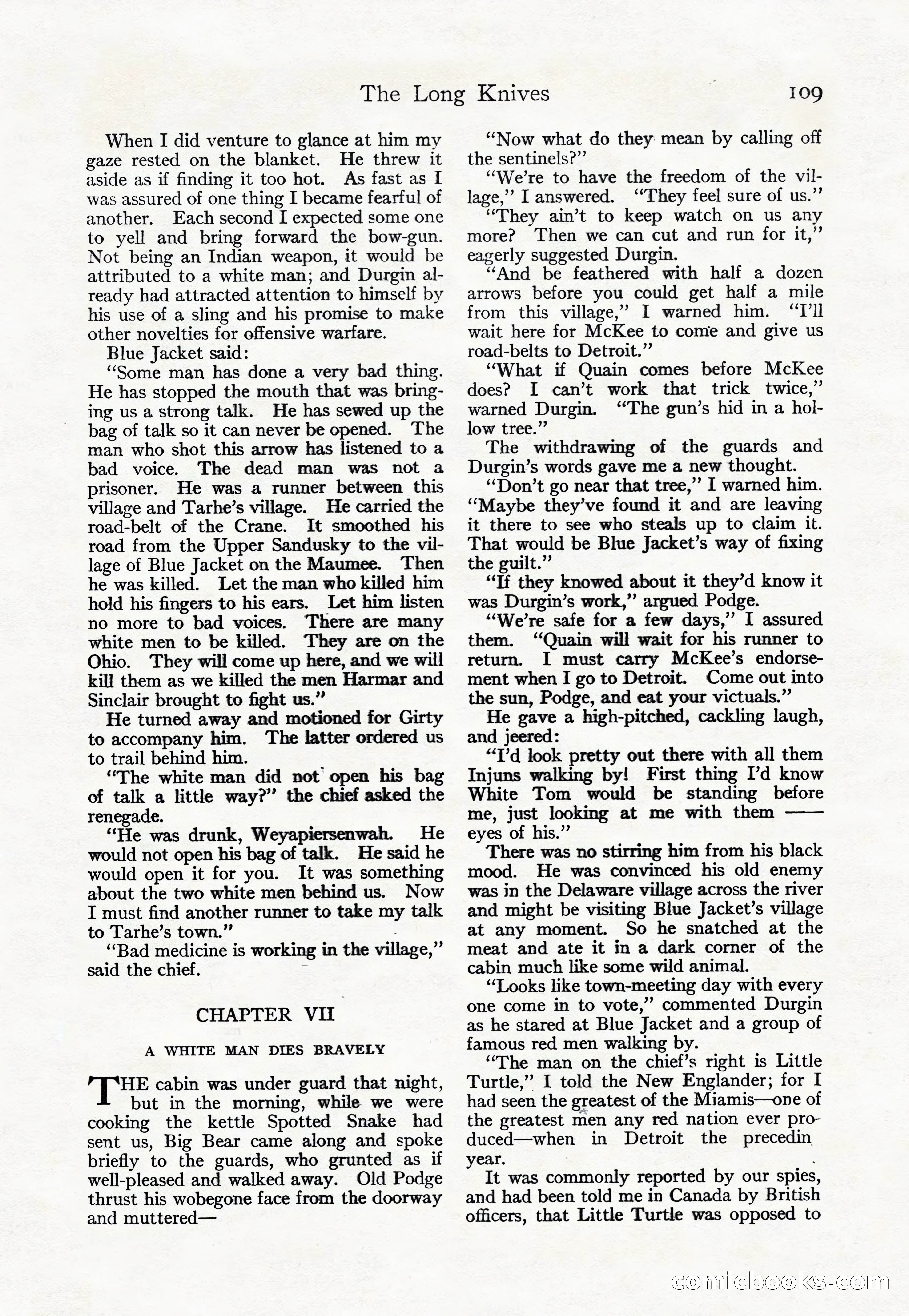
A restored page from Pulp Fiction, 1924. Page through the whole issue in the reader above.
📄 Transcribed text from this page (OCR, searchable)
Machine-transcribed from the original scan — historical spelling and the odd misread are preserved.
The Long Knives When I did venture to glance at him my gaze rested on the blanket. He threw it aside as if finding it too hot. As fast as [ was assured of one thing I became fearful of another. Each second I expected some one to yell and bring forward the bow-gun. Not being an Indian weapon, it would be attributed to a white man; and Durgin al- ready had attracted attention to himself by his use of a sling and his promise to make other novelties for offensive warfare. Blue Jacket said: ‘Some man has done a very bad thing. He has stopped the mouth that was bring- ing us a strong talk. He has sewed up the bag of talk so it can never be opened. The man who shot this arrow has listened to a bad voice. The dead man was not a prisoner. He was a runner between this village and Tarhe’s village. He carried the road-belt of the Crane. It smoothed his road from the Upper Sandusky to the vil- lage of Blue Jacket on the Maumee. Then he was killed. Let the man who killed him hold his fingers to his ears. Let him listen no more to bad voices. There are many white men to be killed. They are on the Ohio. They will come up here, and we will kill them as we killed the men Harmar and Sinclair brought to fight us.” He turned away and motioned for Girty to accompany him. The latter ordered us to trail behind him. : “The white man did not open his bag of talk a little way?” the chief asked the renegade. “He was drunk, Weyapiersenwah. He would not open his bag of talk. He said he would open it for you. It was something about the two white men behind us. Now I must find another runner to take my to Tarhe’s town.”’ “Bad medicine is working in the village,” said the chief. CHAPTER VII A WHITE MAN DIES BRAVELY rT HE cabin was under guard that night, but in the morning, while we were cooking the kettle Spotted Snake had sent us, Big Bear came along and spoke briefly to the guards, who grunted as if well-pleased and walked away. Old Podge thrust his wobegone face from the doorway and muttered— 109 “Now what do they mean by calling off the sentinels?”’ ‘“‘We’re to have the freedom of the vil- lage,” I answered. ‘“They feel sure of us.” “They ain’t to keep watch on us any more? Then we can cut and run for it,” eagerly suggested Durgin. “And be feathered with half a dozen arrows before you could get half a mile from this village,’ I warned him. “T’ll wait here for McKee to come and give us road-belts to Detroit.” “What if Quain comes before McKee does? I can’t work that trick twice,” warned Durgin. “The gun’s hid im a hol- low tree.” The withdrawing of the guards and Durgin’s words gave me a new thought. “Don’t go near that tree,”’ I warned him. ‘Maybe they’ve found it and are leaving it there to see who steals up to claim it. That would be Blue Jacket’s way of fixing the guilt.” “If they knowed about it they’d know it was Durgin’s work,’’ argued Podge. “We're safe for a few days,” I assured them. ‘“Quain will wait for his runner to return. I must carry McKee’s endorse- ment when I go to Detroit. Come out into the sun, Podge, and eat your victuals.” He gave a high-pitched, cackling laugh, and jeered: “T’d look pretty out there with all them Injuns walking by! First thing I’d know White Tom would be standing before me, just looking at me with them eyes of his.” There was no stirring him from his black mood. He was convinced his old enemy was in the Delaware village across the river and might be visiting Blue Jacket’s village at any moment. So he snatched at the meat and ate it in a dark corner of the cabin much like some wild animal. “Looks like town-meeting day with every one come in to vote,” commented Durgin as he stared at Blue Jacket and a group of famous red men walking by. ‘The man on the chief’s right is Little Turtle,” I told the New Englander; for I had seen the greatest of the Miamis—one of the greatest men any red nation ever pro- duced—when in Detroit the precedin year. It was commonly reported by our spies, and had been told me in Canada by British officers, that Little Turtle was opposed to oO COMmMicloo S (©