
Pulp Fiction, 1924 · page 147 of 200
Adventure Magazine Cover — page 147: what you’re looking at
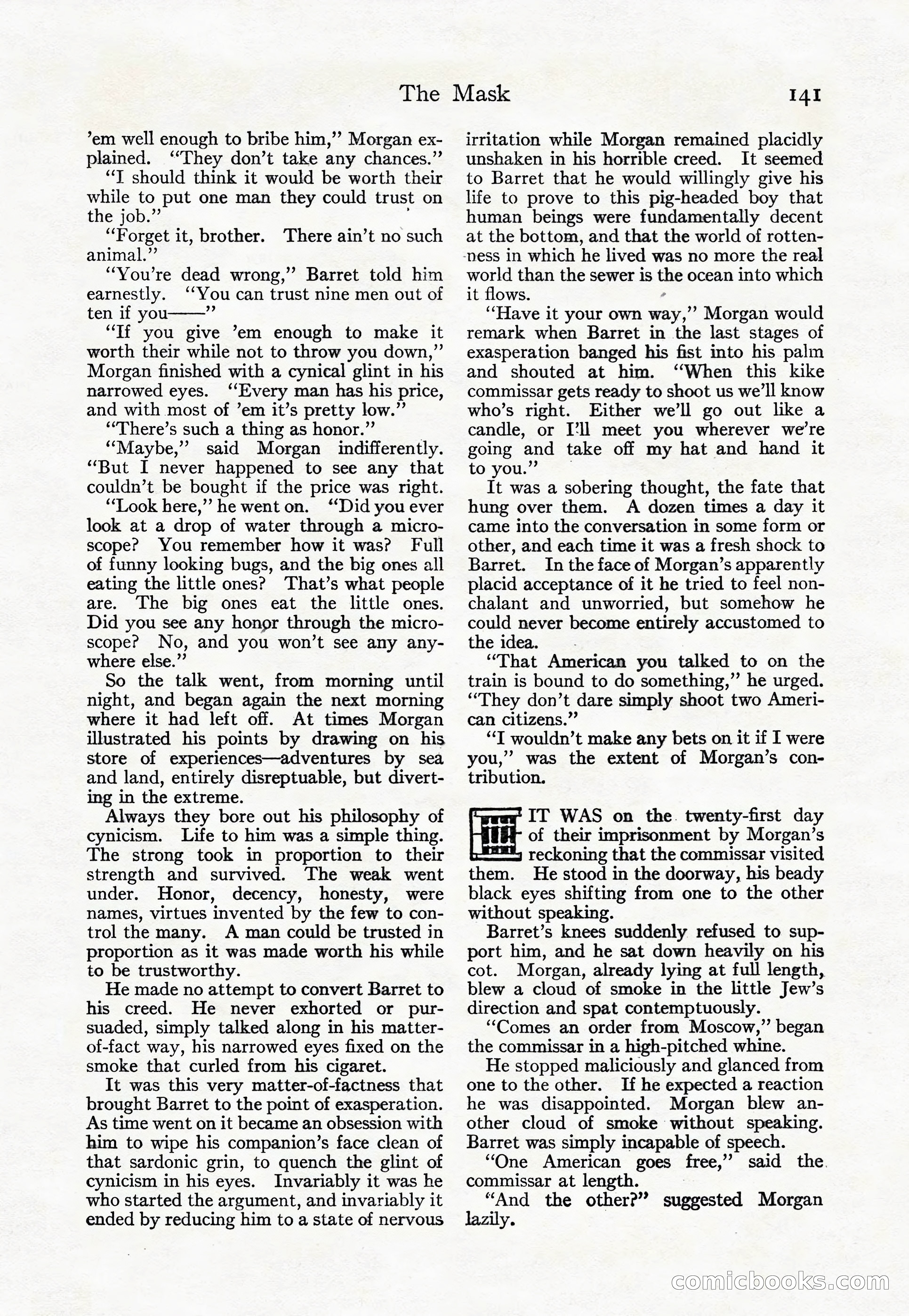
A restored page from Pulp Fiction, 1924. Page through the whole issue in the reader above.
📄 Transcribed text from this page (OCR, searchable)
Machine-transcribed from the original scan — historical spelling and the odd misread are preserved.
The Mask ’em well enough to bribe him,”’ Morgan ex- plained. ‘They don’t take any chances.” “T should think it would be worth their while to put one man they could trust on the job.” “Forget it, brother. animal.” “You're dead wrong,” Barret told him earnestly. ‘‘You can trust nine men out of ten if you it “If you give ’em enough to make it worth their while not to throw you down,” Morgan finished with a cynical glint in his narrowed eyes. ‘Every man has his price, and with most of ’em it’s pretty low.”’ ‘“‘There’s such a thing as honor.”’ : ‘““Maybe,”’ said Morgan indifferently. “But I never happened to see any that couldn’t be bought if the price was right. “Look here,” he wenton. ‘Did you ever look at a drop of water through a micro- scope? You remember how it was? Full of funny looking bugs, and the big ones all eating the little ones? That’s what people are. The big ones eat the little ones. Did you see any honor through the micro- scoper No, and you won’t see any any- where else.” So the talk went, from morning until night, and began again the next morning where it had left off. At times Morgan illustrated his points by drawing on his Store of experiences—adventures by sea and land, entirely disreptuable, but divert- Ing in the extreme. Always they bore out his philosophy of cynicism. Life to him was a simple thing. The strong took in proportion to their strength and survived. The weak went under. Honor, decency, honesty, were names, virtues invented by the few to con- trol the many. A man could be trusted in proportion as it was made worth his while to be trustworthy. He made no attempt to convert Barret to his creed. He never exhorted or pur- suaded, simply talked along in his matter- of-fact way, his narrowed eyes fixed on the smoke that curled from his cigaret. It was this very matter-of-factness that brought Barret to the point of exasperation. As time went on it became an obsession with him to wipe his companion’s face clean of that sardonic grin, to quench the glint of cynicism in his eyes. Invariably it was he who started the argument, and invariably it ended by reducing him to a state of nervous There ain’t no such 141 irritation while Morgan remained placidly unshaken in his horrible creed. It seemed to Barret that he would willingly give his life to prove to this pig-headed boy that human beings were fundamentally decent at the bottom, and that the world of rotten- -ness in which he lived was no more the real world than the sewer is the ocean into which it flows. “Have it your own way,” Morgan would remark when Barret in the last stages of exasperation banged his fist into his palm and shouted at him. “When this kike commissar gets ready to shoot us we’ll know who’s right. Either we’ll go out like a candle, or I'll meet you wherever we’re going and take off my hat and hand it to you.” It was a sobering thought, the fate that hung over them. A dozen times a day it came into the conversation in some form or other, and each time it was a fresh shock to Barret. In the face of Morgan’s apparently placid acceptance of it he tried to feel non- chalant and unworried, but somehow he could never become entirely accustomed to the idea. “That American you talked to on the train is bound to do something,”’ he urged. ‘“‘They don’t dare simply shoot two Ameri- can citizens.” “T wouldn’t make any bets on it if I were you,” was the extent of Morgan’s con- tribution. weeny IT WAS on the. twenty-first day ata of their imprisonment by Morgan’s paaEe, reckoning that the commissar visited them. He stood in the doorway, his beady black eyes shifting from one to the other without speaking. Barret’s knees suddenly refused to sup- port him, and he sat down heavily on his cot. Morgan, already lying at full length, blew a cloud of smoke in the little Jew’s direction and spat contemptuously. ‘Comes an order from Moscow,” began the commissar in a high-pitched whine. He stopped maliciously and glanced from one to the other. If he expected a reaction he was disappointed. Morgan blew an- other cloud of smoke without speaking. Barret was simply incapable of speech. “One American goes free,” commissar at len “And the other?” suggested Morgan lazily. COmiclbook said the. (©