
Pulp Fiction, 1924 · page 164 of 200
Adventure Magazine Cover — page 164: what you’re looking at
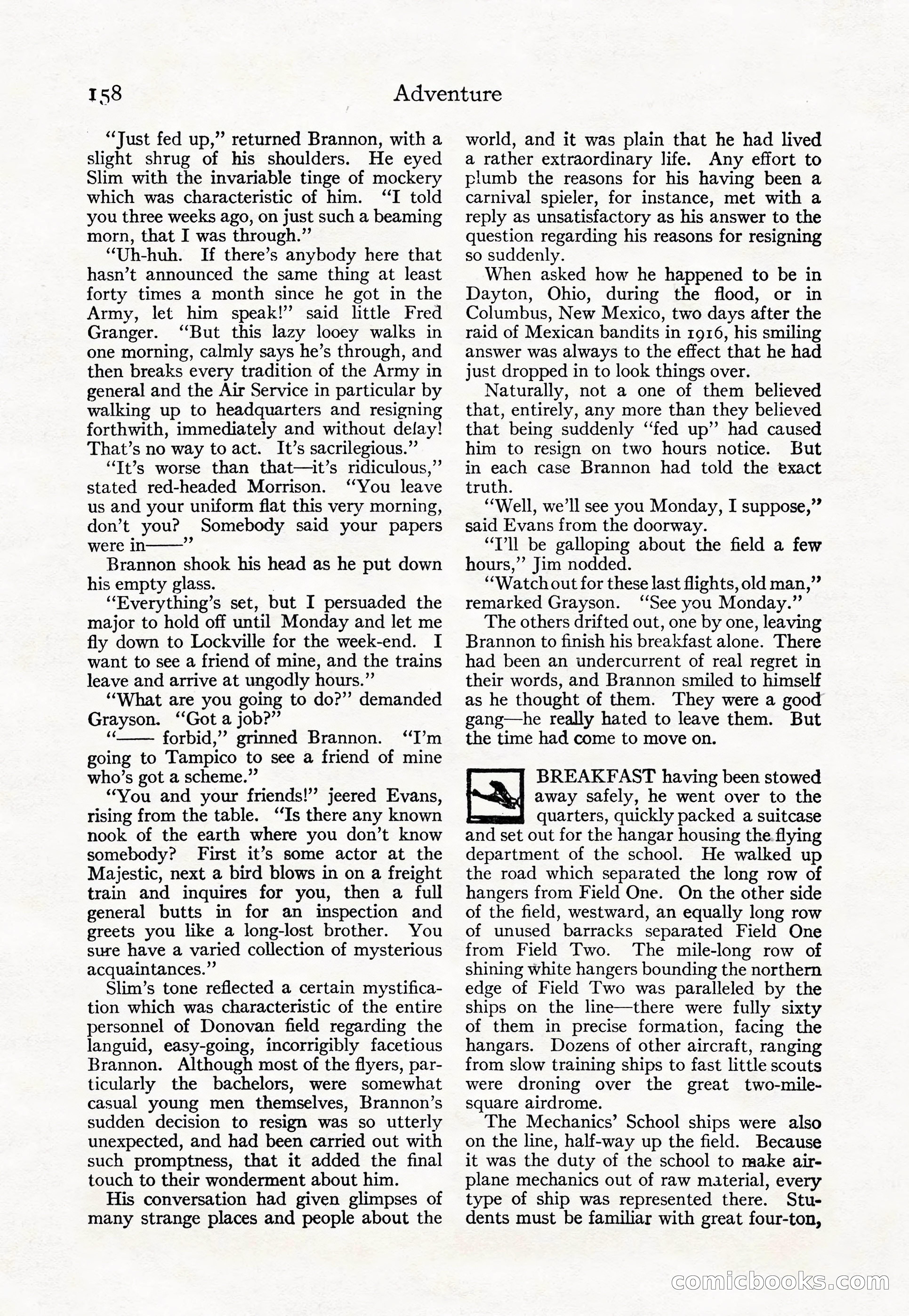
A restored page from Pulp Fiction, 1924. Page through the whole issue in the reader above.
📄 Transcribed text from this page (OCR, searchable)
Machine-transcribed from the original scan — historical spelling and the odd misread are preserved.
158 “Just fed up,” returned Brannon, with a slight shrug of his shoulders. He eyed Slim with the invariable tinge of mockery which was characteristic of him. “TI told you three weeks ago, on just such a beaming morn, that I was through.” “Uh-huh. If there’s anybody here that hasn’t announced the same thing at least forty times a month since he got in the Army, let him speak!’’ said little Fred Granger. “But this lazy looey walks in one morning, calmly says he’s through, and then breaks every tradition of the Army in general and the Air Service in particular by walking up to headquarters and resigning forthwith, immediately and without delay! That’s no way to act. It’s sacrilegious.” “Tt’s worse than that—it’s nidiculous,”’ stated red-headed Morrison. ‘You leave us and your uniform flat this very morning, don’t your Somebody said your papers were in es Brannon shook his head as he put down his empty glass. ‘“Everything’s set, but I persuaded the major to hold off until Monday and let me fly down to Lockville for the week-end. I want to see a friend of mine, and the trains leave and arrive at ungodly hours.” ‘““What are you going to do?’ demanded Grayson. ‘‘Got a job?” forbid,” grinned Brannon. “I’m going to Tampico to see a friend of mine who’s got a scheme.” “You and your friends!’ jeered Evans, rising from the table. “Is there any known nook of the earth where you don’t know somebody? First it’s some actor at the Majestic, next a bird blows in on a freight train and inquires for you, then a full general butts in for an inspection and greets you like a long-lost brother. You sure have a varied collection of mysterious acquaintances.” Slim’s tone reflected a certain mystifica- tion which was characteristic of the entire personnel of Donovan field regarding the languid, easy-going, incorrigibly facetious Brannon. Although most of the flyers, par- ticularly the bachelors, were somewhat casual young men themselves, Brannon’s sudden decision to resign was so utterly unexpected, and had been carried out with such promptness, that it added the final touch to their wonderment about him. His conversation had given glimpses of many strange places and people about the Adventure world, and it was plain that he had lived a rather extraordinary life. Any effort to plumb the reasons for his having been a carnival spieler, for instance, met with a reply as unsatisfactory as his answer to the question regarding his reasons for resigning so suddenly. When asked how he happened to be in Dayton, Ohio, during the flood, or in Columbus, New Mexico, two days after the raid of Mexican bandits in 1916, his smiling answer was always to the effect that he had just dropped in to look things over. Naturally, not a one of them believed that, entirely, any more than they believed that being suddenly ‘‘fed up” had caused him to resign on two hours notice. But in each case Brannon had told the exact truth. ‘“‘Well, we’ll see you Monday, I suppose,” said Evans from the doorway. “T’ll be galloping about the field a few hours,”’ Jim nodded. ‘Watch out for these last flights, old man,” remarked Grayson. ‘See you Monday.” The others drifted out, one by one, leaving Brannon to finish his breakfast alone. There had been an undercurrent of real regret in their words, and Brannon smiled to himself as he thought of them. They were a good gang—he really hated to leave them. But the time had come to move on. cw BREAKFAST having been stowed Pa; away safely, he went over to the quarters, quickly packed a suitcase Lam set out for the hangar housing the. flying department of the school. He walked up the road which separated the long row of hangers from Field One. On the other side of the field, westward, an equally long row of unused barracks separated Field One from Field Two. The mile-long row of shining white hangers bounding the northern edge of Field Two was paralleled by the ships on the line—there were fully sixty of them in precise formation, facing the hangars. Dozens of other aircraft, ranging from slow training ships to fast little scouts were droning over the great two-mile- square airdrome. The Mechanics’ School ships were also on the line, half-way up the field. Because it was the duty of the school to make air- plane mechanics out of raw material, every type of ship was represented there. Stu- dents must be familiar with great four-ton, oO C© MICLOOKS CO