
Pulp Fiction, 1924 · page 189 of 200
Adventure Magazine Cover — page 189: what you’re looking at
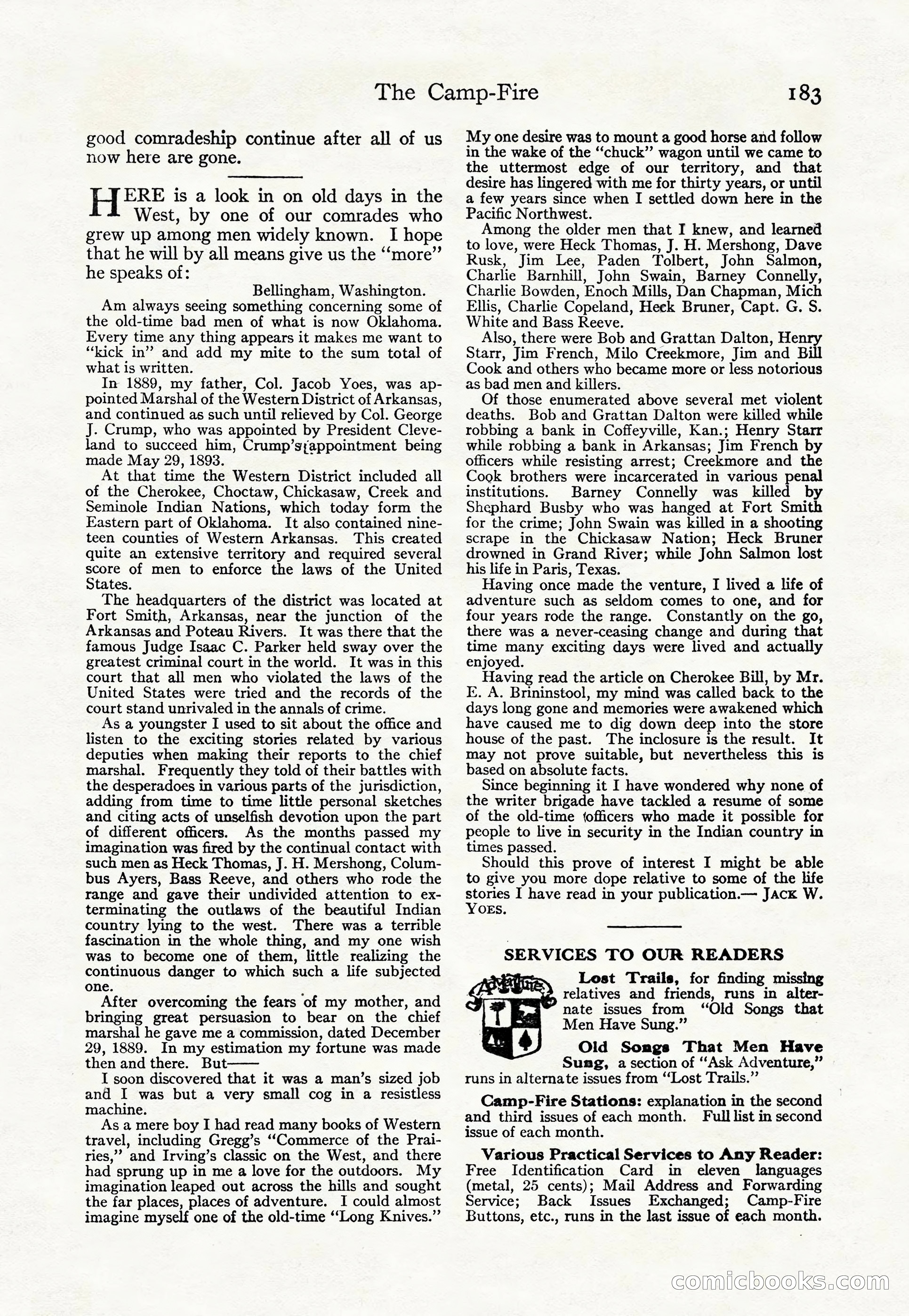
A restored page from Pulp Fiction, 1924. Page through the whole issue in the reader above.
📄 Transcribed text from this page (OCR, searchable)
Machine-transcribed from the original scan — historical spelling and the odd misread are preserved.
The Camp-Fire good comradeship continue after all of us now here are gone. je ie is a look in on old days in the West, by one of our comrades who grew up among men widely known. I hope that he will by all means give us the ‘“‘more”’ he speaks of: Bellingham, Washington. Am always seeing something concerning some of the old-time bad men of what is now Oklahoma. Every time any thing appears it makes me want to “kick in” and add my mite to the sum total of what is written. In 1889, my father, Col. Jacob Yoes, was ap- pointed Marshal of the Western District of Arkansas, and continued as such until relieved by Col. George J. Crump, who was appointed by President Cleve- land to succeed him, Crump’syappointment being made May 29, 1893. At that time the Western District included all of the Cherokee, Choctaw, Chickasaw, Creek and Seminole Indian Nations, which today form the Eastern part of Oklahoma. It also contained nine- teen counties of Western Arkansas. This created quite an extensive territory and required several score of men to enforce the laws of the United States. The headquarters of the district was located at Fort Smith, Arkansas, near the junction of the Arkansas and Poteau Rivers. It was there that the famous Judge Isaac C. Parker held sway over the greatest criminal court in the world. It was in this court that all men who violated the laws of the United States were tried and the records of the court stand unrivaled in the annals of crime. As a youngster I used to sit about the office and listen to the exciting stories related by various deputies when making their reports to the chief marshal. Frequently they told of their battles with the desperadoes in various parts of the jurisdiction, adding from time to time little personal sketches and citing acts of unselfish devotion upon the part of different officers. As the months passed my imagination was fired by the continual contact with such men as Heck Thomas, J. H. Mershong, Colum- bus Ayers, Bass Reeve, and others who rode the range and gave their undivided attention to ex- terminating the outlaws of the beautiful Indian country lying to the west. There was a terrible fascination in the whole thing, and my one wish was to become one of them, little realizing the continuous danger to which such a life subjected one. After overcoming the fears of my mother, and bringing great persuasion to bear on the chief marshal he gave me a commission, dated December 29, 1889. In my estimation my fortune was made then and there. But I soon discovered that it was a man’s sized job and I was but a very small cog in a resistless machine. As a mere boy I had read many books of Western travel, including Gregg’s ‘““Commerce of the Prai- ries,” ‘and Irving’s classic on the West, and there had sprung up in me a love for the outdoors. My imagination leaped out across the hills and sought the far places, places of adventure. I could almost imagine myself one of the old-time ‘“‘Long Knives.” 183 My one desire was to mount a good horse and follow in the wake of the “chuck” wagon until we came to the uttermost edge of our territory, and that desire has lingered with me for thirty years, or until a few years since when I settled down here in the Pacific Northwest. Among the older men that I knew, and learned to love, were Heck Thomas, J. H. Mershong, Dave Rusk, Jim Lee, Paden Tolbert, John Salmon, Charlie Barnhill, John Swain, Barney Connelly, Charlie Bowden, Enoch Mills, Dan Chapman, Mich Ellis, Charlie Copeland, Heck Bruner, Capt. G. S. White and Bass Reeve. Also, there were Bob and Grattan Dalton, Henry Starr, Jim French, Milo Creekmore, Jim and Bill Cook and others who became more or less notorious as bad men and killers. Of those enumerated above several met violent deaths. Bob and Grattan Dalton were killed while robbing a bank in Coffeyville, Kan.; Henry Starr while robbing a bank in Arkansas; Jim French by officers while resisting arrest; Creekmore and the Cook brothers were incarcerated in various penal institutions. Barney Connelly was killed by Shephard Busby who was hanged at Fort Smith for the crime; John Swain was killed in a shooting scrape in the Chickasaw Nation; Heck Bruner drowned in Grand River; while John Salmon lost his life in Paris, Texas. Having once made the venture, I lived a life of adventure such as seldom comes to one, and for four years rode the range. Constantly on the go, there was a never-ceasing change and during that time many exciting days were lived and actually enjoyed. Having read the article on Cherokee Bill, by Mr. IX. A. Brininstool, my mind was called back to the days long gone and memories were awakened which have caused me to dig down deep into the store house of the past. The inclosure is the result. It may not prove suitable, but nevertheless this is based on absolute facts. Since beginning it I have wondered why none of the writer brigade have tackled a resume of some of the old-time {officers who made it possible for people to live in security in the Indian country in times passed. Should this prove of interest I might be able to give you more dope relative to some of the life ae I have read in your publication.— Jack W. OES. SERVICES TO OUR READERS Lost Traile, for finding missing relatives and friends, runs in alter- “nate issues from “Old Songs that Men Have Sung.” Old Songs That Men Have Sung, a section of ‘Ask Adventure,” runs in alternate issues from ‘“‘Lost Trails.” Camp-Fire Stations: explanation in the second and third issues of each month. Full list in second issue of each month. Various Practical Services to Any Reader: Free Identification Card in eleven languages (metal, 25 cents); Mail Address and Forwarding Service; Back Issues Exchanged; Camp-Fire Buttons, etc., runs in the last issue of each month. oO C© MICLOOKS 5}