
Pulp Fiction, 1924 · page 195 of 200
Adventure Magazine Cover — page 195: what you’re looking at
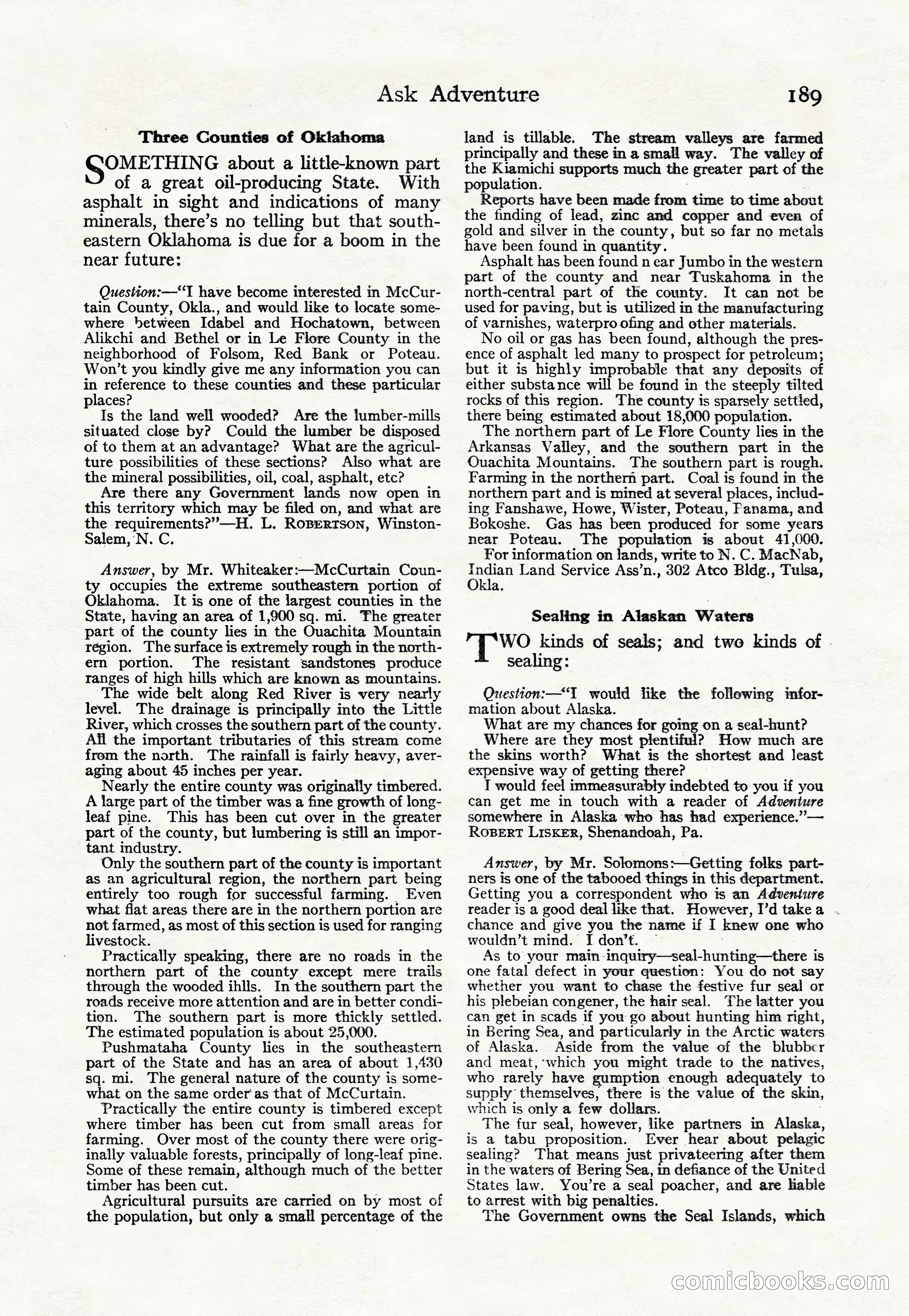
A restored page from Pulp Fiction, 1924. Page through the whole issue in the reader above.
📄 Transcribed text from this page (OCR, searchable)
Machine-transcribed from the original scan — historical spelling and the odd misread are preserved.
Ask Adventure Three Counties of Oklahoma os G about a little-known part of a great oil-producing State. With asphalt in sight and indications of many minerals, there’s no telling but that south- eastern Oklahoma is due for a boom in the near future: Question:—“T have become interested in McCur- tain County, Okla., and would like to locate some- where between Idabel and Hochatown, between Alikchi and Bethel or in Le Flore County in the neighborhood of Folsom, Red Bank or Poteau. Won’t you kindly give me any information you can in reference to these counties and these particular places? Is the land well wooded? Are the lumber-mills situated close by? Could the lumber be disposed of to them at an advantage? What are the agricul- ture possibilities of these sections? Also what are the mineral possibilities, oil, coal, asphalt, etc? Are there any Government lands now open in this territory which may be filed on, and what are the requirements?”—H. L. RoBertson, Winston- Salem, N. C. Answer, by Mr. Whiteaker:—McCurtain Coun- ty occupies the extreme southeastern portion of Oklahoma. It is one of the largest counties in the State, having an area of 1,900 sq. mi. The greater part of the county lies in the Ouachita Mountain région. The surface is extremely rough in the north- ern portion. The resistant sandstones produce ranges of high hills which are known as mountains. The wide belt along Red River is very nearly level. The drainage is principally into the Little River, which crosses the southern part of the county. Ail the important tributaries of this stream come from the north. The rainfall is fairly heavy, aver- aging about 45 inches per year. Nearly the entire county was originally timbered. A large part of the timber was a fine growth of long- leaf pine. This has been cut over in the greater part of the county, but lumbering is still an impor- tant industry. Only the southern part of the county is important as an agricultural region, the northern part being entirely too rough for successful farming. Even what flat areas there are in the northern portion are not farmed, as most of this section is used for ranging livestock. Practically speaking, there are no roads in the northern part of the county except mere trails through the wooded ihlls. In the southern part the roads receive more attention and are in better condi- tion. The southern part is more thickly settled. The estimated population is about 25,000. Pushmataha County lies in the southeastern part of the State and has an area of about 1,430 sq. mi. The general nature of the county is some- what on the same order'as that of McCurtain. Practically the entire county is timbered except where timber has been cut from small areas for farming. Over most of the county there were orig- inally valuable forests, principally of long-leaf pine. Some of these remain, although much of the better timber has been cut. Agricultural pursuits are carried on by most of the population, but only a small percentage of the 189 land is tillable. The stream valleys are farmed principally and these ina small way. The valley of the Kiamichi supports much the greater part of the population. Reports have been made Fou time to time about the finding of lead, zinc and copper and even of gold and silver in the county, but so far no metals have been found in quantity. Asphalt has been found n ear Jumbo in the western part of the county and near Tuskahoma in the north-central part of the county. It can not be used for paving, but is utilized in the manufacturing of varnishes, waterpro ofing and other materials. No oil or gas has been found, although the pres- ence of asphalt led many to prospect for petroleum; but it is highly improbable that any deposits of either substance will be found in the steeply tilted rocks of this region. The county is sparsely settled, there being estimated about 18,000 population. The northern part of Le Flore County lies in the Arkansas Valley, and the southern part in the Ouachita Mountains. The southern part is rough. Farming in the northern part. Coal is found in the northern part and is mined at several places, includ- ing Fanshawe, Howe, Wister, Poteau, Fanama, and Bokoshe. Gas has been produced for some years near Poteau. The population is about 41,000. For information on lands, write to N. C. MacNab, ee Land Service Ass’n., 302 Atco Bldg., Tulsa, cla. Sealing in Alaskan Waters WO kinds of seals; and two kinds of © sealing: Question:—I_ would Tike the following imfor- mation about Alaska. What are my chances for going on a seal-hunt? Where are they most plentiful? How much are the skins worth? What is the shortest and least expensive way of getting there? T would feel immeasurably indebted to you if you can get me in touch with a reader of Adventure somewhere in Alaska who has had experience.” — ROBERT LiskER, Shenandoah, Pa. Answer, by Mr. Solomons:—Getting folks part- ners is one of the tabooed things in this department. Getting you a correspondent who is an Adventure reader is a good deal like that. However, I’d takea - chance and give you the name if I knew one who wouldn’t mind. I don’t. — As to your main: inquiry—seal-hunting—there i is one fatal defect in your question: You do not say whether you want to chase the festive fur seal or his plebeian congener, the hair seal. The latter you can get in scads if you go about hunting him mght, in Bering Sea, and particularly in the Arctic waters of Alaska. Aside from the value of the blubbcr and meat, ‘which you might trade to the natives, who rarely have gumption enough adequately to supply themselves, there is the value of the skin, which is only a few dollars. The fur seal, however, like partners in Alaska, is a tabu proposition. Ever hear about pelagic sealing? That means just privateering after them in the waters of Bering Sea, m defiance of the United States law. You’re a seal poacher, and are lable to arrest with big penalties. The Government owns the Seal Islands, which oO nn) COMmicloo S S|