
Pulp Fiction, 1924 · page 197 of 200
Adventure Magazine Cover — page 197: what you’re looking at
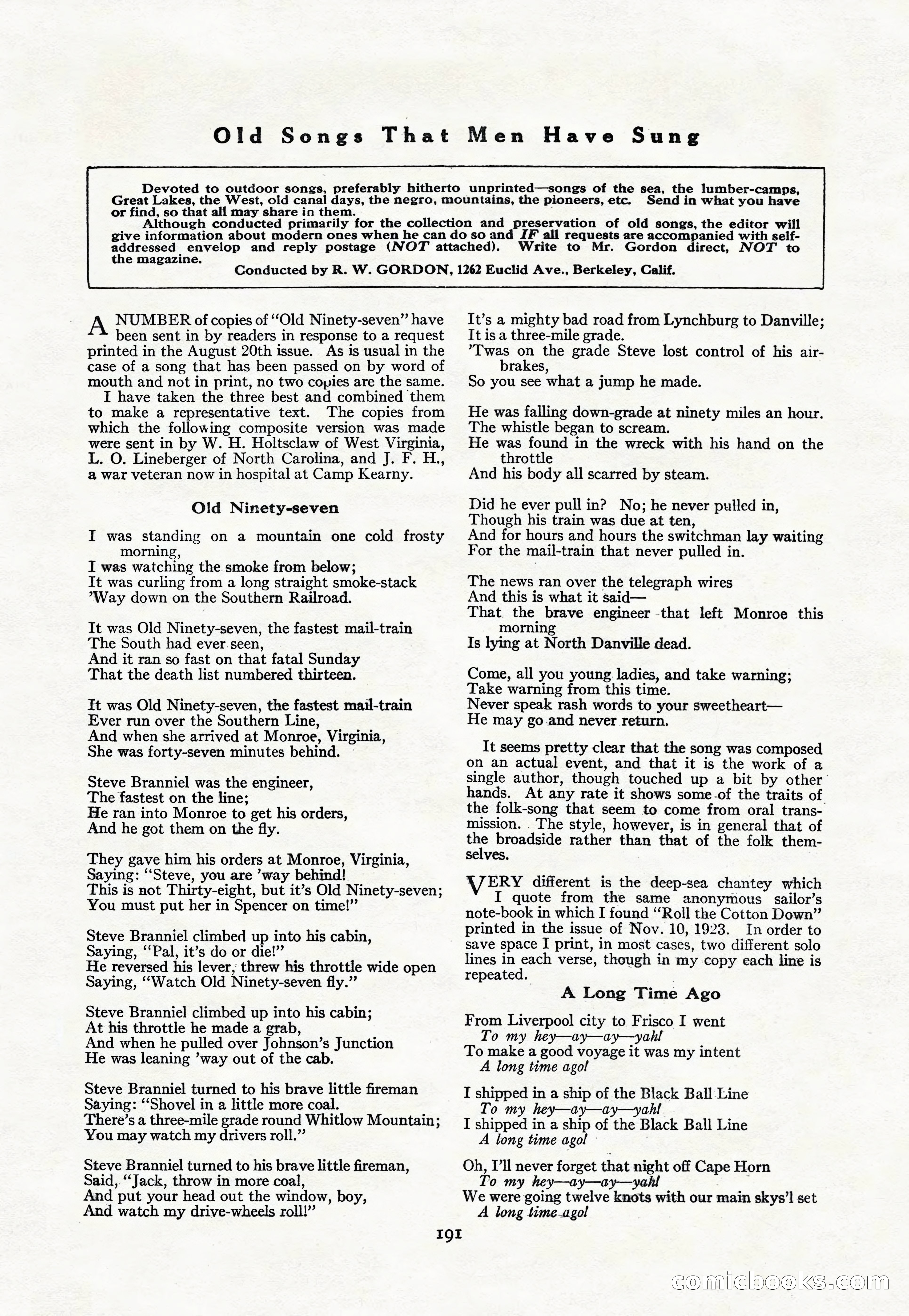
A restored page from Pulp Fiction, 1924. Page through the whole issue in the reader above.
📄 Transcribed text from this page (OCR, searchable)
Machine-transcribed from the original scan — historical spelling and the odd misread are preserved.
Old Songs That Men Have Sung Devoted to outdoor songs, preferably hitherto unprinted—songs of the sea, the lumber-camps, Great Lakes, the West, old canal days, the negro, mountains, the pioneers, etc. Send in what you have or find, so that all may share in them. Although conducted primarily for the collection and preservation of old songs, the editor will give information about modern ones when he can do so and IF all requests are accompanied with self- addressed envelop and reply postage (NOT ' attached). Conducted by R. W. GORDON, 1262 Euclid Ave., Berkeley, Calif. the magazine. A NUMBER of copies of “Old Ninety-seven” have been sent in by readers in response to a request printed in the August 20th issue. As is usual in the case of a song that has been passed on by word of mouth and not in print, no two copies are the same. I have taken the three best and combined them to make a representative text. The copies from which the following composite version was made were sent in by W. H. Holtsclaw of West Virginia, L. O. Lineberger of North Carolina, and J. F. H., @ war veteran now in hospital at Camp Kearny. Old Ninety-seven I was standing on a mountain one cold frosty morning, I was watching the smoke from below; It was curling from a long straight smoke-stack *Way down on the Southern Railroad. It was Old Ninety-seven, the fastest mail-train The South had ever seen, And it ran so fast on that fatal Sunday That the death list numbered thirteen. It was Old Ninety-seven, the fastest mail-train Ever run over the Southern Line, And when she arrived at Monroe, Virginia, She was forty-seven minutes behind. Steve Branniel was the engineer, The fastest on the line; He ran into Monroe to get his orders, And he got them on the fly. They gave him his orders at Monroe, Virginia, Saying: “Steve, you are ’way behind! This is not Thirty-eight, but it’s Old Ninety-seven; You must put her in Spencer on time!” Steve Branniel climbed up into his cabin, Saying, ‘Pal, it’s do or die!” He reversed his lever, threw his throttle wide open Saying, ‘‘Watch Old Ninety-seven fly.” Steve Branniel climbed up into his cabin; At his throttle he made a grab, And when he pulled over Johnson’s Junction He was leaning ’way out of the cab. Steve Branniel turned to his brave little fireman Saying: “Shovel in a little more coal. There’s a three-mile grade round Whitlow Mountain; You may watch my drivers roll.”’ Steve Branniel turned to his brave little fireman, Said, “Jack, throw in more coal, And put your head out the window, boy, And watch my drive-wheels roll!” IOI Write to Mr. Gordon direct, NOT to It’s a mighty bad road from Lynchburg to Danville; It is a three-mile grade. *Twas on the grade Steve lost control of his air- brakes, So you see what a jump he made. He was falling down-grade at ninety miles an hour. The whistle began to scream. He was found in the wreck with his hand on the throttle And his body all scarred by steam. Did he ever pull in? No; he never pulled in, Though his train was due at ten, And for hours and hours the switchman lay waiting For the mail-train that never pulled in. The news ran over the telegraph wires And this is what it said— That. the brave engineer that left Monroe this morning Is lying at North Danville dead. Come, all you young ladies, and take warning; Take warning from this time. Never speak rash words to your sweetheart— He may go.and never return. It seems pretty clear that the song was composed on an actual event, and that it is the work of a single author, though touched up a bit by other hands. At any rate it shows some.of the traits of the folk-song that seem to come from oral trans- mission. . The style, however, is in general that of ee broadside rather than that of the folk them- selves. ERY different is the deep-sea chantey which I quote from the same anonymous sailor’s note-book in which I found ‘Roll the Cotton Down” printed in the issue of Nov. 10, 1923. In order to save space I print, in most cases, two different solo lines in each verse, though in my copy each line is repeated. Oe A Long Time Ago From Liverpool city to Frisco I went To my hey—ay—ay—yahl To make a good voyage it was my intent A long time agol I shipped in a ship of the Black Ball Line To my hey—ay—ay—yahl_ . I shipped in a ship of the Black Ball Line A long time agol -— Oh, I'll never forget that night off Cape Horn To my hey—ay—ay—yahl We were going twelve knots with our main skys’! set A long time-agol COMmicloo (© 5}