
Pulp Fiction, 1924 · page 23 of 200
Adventure Magazine Cover — page 23: what you’re looking at
A restored page from Pulp Fiction, 1924. Page through the whole issue in the reader above.
📄 Transcribed text from this page (OCR, searchable)
Machine-transcribed from the original scan — historical spelling and the odd misread are preserved.
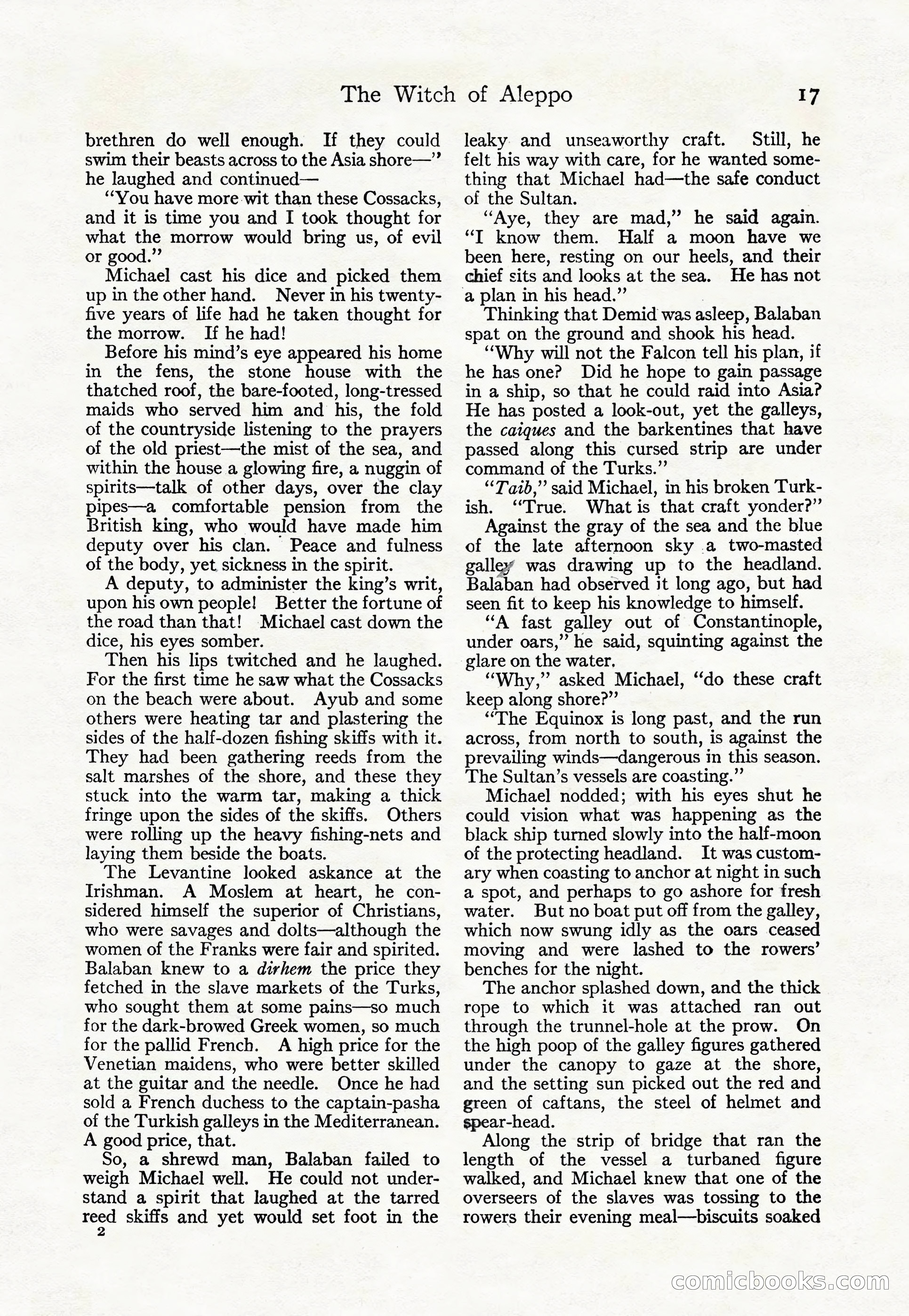
The Witch of Aleppo brethren do well enough. If they could swim their beasts across to the Asia shore—”’ he laughed and continued— ‘“‘You have more-wit than these Cossacks, and it is time you and I took thought for what the morrow would bring us, of evil or good.” Michael cast his dice and picked them up in the other hand. Never in his twenty- five years of life had he taken thought for the morrow. If he had! Before his mind’s eye appeared his home in the fens, the stone house with the thatched roof, the bare-footed, long-tressed maids who served him and his, the fold of the countryside listening to the prayers of the old priest—the mist of the sea, and within the house a glowing fire, a nuggin of spirits—talk of other days, over the clay pipes—a comfortable pension from the British king, who would have made him deputy over his clan. Peace and fulness of the body, yet sickness in the spirit. A deputy, to administer the king’s writ, upon his own people! Better the fortune of the road than that! Michael cast down the dice, his eyes somber. Then his lips twitched and he laughed. For the first time he saw what the Cossacks on the beach were about. Ayub and some others were heating tar and plastering the sides of the half-dozen fishing skiffs with it. They had been gathering reeds from the salt marshes of the shore, and these they stuck into the warm tar, making a thick fringe upon the sides of the skiffs. Others were rolling up the heavy fishing-nets and laying them beside the boats. The Levantine looked askance at the Irishman. A Moslem at heart, he con- sidered himself the superior of Christians, who were savages and dolts—although the women of the Franks were fair and spirited. Balaban knew to a dirhem the price they fetched in the slave markets of the Turks, who sought them at some pains—so much for the dark-browed Greek women, so much for the pallid French. A high price for the Venetian maidens, who were better skilled at the guitar and the needle. Once he had sold a French duchess to the captain-pasha of the Turkish galleys in the Mediterranean. A good price, that. So, a shrewd man, Balaban failed to weigh Michael well. He could not under- stand a spirit that laughed at the tarred reed skiffs and yet would set foot in the 17 leaky. and unseaworthy craft. Still, he felt his way with care, for he wanted some- thing that Michael had—the safe conduct of the Sultan. “Aye, they are mad,” he said again. “T know them. Half a moon have we been here, resting on our heels, and their chief sits and looks at the sea. He has not a plan in his head.” , Thinking that Demid was asleep, Balaban spat on the ground and shook his head. “Why will not the Falcon tell his plan, if he has one? Did he hope to gain passage in a ship, so that he could raid into Asia? He has posted a look-out, yet the galleys, the caiques and the barkentines that have passed along this cursed strip are under command of the Turks.”’ “‘Taib,” said Michael, in his broken Turk- ish. ‘‘True. Whatis that craft yonder?” Against the gray of the sea and the blue of the late afternoon sky .a two-masted galley was drawing up to the headland. Balaban had observed it long ago, but had seen fit to keep his knowledge to himself. “A fast galley out of Constantinople, under oars,” he said, squinting against the glare on the water, “Why,” asked Michael, ‘‘do these craft keep along shore?” “The Equinox is long past, and the run across, from north to south, is against the prevailing winds—dangerous in this season. The Sultan’s vessels are coasting.” Michael nodded; with his eyes shut he could vision what was happening as the black ship turned slowly into the half-moon of the protecting headland. It was custom- ary when coasting to anchor at night in such a spot, and perhaps to go ashore for fresh water. But no boat put off from the galley, which now swung idly as the oars ceased moving and were lashed to the rowers’ benches for the night. The anchor splashed down, and the thick rope to which it was attached ran out through the trunnel-hole at the prow. On the high poop of the galley figures gathered under the canopy to gaze at the shore, and the setting sun picked out the red and green of caftans, the steel of helmet and spear-head. Along the strip of bridge that ran the length of the vessel a turbaned figure walked, and Michael knew that one of the overseers of the slaves was tossing to the rowers their evening meal—biscuits soaked COmiclboolks CO