
Pulp Fiction, 1924 · page 39 of 200
Adventure Magazine Cover — page 39: what you’re looking at
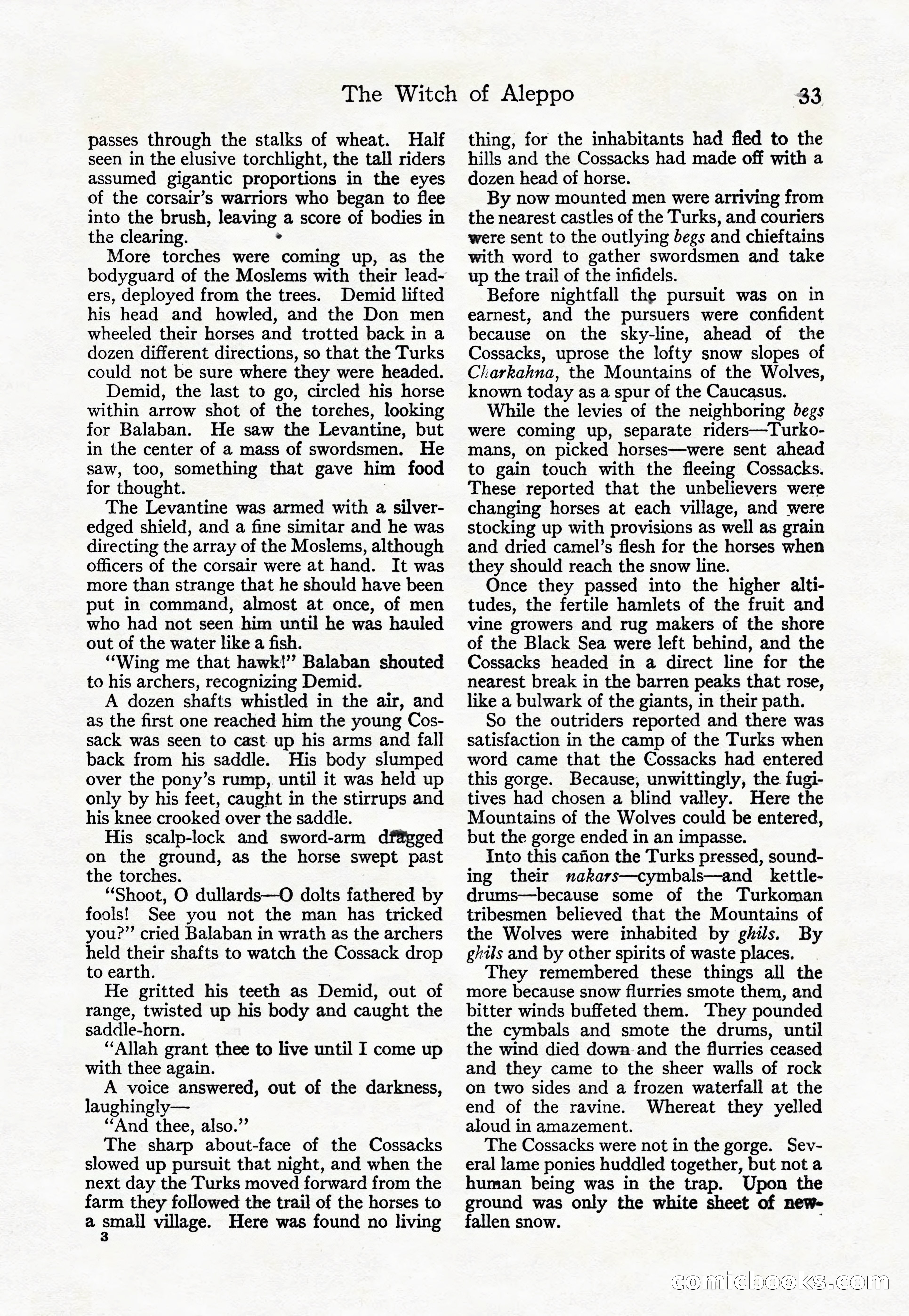
A restored page from Pulp Fiction, 1924. Page through the whole issue in the reader above.
📄 Transcribed text from this page (OCR, searchable)
Machine-transcribed from the original scan — historical spelling and the odd misread are preserved.
The Witch of Aleppo passes through the stalks of wheat. Half seen in the elusive torchlight, the tall riders assumed gigantic proportions in the eyes of the corsair’s warriors who began to flee into the brush, leaving a score of bodies in the clearing. ° More torches were coming up, as the bodyguard of the Moslems with their lead- ers, deployed from the trees. Demid lifted his head and howled, and the Don men wheeled their horses and trotted back in a dozen different directions, so that the Turks could not be sure where they were headed. Demid, the last to go, circled his horse within arrow shot of the torches, looking for Balaban. He saw the Levantine, but in the center of a mass of swordsmen. He saw, too, something that gave him food for thought. : The Levantine was armed with a silver- edged shield, and a fine simitar and he was directing the array of the Moslems, although officers of the corsair were at hand. It was more than strange that he should have been put in command, almost at once, of men who had not seen him until he was hauled out of the water like a fish. “Wing me that hawk!’ Balaban shouted to his archers, recognizing Demid. A dozen shafts whistled in the air, and as the first one reached him the young Cos- sack was seen to cast. up his arms and fall back from his saddle. His body slumped over the pony’s rump, until it was held up only by his feet, caught in the stirrups and his knee crooked over the saddle. His scalp-lock and sword-arm dfégged on the ground, as the horse swept past the torches. ‘Shoot, O dullards—O dolts fathered by fools! See you not the man has tricked you?” cried Balaban in wrath as the archers held their shafts to watch the Cossack drop to earth. He gritted his teeth as Demid, out of range, twisted up his body and caught the saddle-horn. “Allah grant thee to live until I come up with thee again. A voice answered, out of the darkness, laughingly— “‘And thee, also.” The sharp about-face of the Cossacks slowed up pursuit that night, and when the next day the Turks moved forward from the farm they followed the trail of the horses to a small village. Here was found no living 33 thing, for the inhabitants had fled to the hills and the Cossacks had made off with a dozen head of horse. By now mounted men were arriving from the nearest castles of the Turks, and couriers were sent to the outlying begs and chieftains with word to gather swordsmen and take up the trail of the infidels. Before nightfall the pursuit was on in earnest, and the pursuers were confident because on the sky-line, ahead of the Cossacks, uprose the lofty snow slopes of Cliarkahna, the Mountains of the Wolves, known today as a spur of the Caucasus. While the levies of the neighboring begs were coming up, separate riders—Turko- mans, on picked horses—were sent ahead to gain touch with the fleeing Cossacks. These reported that the unbelievers were changing horses at each village, and were stocking up with provisions as well as grain and dried camel’s flesh for the horses when they should reach the snow line. Once they passed into the higher alti- tudes, the fertile hamlets of the fruit and vine growers and rug makers of the shore of the Black Sea were left behind, and the Cossacks headed in a direct line for the nearest break in the barren peaks that rose, like a bulwark of the giants, in their path. So the outriders reported and there was satisfaction in the camp of the Turks when word came that the Cossacks had entered this gorge. Because, unwittingly, the fugi- tives had chosen a blind valley. Here the Mountains of the Wolves could be entered, but the gorge ended in an impasse. Into this cafion the Turks pressed, sound- ing their nakars—cymbals—and kettle- drums—because some of the Turkoman tribesmen believed that the Mountains of the Wolves were inhabited by ghils. By ghtls and by other spirits of waste places. They remembered these things all the more because snow flurries smote them, and bitter winds buffeted them. They pounded the cymbals and smote the drums, until the wind died down-and the flurries ceased and they came to the sheer walls of rock on two sides and a frozen waterfall at the end of the ravine. Whereat they yelled aloud in amazement. The Cossacks were not in the gorge. Sev- eral lame ponies huddled together, but not a human being was in the trap. Upon the ground was only the white sheet of new- fallen snow. COmiclbook ©