
Pulp Fiction, 1924 · page 57 of 200
Adventure Magazine Cover — page 57: what you’re looking at
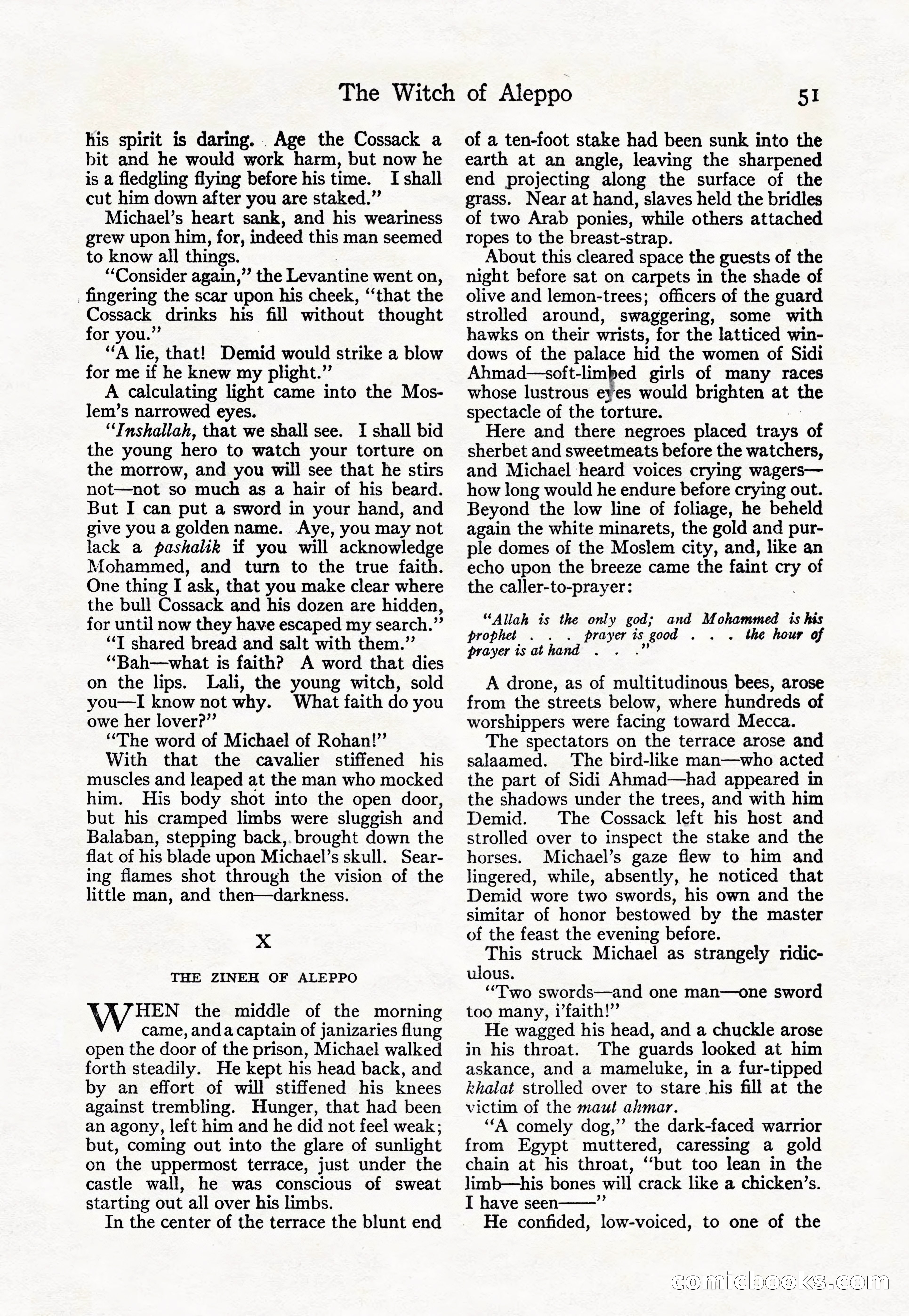
A restored page from Pulp Fiction, 1924. Page through the whole issue in the reader above.
📄 Transcribed text from this page (OCR, searchable)
Machine-transcribed from the original scan — historical spelling and the odd misread are preserved.
The Witch of Aleppo his spirit is daring. . Age the Cossack a bit and he would work harm, but now he is a fledgling flying before his time. I shall cut him down after you are staked.” Michael’s heart sank, and his weariness grew upon him, for, indeed this man seemed to know all things. “Consider again,” the Levantine went on, _fingering the scar upon his cheek, ‘‘that the Cossack drinks his fill without thought for you.” ‘fA lie, that! Demid would strike a blow for me if he knew my plight.” A calculating light came into the Mos- lem’s narrowed eyes. ““Inshallah, that we shall see. I shall bid the young hero to watch your torture on the morrow, and you will see that he stirs not—not so much as a hair of his beard. But I can put a sword in your hand, and give you a golden name. Aye, you may not lack a pashalik if you will acknowledge Mohammed, and turn to the true faith. One thing I ask, that you make clear where the bull Cossack and his dozen are hidden, for until now they have escaped my search.”’ “TI shared bread and salt with them.”’ “‘Bah—what is faith? A word that dies on the lips. Lali, the young witch, sold you—I know not why. What faith do you owe her lover?”’ “The word of Michael of Rohan!” With that the cavalier stiffened his muscles and leaped at the man who mocked him. His body shot into the open door, but his cramped limbs were sluggish and Balaban, stepping back,. brought down the flat of his blade upon Michael’s skull. Sear- ing flames shot through the vision of the little man, and then—darkness. Xx THE ZINEH OF ALEPPO Vy HEN the middle of the morning came, andacaptain of janizaries flung open the door of the prison, Michael walked forth steadily. He kept his head back, and by an effort of will stiffened his knees against trembling. Hunger, that had been an agony, left him and he did not feel weak; but, coming out into the glare of sunlight on the uppermost terrace, just under the castle wall, he was conscious of sweat starting out all over his limbs. In the center of the terrace the blunt end 51 of a ten-foot stake had been sunk into the earth at an angle, leaving the sharpened end projecting along the surface of the grass. Near at hand, slaves held the bridles of two Arab ponies, while others attached ropes to the breast-strap. About this cleared space the guests of the night before sat on carpets in the shade of olive and lemon-trees; officers of the guard strolled around, swaggering, some with hawks on their wrists, for the latticed win- dows of the palace hid the women of Sidi Ahmad—sof t-limped girls of many races whose lustrous eyes would brighten at the spectacle of the torture. Here and there negroes placed trays of sherbet and sweetmeats before the watchers, and Michael heard voices crying wagers— how long would he endure before crying out. Beyond the low line of foliage, he beheld again the white minarets, the gold and pur- ple domes of the Moslem city, and, like an echo upon the breeze came the faint cry of the caller-to-prayer: and Mohammed is his “Allah is the only god; . the hour of prophet . . . prayeris good . . prayerisathand . . .” A drone, as of multitudinous bees, arose from the streets below, where hundreds of worshippers were facing toward Mecca. The spectators on the terrace arose and salaamed. The bird-like man—who acted the part of Sidi Ahmad—had appeared in the shadows under the trees, and with him Demid. The Cossack left his host and strolled over to inspect the stake and the horses. Michael’s gaze flew to him and lingered, while, absently, he noticed that Demid wore two swords, his own and the simitar of honor bestowed by the master of the feast the evening before. This struck Michael as strangely ridic- ulous. “Two swords—and one man—one sword too many, i’faith!”’ He wagged his head, and a chuckle arose in his throat. The guards looked at him askance, and a mameluke, in a fur-tipped khalat strolled over to stare his fill at the victim of the maut ahmar. ‘“‘A comely dog,” the dark-faced warrior from Egypt muttered, caressing a gold chain at his throat, ‘‘but too lean in the limb—his bones will crack like a chicken’s. I have seen i He confided, low-voiced, to one of the cCOmiclboolks (©