
Pulp Fiction, 1924 · page 73 of 200
Adventure Magazine Cover — page 73: what you’re looking at
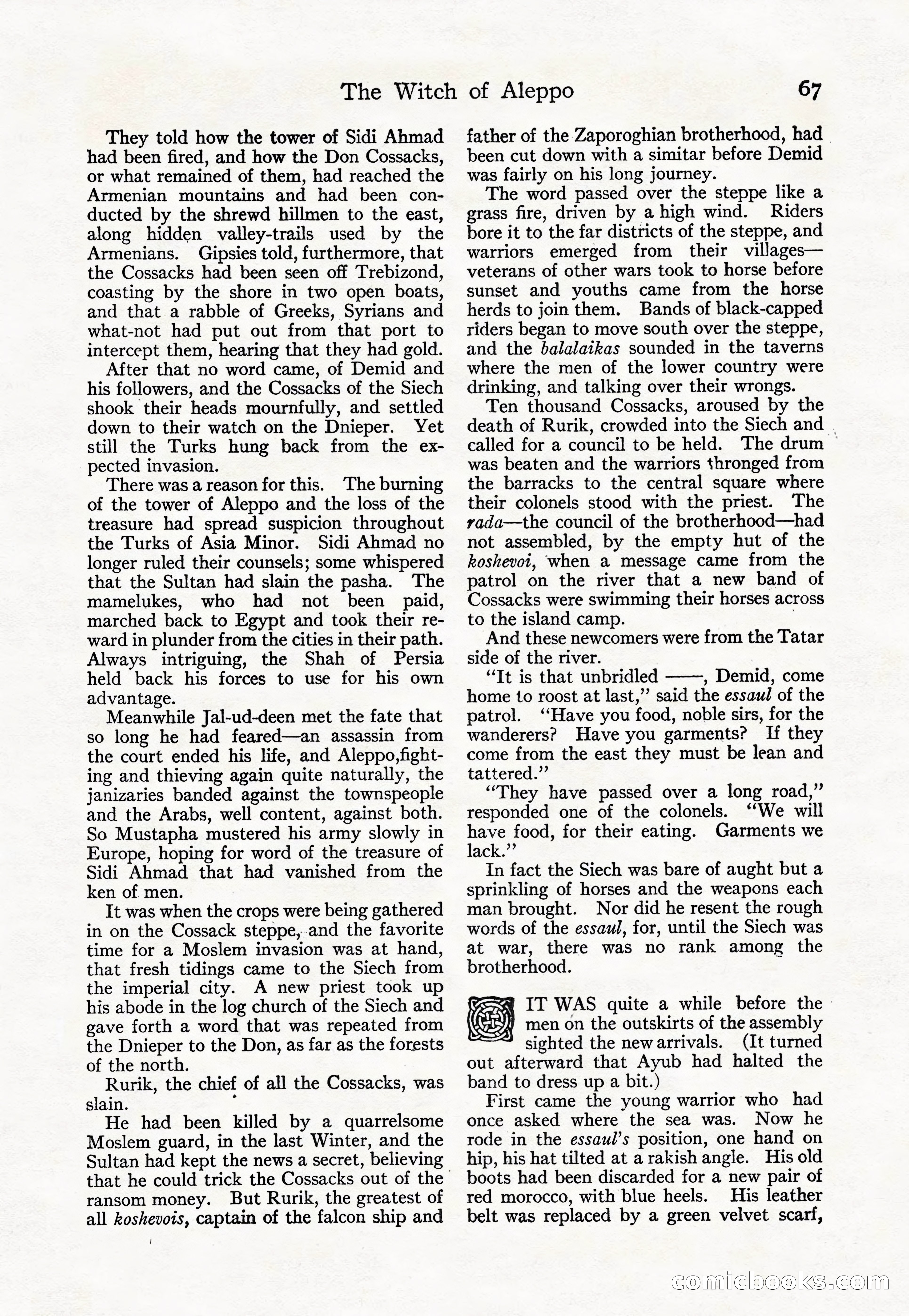
A restored page from Pulp Fiction, 1924. Page through the whole issue in the reader above.
📄 Transcribed text from this page (OCR, searchable)
Machine-transcribed from the original scan — historical spelling and the odd misread are preserved.
The Witch of Aleppo They told how the tower of Sidi Ahmad had been fired, and how the Don Cossacks, or what remained of them, had reached the Armenian mountains and had been con- ducted by the shrewd hillmen to the east, along hidden valley-trails used by the Armenians. Gipsies told, furthermore, that the Cossacks had been seen off Trebizond, coasting by the shore in two open boats, and that a rabble of Greeks, Syrians and what-not had put out from that port to intercept them, hearing that they had gold. After that no word came, of Demid and his followers, and the Cossacks of the Siech shook their heads mournfully, and settled down to their watch on the Dnieper. Yet still the Turks hung back from the ex- pected invasion. There was a reason for this. The burning of the tower of Aleppo and the loss of the treasure had spread suspicion throughout the Turks of Asia Minor. Sidi Ahmad no longer ruled their counsels; some whispered that the Sultan had slain the pasha. The mamelukes, who had not been paid, marched back to Egypt and took their re- ward in plunder from the cities in their path. Always intriguing, the Shah of Persia held back his forces to use for his own advantage. Meanwhile Jal-ud-deen met the fate that so long he had feared—an assassin from the court ended his life, and Aleppo,fight- ing and thieving again quite naturally, the janizaries banded against the townspeople and the Arabs, well content, against both. So Mustapha mustered his army slowly in Europe, hoping for word of the treasure of Sidi Ahmad that had vanished from the ken of men. It was when the crops were being gathered in on the Cossack steppe,-and the favorite time for a Moslem invasion was at hand, that fresh tidings came to the Siech from the imperial city. A new priest took up his abode in the log church of the Siech and gave forth a word that was repeated from the Dnieper to the Don, as far as the forests of the north. : Rurik, the chief of all the Cossacks, was slain. : He had been killed by a quarrelsome Moslem guard, in the last Winter, and the Sultan had kept the news a secret, believing that he could trick the Cossacks out of the ransom money. But Rurik, the greatest of all koshevois, captain of the falcon ship and ' 67 father of the Zaporoghian brotherhood, had _ been cut down with a simitar before Demid was fairly on his long journey. The word passed over the steppe like a grass fire, driven by a high wind. Riders bore it to the far districts of the steppe, and warriors emerged from their villages— veterans of other wars took to horse before sunset and youths came from the horse herds to join them. Bands of black-capped riders began to move south over the steppe, and the balalaikas sounded in the taverns where the men of the lower country were drinking, and talking over their wrongs. Ten thousand Cossacks, aroused by the death of Rurik, crowded into the Siech and . called for a council to be held. The drum — was beaten and the warriors thronged from the barracks to the central square where their colonels stood with the priest. The vada—the council of the brotherhood—had not assembled, by the empty hut of the koshevoit, when a message came from the patrol on the river that a new band of Cossacks were swimming their horses across to the island camp. | And these newcomers were from the Tatar side of the river. | “It is that unbridled , Demid, come home to roost at last,”’ said the essaul of the patrol. ‘Have you food, noble sirs, for the wanderers? Have you garments? If they come from the east they must be lean and tattered.”’ “They have passed over a long road,” responded one of the colonels. ‘‘We will have food, for their eating. Garments we lack.” In fact the Siech was bare of aught but a sprinkling of horses and the weapons each man brought. Nor did he resent the rough words of the essaul, for, until the Siech was at war, there was no rank among the brotherhood. Vem IT WAS quite a while before the (Gn # men on the outskirts of the assembly = sighted the newarrivals. (It turned out afterward that Ayub had halted the band to dress up a bit.) First came the young warrior who had once asked where the sea was. Now he rode in the essaul’s position, one hand on hip, his hat tilted at arakish angle. His old boots had been discarded for a new pair of red morocco, with blue heels. His leather belt was replaced by a green velvet scarf, COmiclboolks ©