
Pulp Fiction, 1924 · page 89 of 200
Adventure Magazine Cover — page 89: what you’re looking at
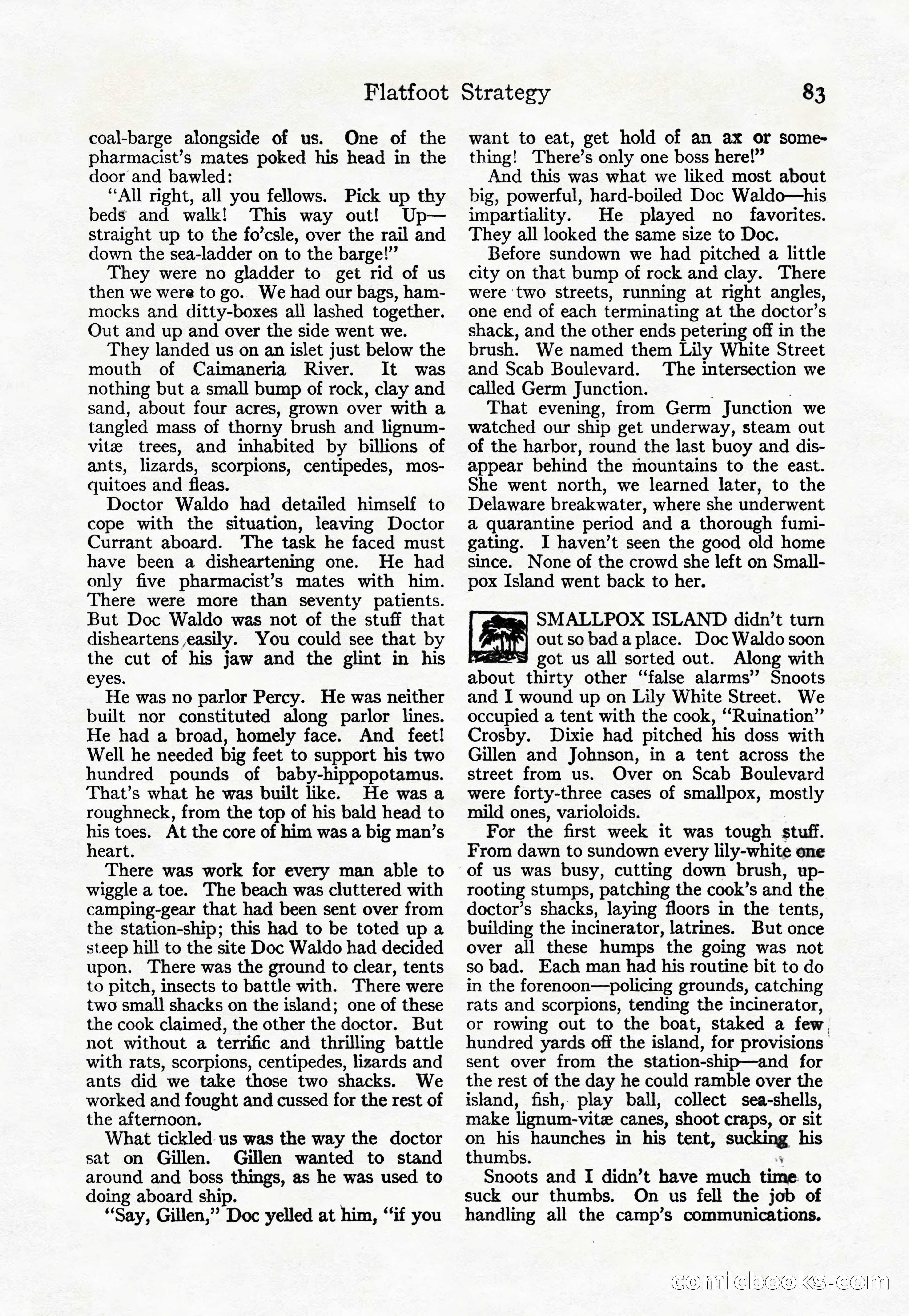
A restored page from Pulp Fiction, 1924. Page through the whole issue in the reader above.
📄 Transcribed text from this page (OCR, searchable)
Machine-transcribed from the original scan — historical spelling and the odd misread are preserved.
Flatfoot Strategy coal-barge alongside of us. One of the pharmacist’s mates poked his head in the door and bawled: “All right, all you fellows. Pick up thy beds and walk! This way out! Up— straight up to the fo’csle, over the rail and down the sea-ladder on to the barge!” They were no gladder to get rid of us then we were to go.. We had our bags, ham- mocks and ditty-boxes all lashed together. Out and up and over the side went we. They landed us on an islet just below the mouth of Caimaneria River. It was nothing but a small bump of rock, clay and sand, about four acres, grown over with a tangled mass of thorny brush and lignum- vite trees, and inhabited by billions of ants, lizards, scorpions, centipedes, mos- quitoes and fleas. Doctor Waldo had detailed himself to cope with the situation, leaving Doctor Currant aboard. The task he faced must have been a disheartening one. He had only five pharmacist’s mates with him. There were more than seventy patients. But Doc Waldo was not of the stuff that disheartens ,easily. You could see that by the cut of his jaw and the glint in his eyes. He was no parlor Percy. He was neither built nor constituted along parlor lines. He had a broad, homely face. And feet! Well he needed big feet to support his two hundred pounds of baby-hippopotamus. That’s what he was built like. He was a roughneck, from the top of his bald head to his toes. At the core of him was a big man’s heart. There was work for every man able to wiggle a toe. The beach was cluttered with camping-gear that had been sent over from the station-ship; this had to be toted up a steep hill to the site Doc Waldo had decided upon. There was the ground to clear, tents to pitch, insects to battle with. There were two small shacks on the island; one of these the cook claimed, the other the doctor. But not without a terrific and thrilling battle with rats, scorpions, centipedes, lizards and ants did we take those two shacks. We worked and fought and cussed for the rest of the afternoon. What tickled us was the way the doctor sat on Gillen. Gillen wanted to stand around and boss things, as he was used to doing aboard ship. “Say, Gillen,” Doc yelled at him, “if you 83 want to eat, get hold of an ax or some- thing! T here’s only one boss here!”’ And this was what we liked most about big, powerful, hard-boiled Doc Waldo—his impartiality. He played no _ favorites. They all looked the same size to Doc. Before sundown we had pitched a little city on that bump of rock and clay. There were two streets, running at right angles, one end of each terminating at the doctor’s shack, and the other ends petering off in the brush. We named them Lily White Street and Scab Boulevard. The intersection we called Germ Junction. That evening, from Germ Junction we watched our ship get underway, steam out of the harbor, round the last buoy and dis- appear behind the mountains to the east. She went north, we learned later, to the Delaware breakwater, where she underwent a quarantine period and a thorough fumi- gating. I haven’t seen the good old home since. None of the crowd she left on Small- pox Island went back to her. ae) SMALLPOX ISLAND didn’t turn iii out so badaplace. Doc Waldo soon S got us all sorted out. Along with shone thirty other ‘‘false alarms’ Snoots and I wound up on Lily White Street. We occupied a tent with the cook, ‘‘Ruination”’ Crosby. Dixie had pitched his doss with Gillen and Johnson, in a tent across the street from us. Over on Scab Boulevard were forty-three cases of smallpox, mostly mild ones, varioloids. For the first week it was tough stuff. From dawn to sundown every lily-white one of us was busy, cutting down brush, up- rooting stumps, patching the cook’s and the doctor’s shacks, laying floors in the tents, building the incinerator, latrines. But once over all these humps the going was not so bad. Each man had his routine bit to do in the forenoon—policing grounds, catching rats and scorpions, tending the incinerator, or rowing out to the boat, staked a few) hundred yards off the island, for provisions | sent over from the station-ship—and for the rest of the day he could ramble over the island, fish, play ball, collect sea-shells, make lignum-vitz canes, shoot craps, or sit on his haunches in his tent, ance his thumbs. Snoots and I didn’t have much time to suck our thumbs. On us fell the job of handling all the camp’s communications. COmiclboolks (©