
Pulp Fiction, 1924 · page 99 of 200
Adventure Magazine Cover — page 99: what you’re looking at
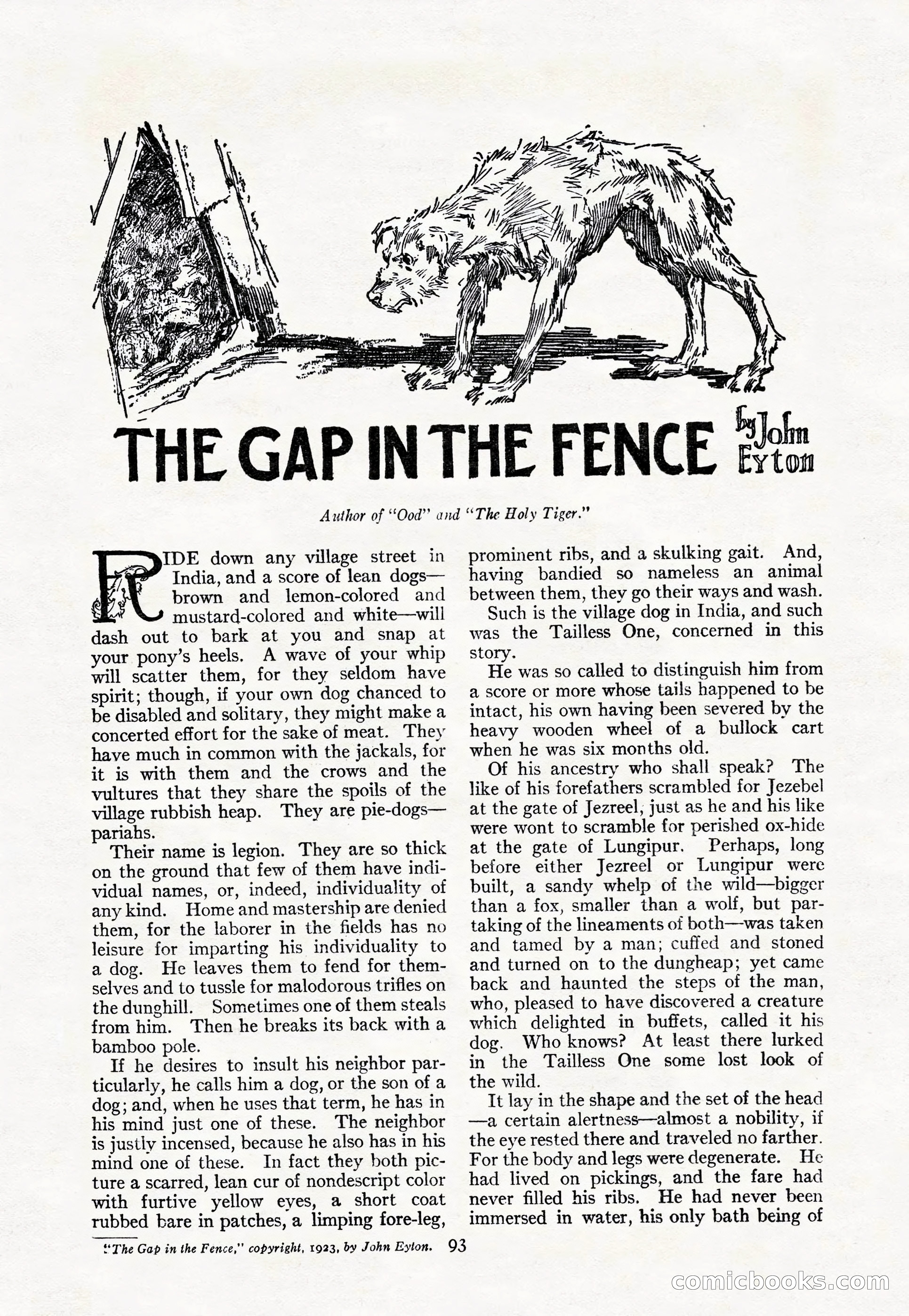
A restored page from Pulp Fiction, 1924. Page through the whole issue in the reader above.
📄 Transcribed text from this page (OCR, searchable)
Machine-transcribed from the original scan — historical spelling and the odd misread are preserved.
Px are, THE GAP INTHE FENCE i by Jofin Eyton = . ZY Author of ‘‘Ood’’ and “The Holy Tiger.” IDE down any village street in India, and a score of lean dogs— brown and lemon-colored and mustard-colored and white—will dash out to bark at you and snap at your pony’s heels. A wave of your whip will scatter them, for they seldom have spirit; though, if your own dog chanced to be disabled and solitary, they might make a concerted effort for the sake of meat. They have much in common with the jackals, for it is with them and the crows and the vultures that they share the spoils of the village rubbish heap. They are pie-dogs— pariahs. Their name is legion. They are so thick on the ground that few of them have indi- vidual names, or, indeed, individuality of any kind. Home and mastership are denied them, for the laborer in the fields has no leisure for imparting his individuality to a dog. He leaves them to fend for them- selves and to tussle for malodorous trifles on the dunghill. Sometimes one of them steals from him. Then he breaks its back with a bamboo pole. If he desires to insult his neighbor par- ticularly, he calls him a dog, or the son of a dog; and, when he uses that term, he has in his mind just one of these. The neighbor is justly incensed, because he also has in his mind one of these. In fact they both pic- ture a scarred, lean cur of nondescript color with furtive yellow eyes, a short coat rubbed bare in patches, a limping fore-leg, “The Gap in the Fence," copyright, 1923, by John Eyton. 93 prominent ribs, and a skulking gait. And, having bandied so nameless an animal between them, they go their ways and wash. Such is the village dog in India, and such was the Tailless One, concerned in this story. He was so called to distinguish him from a score or more whose tails happened to be intact, his own having been severed by the heavy wooden wheel of a bullock cart when he was six months old. Of his ancestry who shall speak? The like of his forefathers scrambled for Jezebel at the gate of Jezreel, just as he and his like were wont to scramble for perished ox-hide at the gate of Lungipur. Perhaps, long before either Jezreel or Lungipur were built, a sandy whelp of the wild—bigger than a fox, smaller than a wolf, but par- taking of the lineaments of both—was taken and tamed by a man; cuffed and stoned and turned on to the dungheap; yet came back and haunted the steps of the man, who, pleased to have discovered a creature which delighted in buffets, called it his dog. Who knows? At least there lurked in the Tailless One some lost look of the wild. It lay in the shape and the set of the head —a certain alertness—almost a nobility, if the eye rested there and traveled no farther. For the body and legs were degenerate. He had lived on pickings, and the fare had never filled his ribs. He had never been immersed in water, his only bath being of oO COMGHOO S (© S|