
Pulp Fiction, 1924 · page 10 of 196
Adventure Magazine, April 10, 1924 — page 10: what you’re looking at
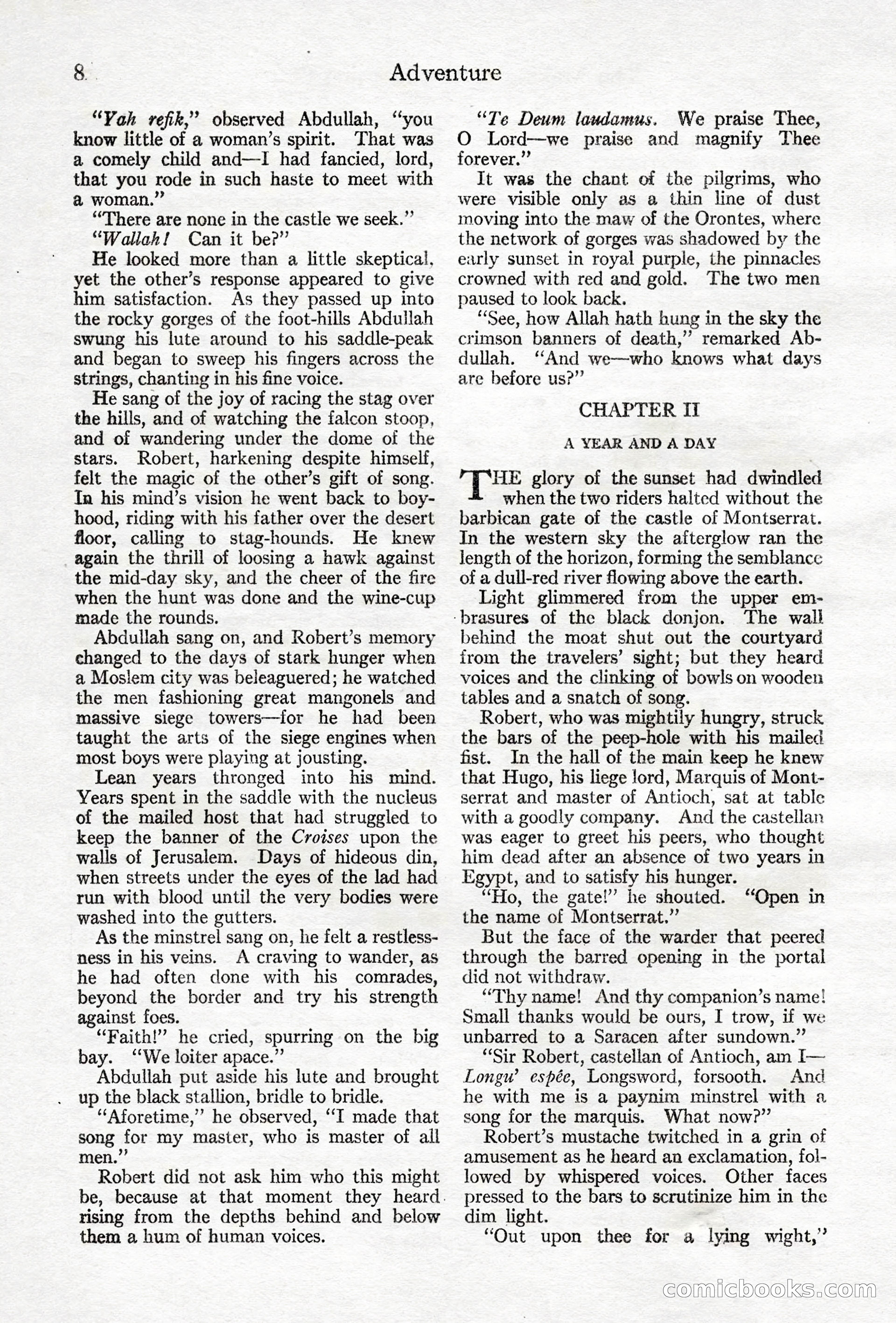
A restored page from Pulp Fiction, 1924. Page through the whole issue in the reader above.
📄 Transcribed text from this page (OCR, searchable)
Machine-transcribed from the original scan — historical spelling and the odd misread are preserved.
8. Adventure “Yah refik,’ observed Abdullah, “you know little of a woman’s spirit. That was a comely child and—I had fancied, lord, that you rode in such haste to meet with @ woman.” “There are none in the castle we seek.” “Wallah! Can it be?” He looked more than a little skeptical, yet the other’s response appeared to give him satisfaction. As they passed up into the rocky gorges of the foot-hills Abdullah swung his lute around to his saddle-peak and began to sweep his fingers across the strings, chanting in his fine voice. He sang of the joy of racing the stag over the hills, and of watching the falcon stoop, and of wandering under the dome of the stars. Robert, harkening despite himself, felt the magic of the other’s gift of song. In his mind’s vision he went back to boy- hood, riding with his father over the desert floor, calling to stag-hounds. He knew again the thrill of loosing a hawk against the mid-day sky, and the cheer of the fire when the hunt was done and the wine-cup made the rounds. Abdullah sang on, and Robert’s memory changed to the days of stark hunger when a Mosiem city was beleaguered; he watched the men fashioning great mangonels and massive siege towers—for he had been taught the arts of the siege engines when most boys were playing at jousting. Lean years thronged into his mind. Years spent in the saddle with the nucleus of the mailed host that had struggled to keep the banner of the Croises upon the walls of Jerusalem. Days of hideous din, when streets under the eyes of the lad had run with blood until the very bodies were washed into the gutters. As the minstrel sang on, he felt a restless- ness in his veins. A craving to wander, as he had often done with his comrades, beyond the border and try his strength against foes. “Faith!” he cried, spurring on the big bay. ‘We loiter apace.” Abdullah put aside his lute and brought up the black stallion, bridle to bridle. ‘“‘Aforetime,’”’ he observed, “‘I made that song for my master, who is master of all men.” Robert did not ask him who this might be, because at that moment they heard. rising from the depths behind and below them a hum of human voices. -brasures of the black donjon. “Te Deum laudamus. We praise Thee, O Lord—we praise and magnify Thee forever.”’ It was the chant of the pilgrims, who were visible only as a thin line of dust moving into the maw of the Orontes, where the network of gorges was shadowed by the early sunset in royal purple, the pinnacles crowned with red and gold. The two men paused to look back. ‘See, how Allah hath hung in the sky the crimson banners of death,” remarked Ab- dullah. ‘And we—who knows what days are before us?” CHAPTER Ii A YEAR AND A DAY g BS glory of the sunset had dwindled when the two riders halted without the barbican gate of the castle of Montserrat. In the western sky the afterglow ran the length of the horizon, forming the semblance of a dull-red river flowing above the earth. Light glimmered from the upper em- The wall behind the moat shut out the courtyard irom the travelers’ sight; but they heard voices and the clinking of bowls on wooden tables and a snatch of song. Robert, who was mightily hungry, struck the bars of the peep-hole with his mailed fist. In the hall of the main keep he knew that Hugo, his liege lord, Marquis of Mont- serrat and master of Antioch, sat at table with a goodly company. And the castellan was eager to greet his peers, who thought him dead after an absence of two years in Egypt, and to satisfy his hunger. “Ho, the gate!’ he shouted. the name of Montserrat.” But the face of the warder that peered through the barred opening in the portal did not withdraw. “Thy name! And thy companion’s name! Small thanks would be ours, I trow, if we unbarred to a Saracen after sundown.” “Sir Robert, castellan of Antioch, am I— Longu’ espée, Longsword, forsooth. And he with me is a paynim minstrel with a song for the marquis. What now?” Robert’s mustache twitched in a grin of amusement as he heard an exclamation, fol- lowed by whispered voices. Other faces pressed to the bars to scrutinize him in the dim light. “Out upon thee for a lying wight,” “Open in GomicdooksEeo S|