
Pulp Fiction, 1924 · page 100 of 196
Adventure Magazine, April 10, 1924 — page 100: what you’re looking at
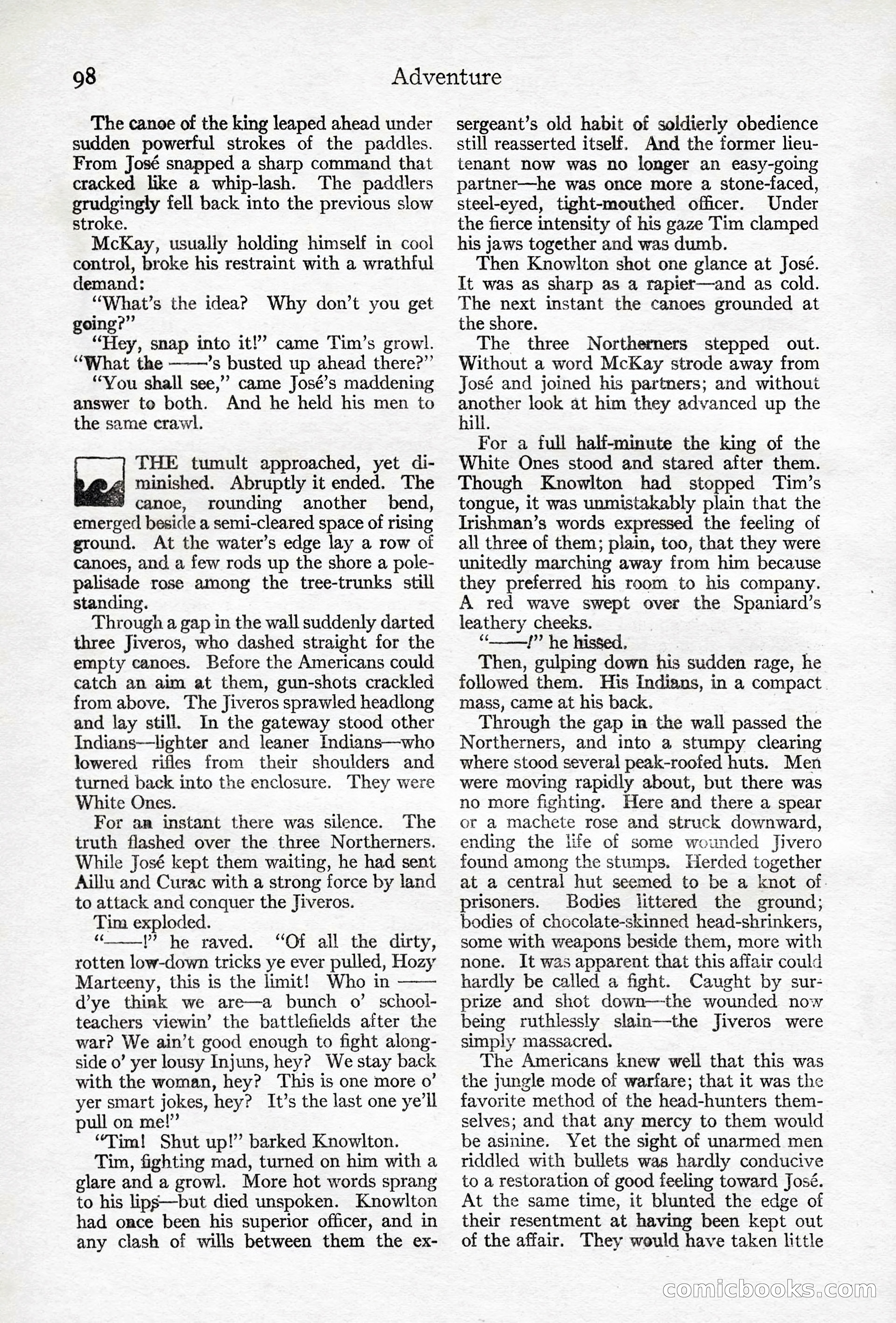
A restored page from Pulp Fiction, 1924. Page through the whole issue in the reader above.
📄 Transcribed text from this page (OCR, searchable)
Machine-transcribed from the original scan — historical spelling and the odd misread are preserved.
98 Adventure The canoe of the king leaped ahead under sudden powerful strokes of the paddles. From José snapped a sharp command that cracked like a whip-lash. The paddlers grudgingly fell back into the previous slow stroke. McKay, usually holding himself in cool control, broke his restraint with a wrathful demand: “What’s the idea? Why don’t you get going?” “Hey, snap into it!” came Tim’s growl. “What the ——’s busted up ahead there?”’ “You shall see,”’ came José’s maddening answer to both. And he held his men to the same crawl. THE tumult approached, yet di- ai minished. Abruptly it ended. The £8 canoe, rounding another bend, emerged besicle a semi-cleared space of rising ground. At the water’s edge lay a row of canoes, and a few rods up the shore a pole- palisade rose among the tree-trunks still standing. Through a gap in the wall suddenly darted three Jiveros, who dashed straight for the empty canoes. Before the Americans could catch an aim at them, gun-shots crackled from above. The Jiveros sprawled headlong and lay still. In the gateway stood other Indians—lighter and leaner Indians—who lowered rifles from their shoulders and turned back into the enclosure. They were White Ones. For aa instant there was silence. The truth flashed over the three Northerners. While José kept them waiting, he had sent Aillu and Curac with a strong force by land to attack and conquer the Jiveros. Tim exploded. “<___'? he raved. “Of all the dirty, rotten low-down tricks ye ever pulled, Hozy Marteeny, this is the limit! Who in d’ye think we are—a bunch o’ school- teachers viewin’ the battlefields after the war? We ain’t good enough to fight along- side o’ yer lousy Injuns, hey? We stay back with the woman, hey? This is one more 0’ yer smart jokes, hey? It’s the last one ye’ll pull on me!” “Tim! Shut up!” barked Knowlton. Tim, fighting mad, turned on him with a glare and a growl. More hot words sprang to his lips—but died unspoken. Knowlton had once been his superior officer, and in any clash of wills between them the ex- sergeant’s old habit of soldierly obedience still reasserted itself. And the former lieu- tenant now was no longer an easy-going partner—he was once more a stone-faced, steel-eyed, tight-mouthed officer. Under the fierce intensity of his gaze Tim clamped his jaws together and was dumb. Then Knowlton shot one glance at José. It was as sharp as a rapier—and as cold. The next instant the canoes grounded at the shore. The three Northerners stepped out. Without a word McKay strode away from José and joined his partners; and without another look at him they advanced up the hill. For a full half-minute the king of the White Ones stood and stared after them. Though Knowlton had stopped Tim’s tongue, it was unmistakably plain that the Irishman’s words expressed the feeling of all three of them; plain, too, that they were unitedly marching away from him because they preferred his room to his company. A red wave swept over the Spaniard’s leathery cheeks. ‘‘___1”” he hissed, : Then, gulping down his sudden rage, he followed them. His Indians, in a compact. mass, came at his back. Through the gap in the wall passed the Northerners, and into a stumpy clearing where stood several peak-roofed huts. Men were moving rapidly about, but there was no more fighting. Here and there a spear or a machete rose and struck downward, ending the life of some wounded Jivero found among the stumps. Herded together at a central hut seemed to be a knot of. prisoners. Bodies littered the ground; bodies of chocolate-skinned head-shrinkers, some with weapons beside them, more with none. It was apparent that this affair could hardly be called a fight. Caught by sur- prize and shot down—the wounded now being ruthlessly slain—the Jiveros were simply massacred. The Americans knew well that this was the jungle mode of warfare; that it was the favorite method of the head-hunters them- selves; and that any mercy to them would be asinine. Yet the sight of unarmed men riddled with bullets was hardly conducive to a restoration of good feeling toward José. At the same time, it blunted the edge of their resentment at having been kept out of the affair. They would have taken little COMICLOOCkKKS. GO 5}