
Pulp Fiction, 1924 · page 110 of 196
Adventure Magazine, April 10, 1924 — page 110: what you’re looking at
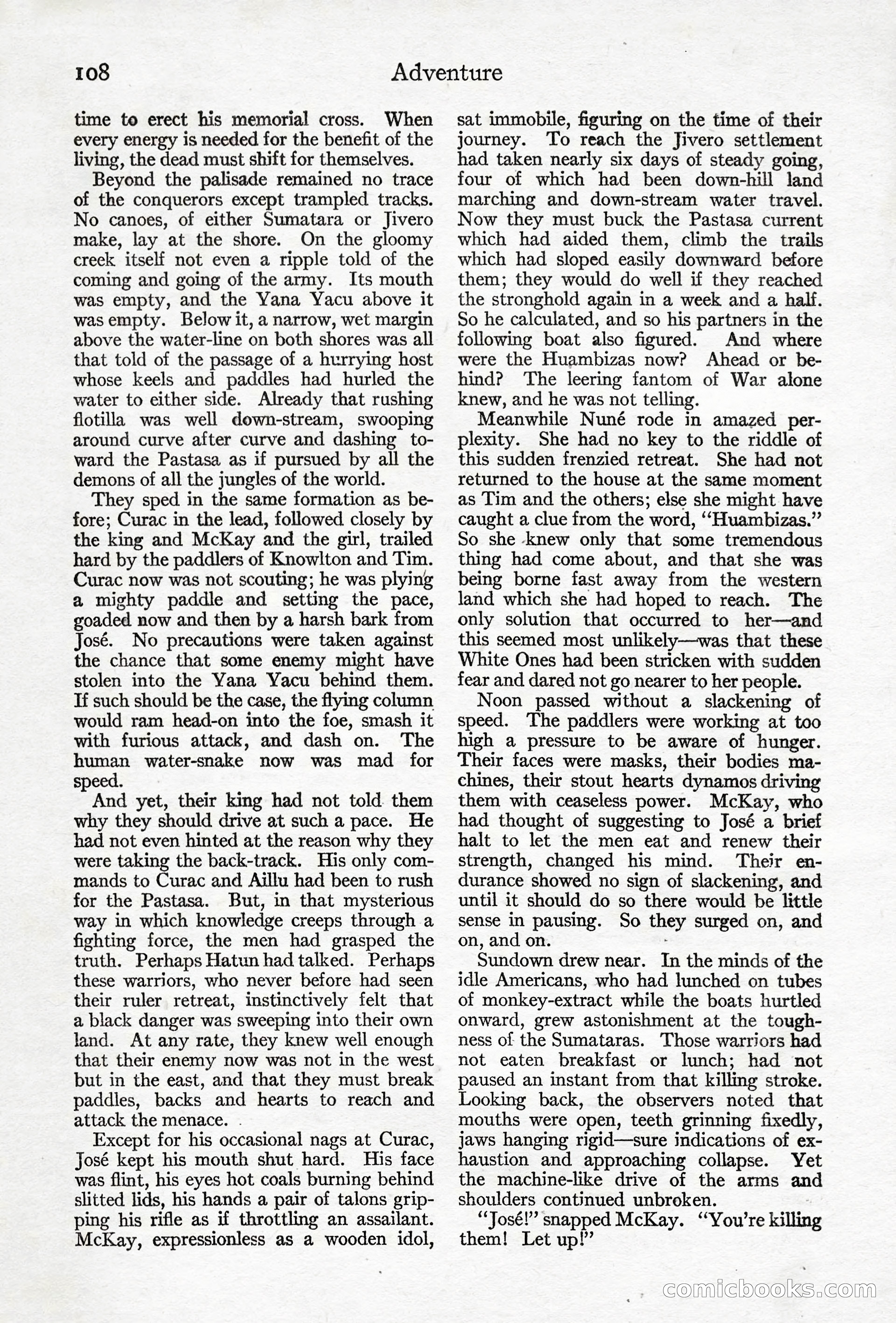
A restored page from Pulp Fiction, 1924. Page through the whole issue in the reader above.
📄 Transcribed text from this page (OCR, searchable)
Machine-transcribed from the original scan — historical spelling and the odd misread are preserved.
108 time to erect his memorial cross. When every energy is needed for the benefit of the living, the dead must shift for themselves. Beyond the palisade remained no trace of the conquerors except trampled tracks. No canoes, of either Sumatara or Jivero make, lay at the shore. On the gloomy creek itself not even a ripple told of the coming and going of the army. Its mouth was empty, and the Yana Yacu above it wasempty. Below it, a narrow, wet margin above the water-line on both shores was all that told of the passage of a hurrying host whose keels and paddles had hurled the water to either side. Already that rushing flotilla was well down-stream, swooping around curve after curve and dashing to- ward the Pastasa as if pursued by all the demons of all the jungles of the world. They sped in the same formation as be- fore; Curac in the lead, followed closely by the king and McKay and the girl, trailed hard by the paddlers of Knowlton and Tim. Curac now was not scouting; he was plying a mighty paddle and setting the pace, goaded now and then by a harsh bark from José. No precautions were taken against the chance that some enemy might have stolen into the Yana Yacu behind them. If such should be the case, the flying column would ram head-on into the foe, smash it with furious attack, and dash on. The human water-snake now was mad for speed. And yet, their king had not told. them why they should drive at such a pace. He had not even hinted at the reason why they were taking the back-track. His only com- mands to Curac and Aillu had been to rush for the Pastasa. But, in that mysterious way in which knowledge creeps through a fighting force, the men had grasped the truth. Perhaps Hatun had talked. Perhaps these warriors, who never before had seen their ruler retreat, instinctively felt that a black danger was sweeping into their own land. At any rate, they knew well enough that their enemy now was not in the west but in the east, and that they must break paddles, backs and hearts to reach and attack the menace. . Except for his occasional nags at Curac, José kept his mouth shut hard. His face was flint, his eyes hot coals burning behind slitted lids, his hands a pair of talons grip- ping his rifle as if throttling an assailant. McKay, expressionless as a wooden idol, Adventure sat immobile, figuring on the time of their journey. To reach the Jivero settlement had taken nearly six days of steady going, four of which had been down-hill land marching and down-stream water travel. Now they must buck the Pastasa current which had aided them, climb the trails which had sloped easily downward before them; they would do well if they reached the stronghold again in a week and a half. So he calculated, and so his partners in the following boat also figured. And where were the Huambizas now? Ahead or be- hind? The leering fantom of War alone knew, and he was not telling. Meanwhile Nuné rode in amazed per- plexity. She had no key to the riddle of this sudden frenzied retreat. She had not returned to the house at the same moment as Tim and the others; else she might have caught a clue from the word, ‘“‘Huambizas.”’ So she knew only that some tremendous thing had come about, and that she was being borne fast away from the western land which she had hoped to reach. The only solution that occurred to her—and this seemed most unlikely—was that these White Ones had been stricken with sudden fear and dared not go nearer to her people. Noon passed without a slackening of speed. The paddlers were working at too high a pressure to be aware of hunger. Their faces were masks, their bodies ma- chines, their stout hearts dynamos driving them with ceaseless power. McKay, who had thought of suggesting to José a brief halt to let the men eat and renew their strength, changed his mind. Their en- durance showed no sign of slackening, and until it should do so there would be little sense in pausing. So they surged on, and on, and on. Sundown drew near. In the minds of the idle Americans, who had lunched on tubes of monkey-extract while the boats hurtled onward, grew astonishment at the tough- ness of the Sumataras. Those warriors had not eaten breakfast or lunch; had not paused an instant from that killing stroke. Looking back, the observers noted that mouths were open, teeth grinning fixedly, jaws hanging rigid—sure indications of ex- haustion and approaching collapse. Yet the machine-like drive of the arms and shoulders continued unbroken. “José!” snapped McKay. “You're killing them! Let up!” S COmicloo C@