
Pulp Fiction, 1924 · page 120 of 196
Adventure Magazine, April 10, 1924 — page 120: what you’re looking at
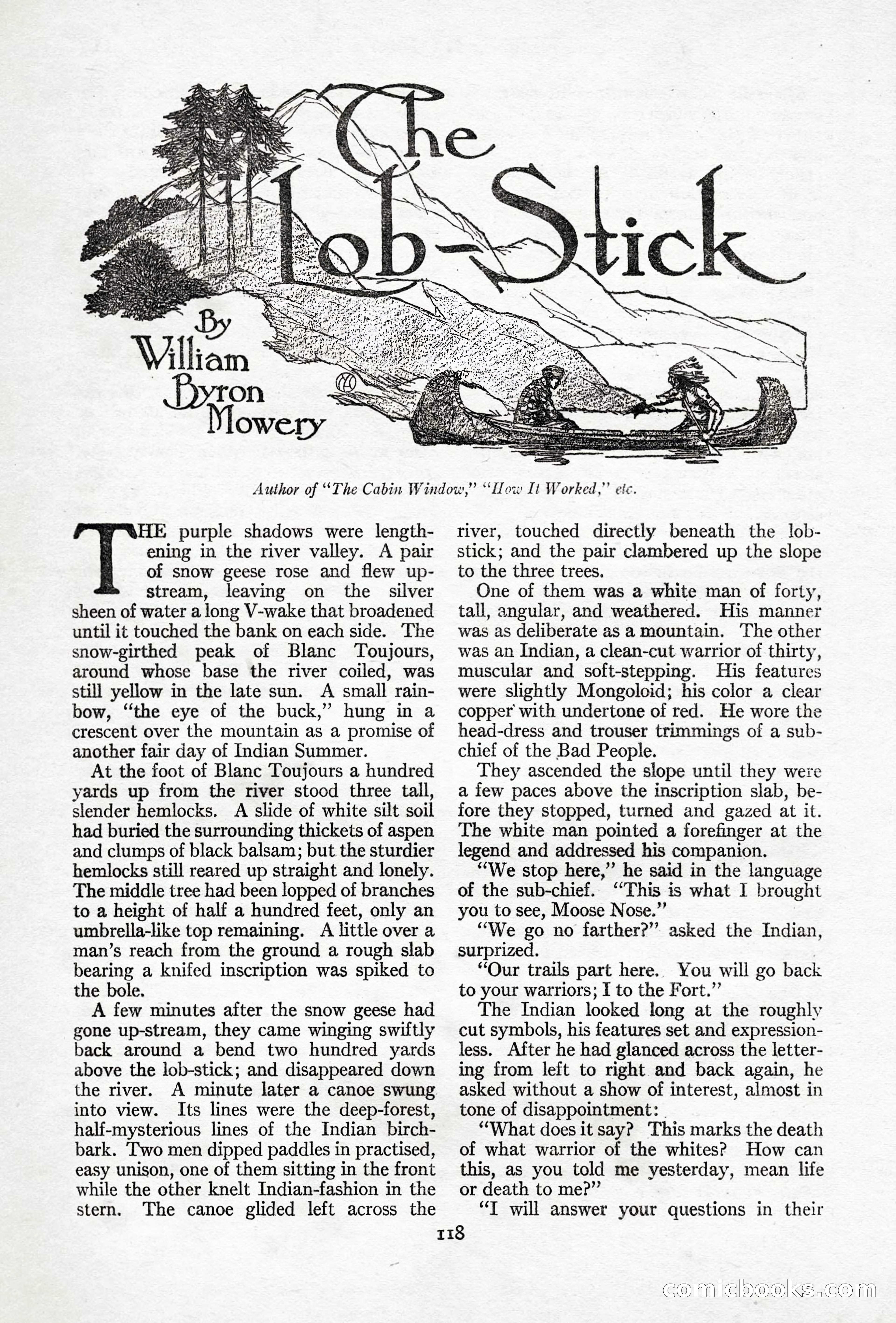
A restored page from Pulp Fiction, 1924. Page through the whole issue in the reader above.
📄 Transcribed text from this page (OCR, searchable)
Machine-transcribed from the original scan — historical spelling and the odd misread are preserved.
Villon Pyr on Mowery Author of “The Cabin Window,” “How It Worked,” ete. HE purple shadows were length- ening in the river valley. A pair of snow geese rose and flew up- stream, leaving on the silver sheen of water a long V-wake that broadened until it touched the bank on each side. The snow-girthed peak of Blanc Toujours, around whose base the river coiled, was still yellow in the late sun. A small rain- bow, “the eye of the buck,” hung in a crescent over the mountain as a promise of another fair day of Indian Summer. At the foot of Blanc Toujours a hundred yards up from the river stood three tall, slender hemlocks. A slide of white silt soil had buried the surrounding thickets of aspen and clumps of black balsam; but the sturdier hemlocks still reared up straight and lonely. The middle tree had been lopped of branches to a height of half a hundred feet, only an umbrella-like top remaining. A little over a man’s reach from the ground a rough slab bearing a knifed inscription was spiked to the bole. A few minutes after the snow geese had gone up-stream, they came winging swiftly back around a bend two hundred yards above the lob-stick; and disappeared down the river. A minute later a canoe swung into view. Its lines were the deep-forest, half-mysterious lines of the Indian birch- bark. Two men dipped paddles in practised, easy unison, one of them sitting in the front while the other knelt Indian-fashion in the stern, The canoe glided left across the river, touched directly beneath the lob- stick; and the pair clambered up the slope to the three trees. One of them was a white man of forty, tall, angular, and weathered. His manner was as deliberate as a mountain. The other was an Indian, a clean-cut warrior of thirty, muscular and soft-stepping. His features were slightly Mongoloid; his color a clear copper with undertone of red. He wore the head-dress and trouser trimmings of a sub- chief of the Bad People. They ascended the slope until they were a few paces above the inscription slab, be- fore they stopped, turned and gazed at it. The white man pointed a forefinger at the legend and addressed his companion. “We stop here,” he said in the language of the sub-chief. “This is what I brought you to see, Moose Nose.” “We go no farther?” asked the Indian, surprized. , “Our trails part here. You will go back to your warriors; I to the Fort.” The Indian looked long at the roughly cut symbols, his features set and expression- less. After he had glanced across the letter- ing from left to right and back again, he asked without a show of interest, almost in tone of disappointment: | “What does it say? This marks the death of what warrior of the whites? How can this, as you told me yesterday, mean life or death to me?” “T will answer your questions in their 118 COmiclbookSs.G©