
Pulp Fiction, 1924 · page 123 of 196
Adventure Magazine, April 10, 1924 — page 123: what you’re looking at
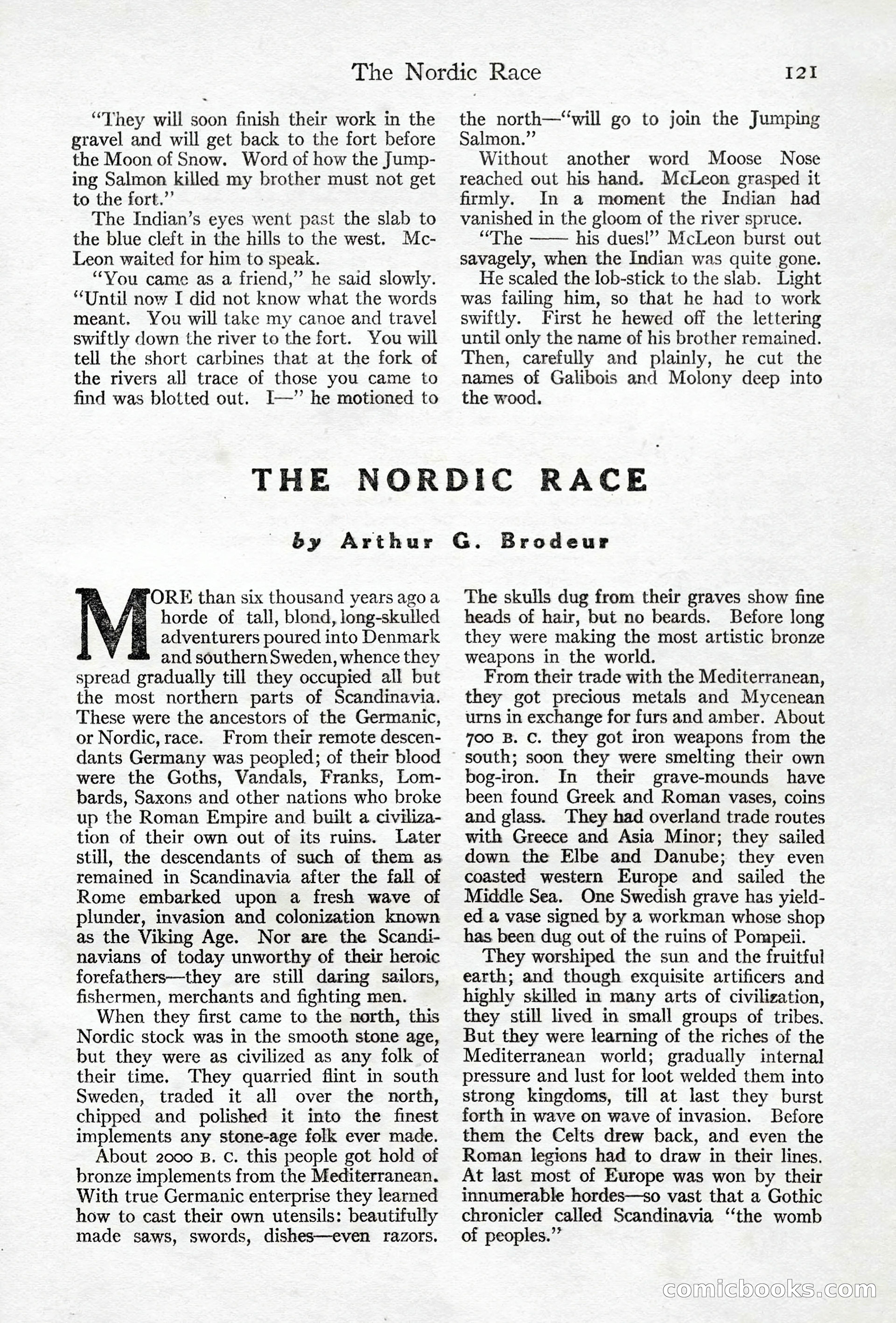
A restored page from Pulp Fiction, 1924. Page through the whole issue in the reader above.
📄 Transcribed text from this page (OCR, searchable)
Machine-transcribed from the original scan — historical spelling and the odd misread are preserved.
The Nordic Race “They will soon finish their work in the gravel and will get back to the fort before the Moon of Snow. Word of how the Jump- ing Salmon killed my brother must not get to the fort.’’ The Indian’s eyes went past the slab to the blue cleft in the hills to the west. Mc- Leon waited for him to speak. “You came as a friend,” he said slowly. “Until now I did not know what the words meant. You will take my canoe and travel swiftly down the river to the fort. You will tell the short carbines that at the fork of the rivers all trace of those you came to find was blotted out. I-—” he motioned to I2I the north—“‘will go to join the Jumping Salmon.” Without another word Moose Nose reached out his hand. McLeon grasped it firmly. In a moment the Indian had vanished in the gloom of the river spruce. ‘The his dues!’’ McLeon burst out savagely, when the Indian was quite gone. He scaled the lob-stick to the slab. Light was failing him, so that he had to work swiftly. First he hewed off the lettering until only the name of his brother remained. Then, carefully and plainly, he cut the names of Galibois and Molony deep into the wood. THE NORDIC RACE by Arthur G. Brodeur f ORE than six thousand years ago a A fe horde of tall, blond, long-skulled ® @ adventurers poured into Denmark ' @% and southern Sweden, whence they spread gradually till they occupied all but the most northern parts of Scandinavia. These were the ancestors of the Germanic, or Nordic, race. dants Germany was peopled; of their blood were the Goths, Vandals, Franks, Lom- bards, Saxons and other nations who broke up the Roman Empire and built a civiliza- Later still, the descendants of such of them as remained in Scandinavia after the fall of tion of their own out of its ruins. Rome embarked upon a fresh wave of plunder, invasion and colonization known as the Viking Age. Nor are the Scandi- navians of today unworthy of their heroic forefathers—they are still daring sailors, fishermen, merchants and fighting men. When they first came to the north, this Nordic stock was in the smooth stone age, but they were as civilized as any folk of their time. They quarried flint in south Sweden, traded it all over the north, chipped and polished it into the finest implements any stone-age folk ever made. About 2000 B. C. this people got hold of bronze implements from the Mediterranean. With true Germanic enterprise they learned how to cast their own utensils: beautifully made saws, swords, dishes—even razors. From their remote descen- The skulls dug from their graves show fine heads of hair, but no beards. Before long they were making the most artistic bronze weapons in the world. From their trade with the Mediterranean, they got precious metals and Mycenean urns in exchange for furs and amber. About 700 B. C. they got iron weapons from the south; soon they were smelting their own bog-iron. In their grave-mounds have been found Greek and Roman vases, coins and glass. They had overland trade routes with Greece and Asia Minor; they sailed down the Elbe and Danube; they even coasted western Europe and sailed the Middle Sea. One Swedish grave has yield- ed a vase signed by a workman whose shop has been dug out of the ruins of Pompeii. They worshiped the sun and the fruitful earth; and though exquisite artificers and highly skilled in many arts of civilization, they still lived in small groups of tribes, But they were learning of the riches of the Mediterranean world; gradually internal pressure and lust for loot welded them into strong kingdoms, till at last they burst forth in wave on wave of invasion. Before them the Celts drew back, and even the Roman legions had to draw in their lines. At last most of Europe was won by their innumerable hordes—so vast that a Gothic chronicler called Scandinavia “the womb of peoples.” COMMCLMOOCKKS.CO© |