
Pulp Fiction, 1924 · page 128 of 196
Adventure Magazine, April 10, 1924 — page 128: what you’re looking at
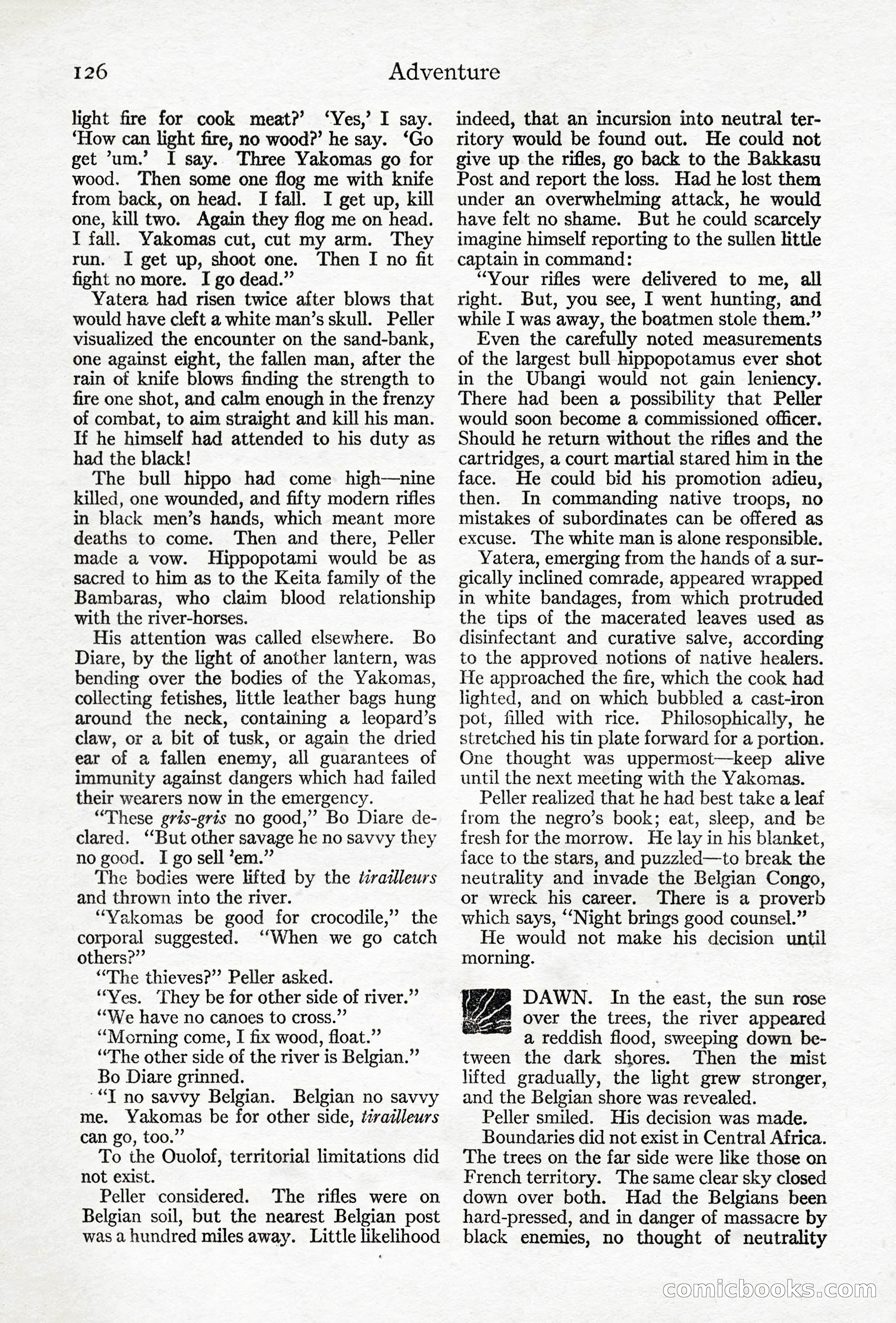
A restored page from Pulp Fiction, 1924. Page through the whole issue in the reader above.
📄 Transcribed text from this page (OCR, searchable)
Machine-transcribed from the original scan — historical spelling and the odd misread are preserved.
126 light fire for cook meat?’ ‘Yes,’ I say. “How can light fire, no wood?’ he say. ‘Go get ’um.’ I say. Three Yakomas go for wood. Then some one flog me with knife from back, on head. I fall. I get up, kill one, kill two. Again they flog me on head. Y fall. Yakomas cut, cut my arm. They run. I get up, shoot one. Then I no fit fight no more. I go dead.” Yatera had risen twice after blows that would have cleft a white man’s skull. Peller visualized the encounter on the sand-bank, one against eight, the fallen man, after the rain of knife blows finding the strength to fire one shot, and calm enough in the frenzy of combat, to aim straight and kill his man. If he himself had attended to his duty as had the black! The bull hippo had come high—nine killed, one wounded, and fifty modern rifles in black men’s hands, which meant more deaths to come. ‘Then and there, Peller made a vow. Hippopotami would be as sacred to him as to the Keita family of the Bambaras, who claim blood relationship with the river-horses. His attention was called elsewhere. Bo Diare, by the light of another lantern, was bending over the bodies of the Yakomas, collecting fetishes, little leather bags hung around the neck, containing a leopard’s claw, or a bit of tusk, or again the dried ear of a fallen enemy, all guarantees of immunity against dangers which had failed their wearers now in the emergency. “These gris-gris no good,” Bo Diare de- clared. “But other savage he no savvy they no good. I go sell ’em.” The bodies were lifted by the ¢érazlleurs and thrown into the river. “Vakomas be good for crocodile,” the corporal suggested. “‘When we go catch others?” “The thieves?” Peller asked. “Yes. They be for other side of river.” ‘‘We have no canoes to cross.” “Morning come, I fix wood, float.” “The other side of the river is Belgian.” Bo Diare grinned. ““T no savvy Belgian. Belgian no savvy me. Yakomas be for other side, tirailleurs can go, too.” To the Ouolof, territorial limitations did not exist. Peller considered. The rifles were on Belgian soil, but the nearest Belgian post was a hundred miles away. Little likelihood Adventure indeed, that an incursion into neutral ter- ritory would be found out. He could not give up the rifles, go back to the Bakkasu Post and report the loss. Had he lost them under an overwhelming attack, he would have felt no shame. But he could scarcely imagine himself reporting to the sullen little captain in command: “Your rifles were delivered to me, all right. But, you see, I went hunting, and while I was away, the boatmen stole them.” Even the carefully noted measurements of the largest bull hippopotamus ever shot in the Ubangi would not gain leniency. There had been a possibility that Peller would soon become a commissioned officer. Should he return without the rifles and the cartridges, a court martial stared him in the face. He could bid his promotion adieu, then. In commanding native troops, no mistakes of subordinates can be offered as excuse. The white man is alone responsible. Yatera, emerging from the hands of a sur- gically inclined comrade, appeared wrapped in white bandages, from which protruded the tips of the macerated leaves used as disinfectant and curative salve, according to the approved notions of native healers. He approached the fire, which the cook had lighted, and on which bubbled a cast-iron pot, filled with rice. Philosophically, he stretched his tin plate forward for a portion. One thought was uppermost—keep alive until the next meeting with the Yakomas. Peller realized that he had best take a leaf from the negro’s book; eat, sleep, and be fresh for the morrow. He lay in his blanket, face to the stars, and puzzled—to break the neutrality and invade the Belgian Congo, or wreck his career. ‘There is a proverb which says, “‘Night brings good counsel.” He would not make his decision until morning. DAWN. In the east, the sun rose over the trees, the river appeared a reddish flood, sweeping down be- tween the dark shores. Then the mist lifted gradually, the light grew stronger, and the Belgian shore was revealed. Peller smiled. His decision was made. Boundaries did not exist in Central Africa. The trees on the far side were like those on French territory. The same clear sky closed down over both. Had the Belgians been hard-pressed, and in danger of massacre by black enemies, no thought of neutrality COMmMiICOOokkS.CGO 5}