
Pulp Fiction, 1924 · page 15 of 196
Adventure Magazine, April 10, 1924 — page 15: what you’re looking at
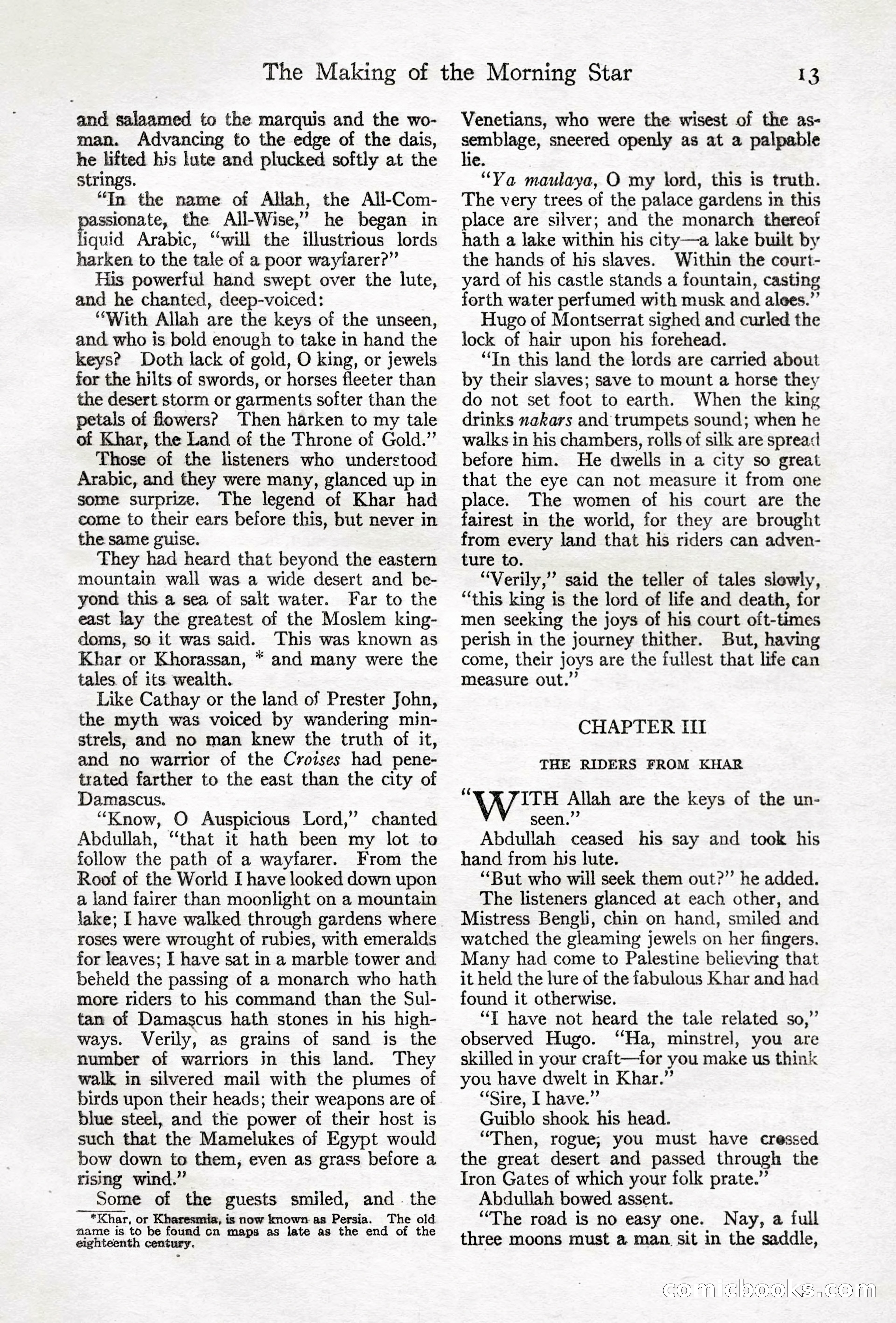
A restored page from Pulp Fiction, 1924. Page through the whole issue in the reader above.
📄 Transcribed text from this page (OCR, searchable)
Machine-transcribed from the original scan — historical spelling and the odd misread are preserved.
The Making of the Morning Star and salaamed to the marquis and the wo- man. Advancing to the edge of the dais, he lifted his lute and plucked softly at the strings. “In the name of Allah, the All-Com- passionate, the All-Wise,” he began in liquid Arabic, “‘will the illustrious lords harken to the tale of a poor wayfarer?” His powerful hand swept over the lute, and he chanted, deep-voiced: ‘With Allah are the keys of the unseen, and who is bold enough to take in hand the keys? Doth lack of gold, O king, or jewels for the hilts of swords, or horses fleeter than the desert storm or garments softer than the petals of fowers? Then harken to my tale of Khar, the Land of the Throne of Gold.” Those of the listeners who understood Arabic, and they were many, glanced up in some surprize. The legend of Khar had come to their ears before this, but never in the same guise. They had heard that beyond the eastern mountain wall was a wide desert and be- yond this a sea of salt water. Far to the east lay the greatest of the Moslem king- doms, so it was said. This was known as Khar or Khorassan, * and many were the tales. of its wealth. Like Cathay or the land of Prester John, the myth was voiced by wandering min- strels, and no man knew the truth of it, and no warrior of the Croises had pene- trated farther to the east than the city of Damascus. “Know, O Auspicious Lord,” chanted Abdullah, “that it hath been my lot to follow the path of a wayfarer. From the Roof of the World I have looked down upon a land fairer than moonlight on a mountain lake; [ have walked through gardens where roses were wrought of rubies, with emeralds for leaves; I have sat in a marble tower and beheld the passing of a monarch who hath more riders to his command than the Sul- tan of Damascus hath stones in his high- ways. Verily, as grains of sand is the number of warriors in this land. They walk in silvered mail with the plumes of birds upon their heads; their weapons are of blue steel, and the power of their host is such that the Mamelukes of Egypt would bow down to them, even as grass before a rising wind.” Some of the guests smiled, and - the “Khar, or Kharesmia, is now known as Persia. The old mame is to be found cn maps as late as the end of the eighteenth century. 13 Venetians, who were the wisest of the as- semblage, sneered openly as at a palpable he. “Va maulaya, O my lord, this is truth. The very trees of the palace gardens in this place are silver; and the monarch thereof hath a lake within his city—a lake built by the hands of his slaves. Within the court- yard of his castle stands a fountain, casting forth water perfumed with musk and alees.”’ Hugo of Montserrat sighed and curled the lock of hair upon his forehead. “In this land the lords are carried about by their slaves; save to mount a horse they do not set foot to earth. When the king drinks nakars and trumpets sound; when he walks in his chambers, rolls of silk are spread before him. He dwells in a city so great that the eye can not measure it from one place. The women of his court are the fairest in the world, for they are brought from every land that his riders can adven- ture to. ““Verily,”’ said the teller of tales slowly, “this king is the lord of life and death, for men seeking the joys of his court oft-times perish in the journey thither. But, having come, their joys are the fullest that life can measure out.” CHAPTER III THE RIDERS FROM KHAR “Will Allah are the keys of the un- seen.” Abdullah ceased his say and took his hand from his lute. “But who will seek them out?” he added. The listeners glanced at each other, and Mistress Bengli, chin on hand, smiled and watched the gleaming jewels on her fingers. Many had come to Palestine believing that it held the lure of the fabulous Khar and had found it otherwise. “T have not heard the tale related so,” observed Hugo. “Ha, minstrel, you are skilled in your craft—for you make us think you have dwelt in Khar.” “Sire, I have.” Guiblo shook his head. “Then, rogue; you must have cressed the great desert and passed through the Iron Gates of which your folk prate.” Abdullah bowed assent. “The road is no easy one. Nay, a full three moons must a man sit in the saddle, COnmiclbooks G (C©