
Pulp Fiction, 1924 · page 190 of 196
Adventure Magazine, April 10, 1924 — page 190: what you’re looking at
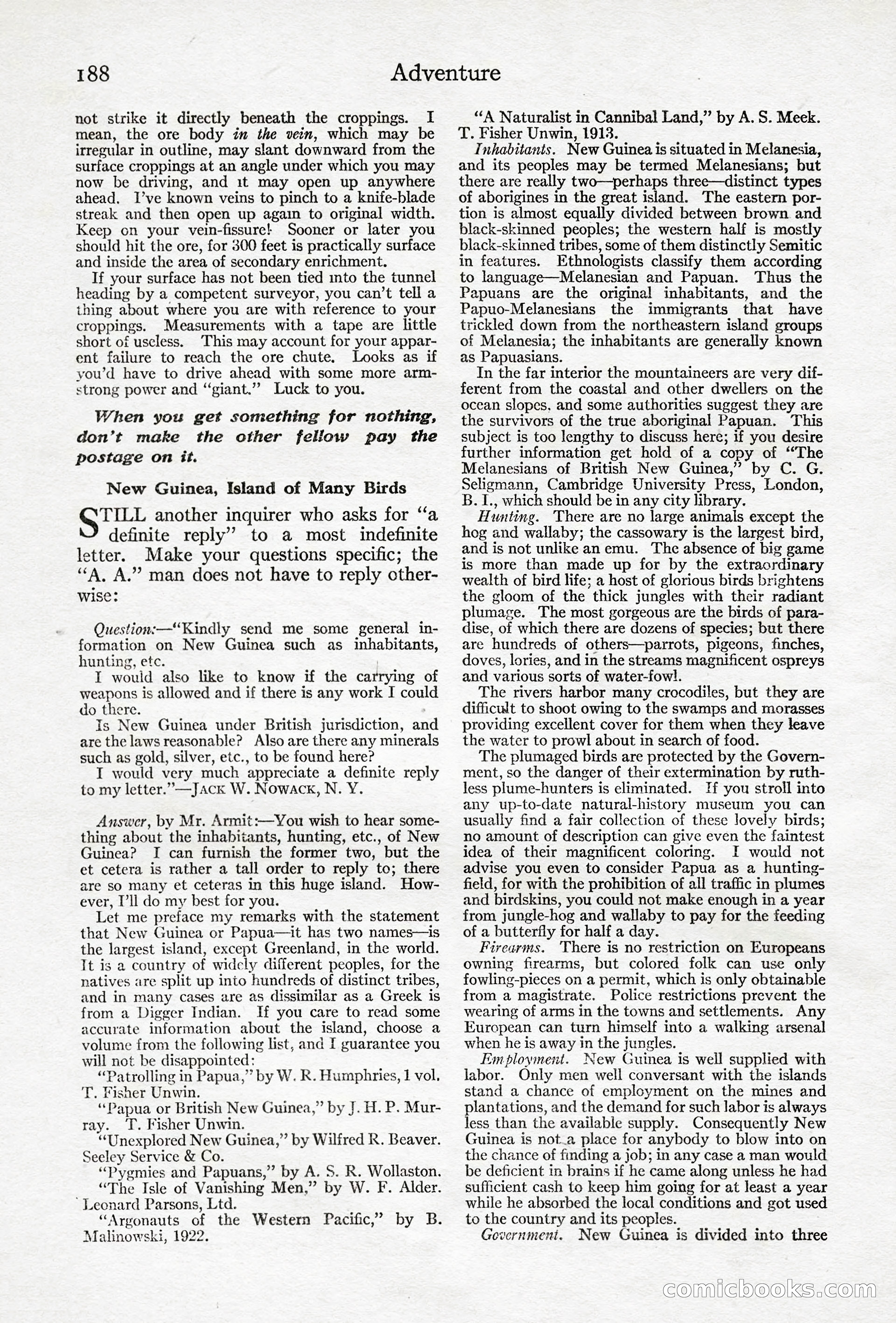
A restored page from Pulp Fiction, 1924. Page through the whole issue in the reader above.
📄 Transcribed text from this page (OCR, searchable)
Machine-transcribed from the original scan — historical spelling and the odd misread are preserved.
188 not strike it directly beneath the croppings. I mean, the ore body in the vein, which may be irregular in outline, may slant downward from the surface croppings at an angle under which you may now be driving, and 1t may open up anywhere ahead. I’ve known veins to pinch to a knife-blade streak and then open up again to original width. Keep on your vein-fissure! Sooner or later you should hit the ore, for 300 feet is practically surface and inside the area of secondary enrichment. If your surface has not been tied mto the tunnel heading by a competent surveyor, you can’t tell a thing about where you are with reference to your croppings. Measurements with a tape are little short of useless. This may account for your appar- ent failure to reach the ore chute. Looks as if you’d have to drive ahead with some more arm- strong power and “giant.”” Luck to you. When you get something for nothing, don’t make the other fellow pay the postage on it. New Guinea, Island of Many Birds ike another inquirer who asks for “ definite reply’ to a most indefinite letter. Make your questions specific; the ‘A, A.” man does not have to reply other- wise: Question: —“Kindly send me some general in- formation on New Guinea such as inhabitants, hunting, etc. I would also like to know if the carrying of weapons is allowed and if there is any work I could do there. Is New Guinea under British jurisdiction, and are the laws reasonable? Also are there any minerals such as gold, silver, etc., to be found here? I would very much ‘appreciate a definite reply to my letter.” —Jack W. Nowack, N. Y. Answer, by Mr. Armit:—You wish to hear some- thing about the inhabitants, hunting, etc., of New Guinea? I can furnish the former two, “put the et cetera is rather a tall order to reply to; there are so many et ceteras in this huge island. How- ever, I’ll do my best for you. Let me preface my remarks with the statement that New Guinea or Papua—it has two names—is the largest island, except Greenland, in the world. It is a ‘country of widely different peoples, for the natives are split up into hundreds of distinct tribes, and in many cases are as dissimilar as a Greek is from a Digger Indian. If you care to read some accurate information about the island, choose a volume from the following list, and I guarantee you will not be disappointed: “Patrolling in Papua,’ T. Fisher Unwin. “Papua or British New Guinea, ray. T. Fisher Unwin. “Unexplored New Guinea,” by Wilfred R. Beaver. Seeley Service & Co. ‘“Pyomies and Papuans,” by A. 5. R. Wollaston. “The Isle of Vanishing Men,” by W. F. Alder. ‘Leonard Parsons, Ltd. “Argonauts of the Western Pacific,’ by B. Malinowski, 1922. *by W. R. Humphries, 1 vol. ” by J.H. P. Mur- Adventure ““A Naturalist in Cannibal Land,” by A. S. Meek. T. Fisher Unwin, 1913. Inhabitants. New Guinea is situated in Melanesia, and its peoples may be termed Melanesians; but there are really two—perhaps three—distinct types of aborigines in the great island. The eastern por- tion is almost equally divided between brown and black-skinned peoples; the western half is mostly black-skinned tribes, some of them distinctly Semitic in features. Ethnologists classify them according to language—Melanesian and Papuan. Thus the Papuans are the original inhabitants, and_ the Papuo-Melanesians the immigrants that have trickled down from the northeastern island groups of Melanesia; the inhabitants are generally known as Papuasians. In the far interior the mountaineers are very dif- ferent from the coastal and other dwellers on the ocean slopes, and some authorities suggest they are the survivors of the true aboriginal Papuan. This subject is too lengthy to discuss here; if you desire further information get hold of a copy of “The Melanesians of British New Guinea,” by C. G. Seligmann, Cambridge University Press, London, B. I., which should be in any city library. H unting. There are no large animals except the hog and wallaby; the cassowary is the largest bird, and is not unlike an emu. The absence of big game is more than made up for by the extraordinary wealth of bird life; a host of glorious birds brightens the gloom of the thick jungles with their radiant plumage. The most gorgeous are the birds of para- dise, of which there are dozens of species; but there are hundreds of others—parrots, pigeons, finches, doves, lories, and in the streams magnificent ospreys and various sorts of water-fowl. The rivers harbor many crocodiles, but they are difficwt to shoot owing to the swamps and morasses providing excellent cover for them when they leave the water to prowl about in search of food. The plumaged birds are protected by the Govern- ment, so the danger of their extermination by ruth- less plume-hunters is eliminated. [Hf you stroll into any up-to-date natural-history museum you can usually find a fair collection of these lovely birds; no amount of description can give even the faintest idea of their magnificent coloring. I would not advise you even to consider Papua as a hunting- field, for with the prohibition of all traffic in plumes and birdskins, you could not make enough in a year from jungle-hog and wallaby to pay for the feeding of a butterfly for half a day. Firearms. There is no restriction on Europeans owning firearms, but colored folk can use only fowling-pieces on a permit, which is only obtainable from a magistrate. Police restrictions prevent the wearing of arms in the towns and settlements. Any European can turn himself into a walking arsenal when he is away in the jungles. Employment. New Guinea is well supplied with labor. Only men well conversant with the islands stand a chance of employment on the mines and plantations, and the demand for such labor is always Jess than the available supply. Consequently New Guinea is not_a place for anybody to blow into on the chance of finding a job; in any case a man would be deficient in brains if he came along unless he had sufficient cash to keep him going for at least a year while he absorbed the local conditions and got used to the country and its peoples. Government. New Guinea is divided into three COMmMiCOoOokkS.C©