
Pulp Fiction, 1924 · page 192 of 196
Adventure Magazine, April 10, 1924 — page 192: what you’re looking at
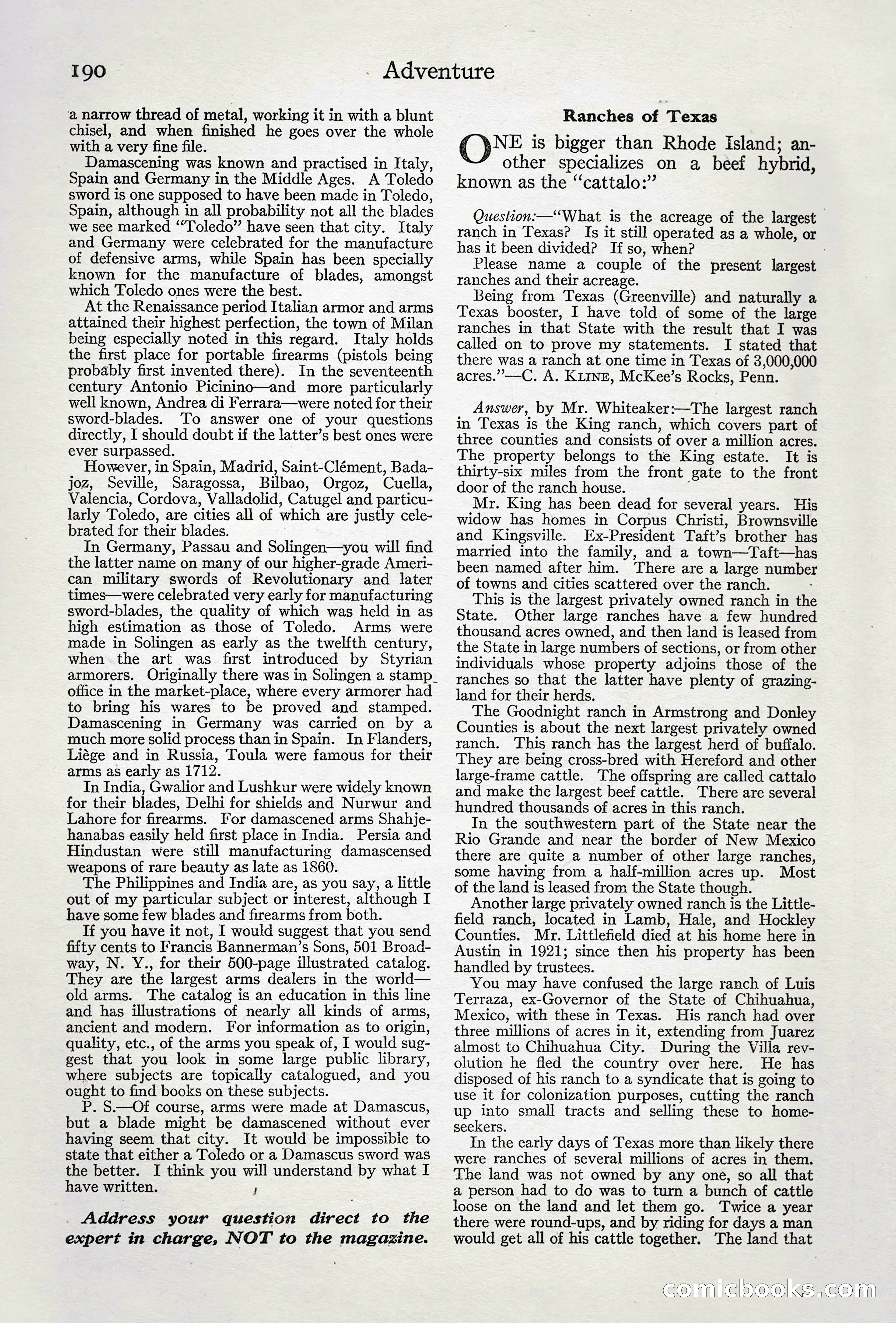
A restored page from Pulp Fiction, 1924. Page through the whole issue in the reader above.
📄 Transcribed text from this page (OCR, searchable)
Machine-transcribed from the original scan — historical spelling and the odd misread are preserved.
190 ‘a narrow thread of metal, working it in with a blunt chisel, and when finished he goes over the whole with a very fine file. Damascening was known and practised in Italy, Spain and Germany in the Middle Ages. A Toledo sword is one supposed to have been made in Toledo, Spain, although in all probability not all the blades we see marked ‘“Toledo” have seen that city. Italy and Germany were celebrated for the manufacture of defensive arms, while Spain has been specially known for the manufacture of blades, amongst which Toledo ones were the best. At the Renaissance period Italian armor and arms attained their highest perfection, the town of Milan being especially noted in this regard. Italy holds the first place for portable firearms (pistols being probably first invented there). In the seventeenth century Antonio Picinino—and more particularly well known, Andrea di Ferrara—were noted for their sword-blades. To answer one of your questions directly, I should doubt if the latter’s best ones were ever surpassed. However, in Spain, Madrid, Saint-Clément, Bada- joz, Seville, Saragossa, Bilbao, Orgoz, Cuella, Valencia, Cordova, Valladolid, Catugel and particu- larly Toledo, are cities all of which are justly cele- brated for their blades. In Germany, Passau and Solingen—you will find the latter name on many of our higher-grade Ameri- can military swords of Revolutionary and later times—were celebrated very early for manufacturing sword-blades, the quality of which was held in as high estimation as those of Toledo. Arms were made in Solingen as early as the twelfth century, when the art was first introduced by Styrian armorers. Originally there was in Solingen a stamp_ office in the market-place, where every armorer had to bring his wares to be proved and stamped. Damascening in Germany was carried on by a much more solid process than in Spain. In Flanders, Liége and in Russia, Toula were famous for their arms as early as 1712. In India, Gwalior and Lushkur were widely known for their blades, Delhi for shields and Nurwur and Lahore for firearms. For damascened arms Shahje- hanabas easily held first place in India. Persia and Hindustan were still manufacturing damascensed weapons of rare beauty as late as 1860. The Philippines and India are, as you say, a little out of my particular subject or interest, although I have some few blades and firearms from both. If you have it not, I would suggest that you send fifty cents to Francis Bannerman’s Sons, 501 Broad- way, N. Y., for their 500-page illustrated catalog. They are the largest arms dealers in the world— old arms. The catalog is an education in this line and has illustrations of nearly all kinds of arms, ancient and modern. For information as to origin, quality, etc., of the arms you speak of, I would sug- gest that you look in some large public library, where subjects are topically catalogued, and you ought to find books on these subjects. P. S.—Of course, arms were made at Damascus, but a blade might be damascened without ever having seem that city. It would be impossible to state that either a Toledo or a Damascus sword was the better. I think you will understand by what I have written. F Address your question direct to the expert in charge, NOT to the magazine. . Adventure Ranches of Pexns (NE is bigger than Rhode Island; an- other specializes on a beef hybrid, known as the ‘‘cattalo:” Question:—‘‘What is the acreage of the largest — ranch in Texas? Is it still operated as a whole, or has it been divided? If so, when? Please name a couple of the present largest ranches and their acreage. Being from Texas (Greenville) and naturally a Texas booster, I have told of some of the large ranches in that State with the result that I was called on to prove my statements. I stated that there was a ranch at one time in Texas of 3,000,000 acres.” —C. A. Kirne, McKee’s Rocks, Penn. Answer, by Mr. Whiteaker:—The largest ranch in Texas is the King ranch, which covers part of three counties and consists of over a million acres. The property belongs to the King estate. It is thirty-six miles from the front gate to the front door of the ranch house. ; Mr. King has been dead for several years. His widow has homes in Corpus Christi, Brownsville and Kingsville. Ex-President Taft’s brother has married into the family, and a town—Taft—has been named after him. There are a large number of towns and cities scattered over the ranch. This is the largest privately owned ranch in the State. Other large ranches have a few hundred thousand acres owned, and then land is leased from the State in large numbers of sections, or from other individuals whose property adjoins those of the ranches so that the latter have plenty of grazing- land for their herds. The Goodnight ranch in Armstrong and Donley Counties is about the next largest privately owned ranch. This ranch has the largest herd of buffalo. They are being cross-bred with Hereford and other large-frame cattle. The offspring are called cattalo and make the largest beef cattle. There are several hundred thousands of acres in this ranch. In the southwestern part of the State near the Rio Grande and near the border of New Mexico there are quite a number of other large ranches, some having from a half-million acres up. Most of the land is leased from the State though. Another large privately owned ranch is the Little- field ranch, located in Lamb, Hale, and Hockley Counties. Mr. Littlefield died at his home here in Austin in 1921; since then his property has been handled by trustees. You may have confused the large ranch of Luis Terraza, ex-Governor of the State of Chihuahua, Mexico, with these in Texas. His ranch had over three millions of acres in it, extending from Juarez almost to Chihuahua City. During the Villa rev- olution he fled the country over here. He has disposed of his ranch to a syndicate that is going to use It for colonization purposes, cutting the ranch up into small tracts and selling these to home- seekers. In the early days of Texas more than likely there were ranches of several millions of acres in them. The land was not owned by any one, so all that a person had to do was to turn a bunch of cattle loose on the land and let them go. Twice a year there were round-ups, and by riding for days a man would get all of his cattle together. The land that MICLOOOKS (C@