
Pulp Fiction, 1924 · page 37 of 196
Adventure Magazine, April 10, 1924 — page 37: what you’re looking at
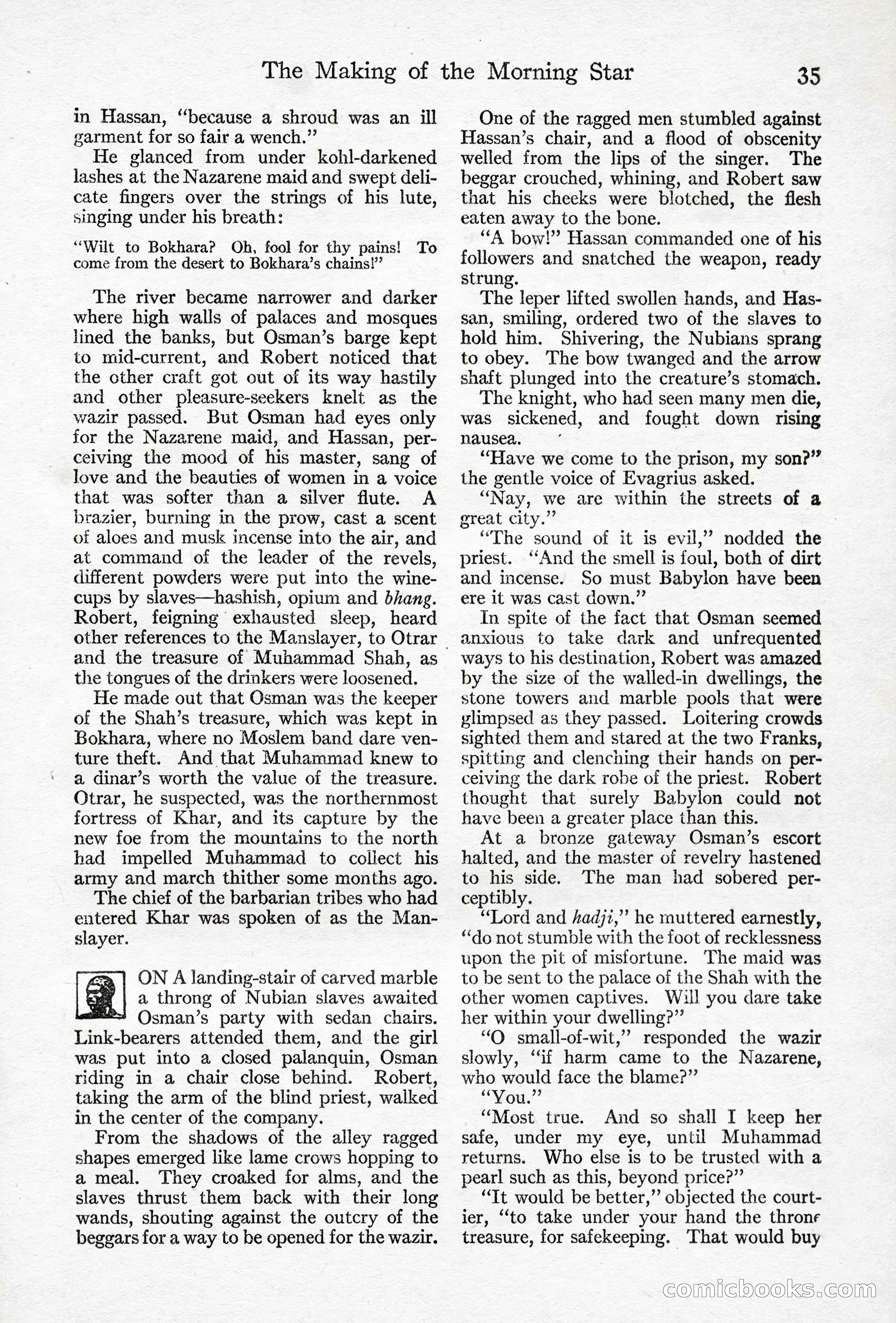
A restored page from Pulp Fiction, 1924. Page through the whole issue in the reader above.
📄 Transcribed text from this page (OCR, searchable)
Machine-transcribed from the original scan — historical spelling and the odd misread are preserved.
The Making of the Morning Star in Hassan, “because a shroud was an ill garment for so fair a wench.” He glanced from under kohl-darkened lashes at the Nazarene maid and swept deli- cate fingers over the strings of his lute, singing under his breath: ‘Wilt to BokharaP Oh, fool for thy pains! come from the desert to Bokhara’s chains!” To The river became narrower and darker where high walls of palaces and mosques lined the banks, but Osman’s barge kept to mid-current, and Robert noticed that the other craft got out of its way hastily and other pleasure-seekers knelt as the wazir passed. But Osman had eyes only for the Nazarene maid, and Hassan, per- ceiving the mood of his master, sang of Jove and the beauties of women in a voice that was softer than a silver flute. A brazier, burning in the prow, cast a scent of aloes and musk incense into the air, and at command of the leader of the revels, different powders were put into the wine- cups by slaves—hashish, opium and bhang. Robert, feigning exhausted sleep, heard other references to the Manslayer, to Otrar and the treasure of Muhammad Shah, as the tongues of the drinkers were loosened. He made out that Osman was the keeper of the Shah’s treasure, which was kept in Bokhara, where no Moslem band dare ven- ture theft. And that Muhammad knew to a dinar’s worth the value of the treasure. Otrar, he suspected, was the northernmost fortress of Khar, and its capture by the new foe from the mountains to the north had impelled Muhammad to collect his army and march thither some months ago. The chief of the barbarian tribes who had entered Khar was spoken of as the Man- slayer. ON A landing-stair of carved marble ex | a throng of Nubian slaves awaited = Osman’s party with sedan chairs. Link-bearers attended them, and the girl was put into a closed palanquin, Osman riding in a chair close behind. Robert, taking the arm of the blind priest, walked in the center of the company. From the shadows of the alley ragged shapes emerged like lame crows hopping to a meal. They croaked for alms, and the slaves thrust them back with their long wands, shouting against the outcry of the beggars for a way to be opened for the wazir. 35 One of the ragged men stumbled against Hassan’s chair, and a flood of obscenity welled from the lips of the singer. The beggar crouched, whining, and Robert saw that his cheeks were blotched, the flesh eaten away to the bone. “A bow!” Hassan commanded one of his followers and snatched the weapon, ready strung. The leper lifted swollen hands, and Has- san, smiling, ordered two of the slaves to hold him. Shivering, the Nubians sprang to obey. The bow twanged and the arrow shaft plunged into the creature’s stomach. The knight, who had seen many men die, was sickened, and fought down rising nausea. “Have we come to the prison, my son?” the gentle voice of Evagrius asked. “Nay, we are within the streets of a great city.” “The sound of it is evil,’ nodded the priest. “And the smell is foul, both of dirt and incense. So must Babylon have been ere it was cast down.” In spite of the fact that Osman seemed anxious to take dark and unfrequented ways to his destination, Robert was amazed by the size of the walled-in dwellings, the stone towers and marble pools that were ylimpsed as they passed. Loitering crowds sighted them and stared at the two Franks, spitting and clenching their hands on per- ceiving the dark robe of the priest. Robert thought that surely Babylon could not have been a greater place than this. At a bronze gateway Osman’s escort halted, and the master of revelry hastened to his side. ‘The man had sobered per- ceptibly. “Lord and hadji,”’ he muttered earnestly, “do not stumble with the foot of recklessness upon the pit of misfortune. The maid was to be sent to the palace of the Shah with the other women captives. Wiuil you dare take her within your dwelling?” “QO small-of-wit,” responded the wazir slowly, ‘if harm came to the Nazarene, who would face the blame?” {(Vieu?* “Most true. And so shall I keep her safe, under my eye, until Muhammad returns. Who else is to be trusted with a pearl such as this, beyond price?” “It would be better,” objected the court- ier, ‘to take under your hand the throne treasure, for safekeeping. That would buy COnmmiclbooks G (C@ 5}