
Pulp Fiction, 1924 · page 41 of 196
Adventure Magazine, April 10, 1924 — page 41: what you’re looking at
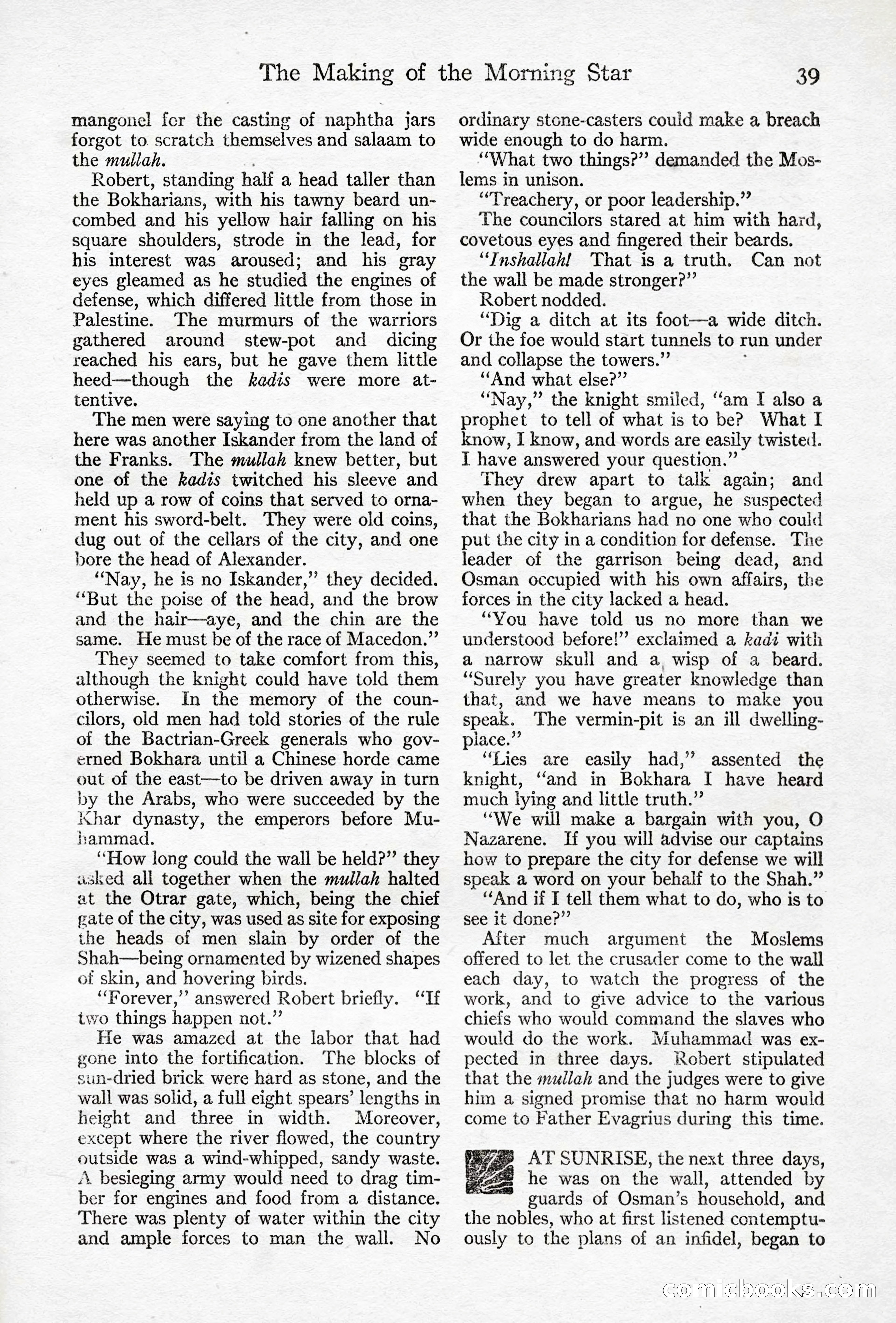
A restored page from Pulp Fiction, 1924. Page through the whole issue in the reader above.
📄 Transcribed text from this page (OCR, searchable)
Machine-transcribed from the original scan — historical spelling and the odd misread are preserved.
The Making of the Morning Star 39 mangonel fer the casting of naphtha Jars forgot to. scratch themselves and salaam to the mullah. Robert, standing half a head taller than the Bokharians, with his tawny beard un- combed and his yellow hair falling on his square shoulders, strode in the lead, for his interest was aroused; and his gray eyes gleamed as he studied the engines of defense, which differed little from those in Palestine. The murmurs of the warriors gathered around stew-pot and _ dicing reached his ears, but he gave them little heed—though the kedis were more at- tentive. The men were saylag to one another that here was another Iskander from the land of the Franks. The mullak knew better, but one of the kadzs twitched his sleeve and held up a row of coins that served to orna- ment his sword-belt. They were old coins, dug out of the cellars of the city, and one bore the head of Alexander. “Nay, he is no Iskander,”’ they decided. “But the poise of the head, and the brow and the hair—aye, and the chin are the same. He must be of the race of Macedon.” They seemed to take comfort from this, although the knight could have told them otherwise. In the memory of the coun- cilors, old men had told stories of the rule of the Bactrian-Greek generals who gov- erned Bokhara until a Chinese horde came out of the east—to be driven away in turn by the Arabs, who were succeeded by the har dynasty, the emperors before Mu- hammad. ‘‘How long could the wall be held?” they asked all together when the mullah halted at the Otrar gate, which, being the chief gate of the city, was used as site for exposing the heads of men slain by order of the Shah—being ornamented by wizened shapes of skin, and hovering birds. ‘““Forever,’’ answered Robert briefly. “Tf two things happen not.” He was amazed at the labor that had gone into the fortification. The blocks of sun-dried brick were hard as stone, and the wall was solid, a full eight spears’ lengths in height and three in width. Moreover, except where the river flowed, the country outside was a wind-whipped, sandy waste. A. besieging army would need to drag tim- ber for engines and food from a distance. There was plenty of water within the city and ample forces to man the wall. No ordinary stone-casters could make a breach wide enough to do harm. “What two things?” demanded the Mos- lems in unison. “Treachery, or poor leadership.” The councilors stared at him with hard, covetous eyes and fingered their beards. “Inshallah! That is a truth. Can not the wall be made stronger?”’ Robert nodded. “Dig a ditch at its foot—a wide ditch. Or the foe would start tunnels to run under and collapse the towers.” “And what else?” “Nay,” the knight smiled, “am I also a prophet to tell of what is to be? What I know, I know, and words are easily twisted. T have answered your question.” They drew apart to talk again; and when they began to argue, he suspected that the Bokharians had no one who could put the city in a condition for defense. The leader of the garrison being dead, and Osman occupied with his own affairs, the forces in the city lacked a head. “You have told us no more than we understood before!’’ exclaimed a kadi with a narrow skull and a wisp of a beard. “Surely you have greater knowledge than that, and we have means to make you speak. The vermin-pit is an ill dwelling- place.” “Lies are easily had,” assented the knight, “and in Bokhara I have heard much lying and little truth.” “We will make a bargain with you, O Nazarene. If you will advise our captains how to prepare the city for defense we will speak a word on your behalf to the Shah.” ‘“‘And if I tell them what to do, who is to see it done?” After much argument the Moslems offered to let the crusader come to the wall each day, to watch the progress of the work, and to give advice to the various chiefs who would command the slaves who would do the work. Muhammad was ex- pected in three days. Robert stipulated that the mudlah and the judges were to give him a signed promise that no harm would come to Father Evagrius during this time. eea> AT SUNRISE, the next three days, £: he was on the wall, attended by ; guards of Osman’s household, and the nobles, who at first listened contemptu- ously to the plans of an infidel, began to S| Eonicbooks.c©