
Pulp Fiction, 1924 · page 46 of 196
Adventure Magazine, April 10, 1924 — page 46: what you’re looking at
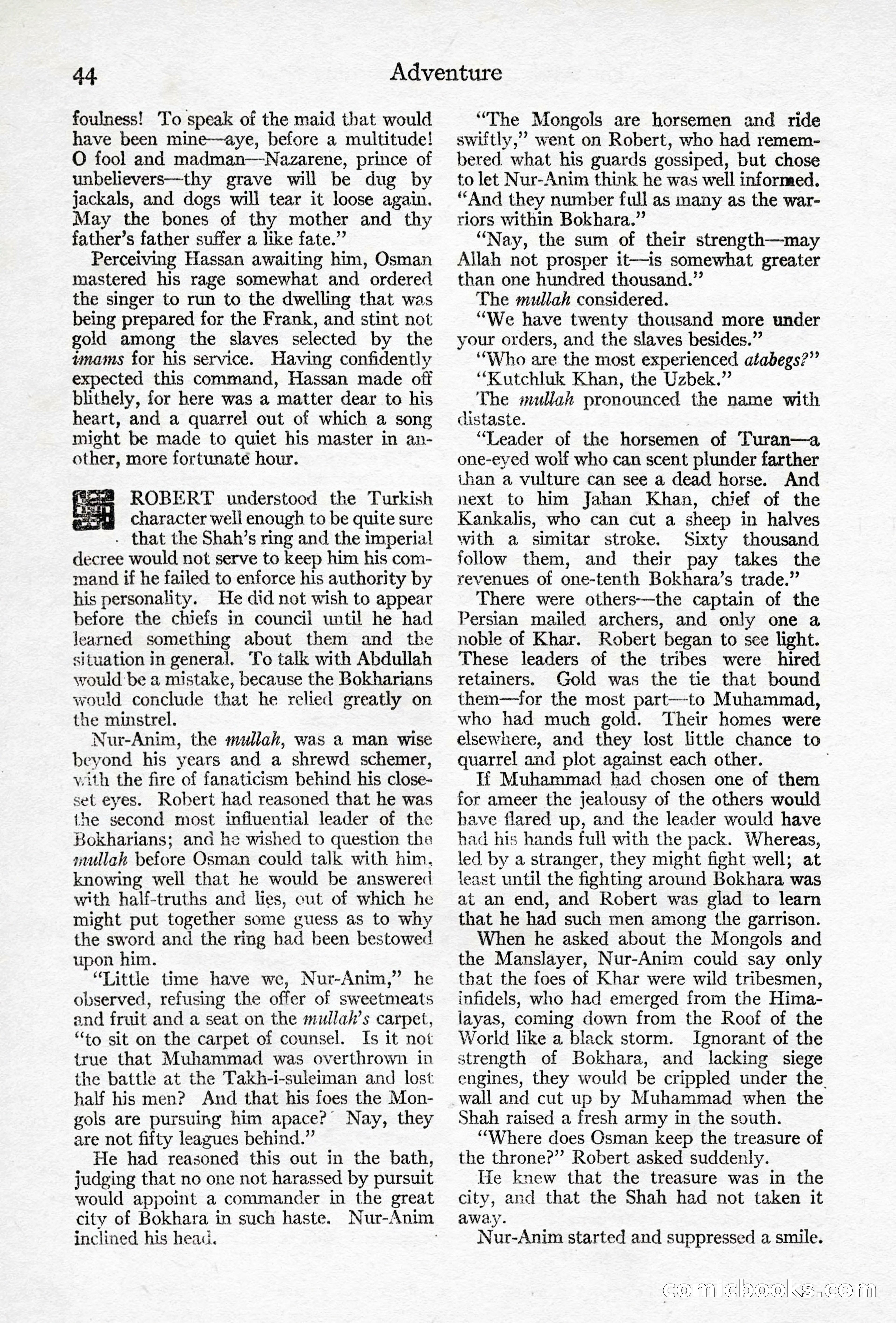
A restored page from Pulp Fiction, 1924. Page through the whole issue in the reader above.
📄 Transcribed text from this page (OCR, searchable)
Machine-transcribed from the original scan — historical spelling and the odd misread are preserved.
44 foulness! To speak of the maid that would have been mine—aye, before a multitude! O fool and madman-—-Nazarene, prince of unbelievers—thy grave will be dug by jackals, and dogs will tear it loose again. May the bones of thy mother and thy father’s father suffer a like fate.” Perceiving Hassan awaiting him, Osman mastered his rage somewhat and ordered the singer to run to the dwelling that was being prepared for the Frank, and stint not gold among the slaves selected by the tmams for his service. Having confidently expected this command, Hassan made off blithely, for here was a matter dear to his heart, and a quarrel out of which a song might be made to quiet his master in an- other, more fortunaté hour. ROBERT understood the Turkish ™y character well enough to be quite sure . that the Shah’s ring and the imperial decree would not serve to keep him his com- mand if he failed to enforce his authority by his personality. He did not wish to appear before the chiefs in council until he had learned something about them and the situation in general. To talk with Abdullah would be a mistake, because the Bokharians would conclude that he relied greatly on the minstrel. Nur-Anim, the mullah, was a man wise beyond his years and a shrewd schemer, with the fire of fanaticism behind his close- set eyes. Robert had reasoned that he was the second most influential leader of the Bokharians; and he wished to question the mullahk before Osman could talk with him, knowing well that he would be answered with half-truths and lies, cut of which he might put together some guess as to why the sword and the ring had been bestowed upon him. “Tittle time have we, Nur-Anim,” he observed, refusing the offer of sweetmeats and fruit and a seat on the mullah’s carpet, “to sit on the carpet of counsel. Is it not irue that Muhammad was overthrown in the battle at the Takh-i-suleiman and lost half his men? And that his foes the Mon- gols are pursuing him apace? Nay, they are not fifty leagues behind.” He had reasoned this out in the bath, judging that no one not harassed by pursuit would appoint a commander in the great city of Bokhara in such haste. Nur-Anim inclined his head. Adventure “The Mongols are horsemen and ride switly,” went on Robert, who had remem- bered what his guards gossiped, but chose to let Nur-Anim think he was well informed. “And they number full as many as the war- riors within Bokhara.” “Nay, the sum of their strength—may Allah not prosper it—is somewhat greater than one hundred thousand.” The mullah considered. “We have twenty thousand more under your orders, and the slaves besides.” ‘Who are the most experienced atabegs?” “Kutchluk Khan, the Uzbek.” The miullah pronounced the name with distaste. ; “Leader of the horsemen of Turan—a one-eyed wolf who can scent plunder farther than a vulture can see a dead horse. And next to him Jahan Khan, chief of the Kankalis, who can cut a sheep in halves with a simitar stroke. Sixty thousand follow them, and their pay takes the revenues of one-tenth Bokhara’s trade.” There were others—the captain of the Persian mailed archers, and only one a noble of Khar. Robert began to see light. These leaders of the tribes were hired retainers. Gold was the tie that bound them—for the most part—to Muhammad, who had much gold. Their homes were elsewhere, and they lost little chance to quarrel and plot against each other. If Muhammad had chosen one of them for ameer the jealousy of the others would have flared up, and the leader would have had his hands full with the pack. Whereas, led by a stranger, they might fight well; at least until the fighting around Bokhara was at an end, and Robert was glad to learn that he had such men among the garrison. When he asked about the Mongols and the Manslayer, Nur-Anim could say only that the foes of Khar were wild tribesmen, infidels, who had emerged from the Hima- layas, coming down from the Roof of the World like a black storm. Ignorant of the strength of Bokhara, and lacking siege engines, they would be crippled under the wall and cut up by Muhammad when the Shah raised a fresh army in the south. ‘“‘Where does Osman keep the treasure of the throne?” Robert asked suddenly. He knew that the treasure was in the city, and that the Shah had not taken it away. Nur-Anim started and suppressed a smile. COMIC OOO C S (©