
Pulp Fiction, 1924 · page 69 of 196
Adventure Magazine, April 10, 1924 — page 69: what you’re looking at
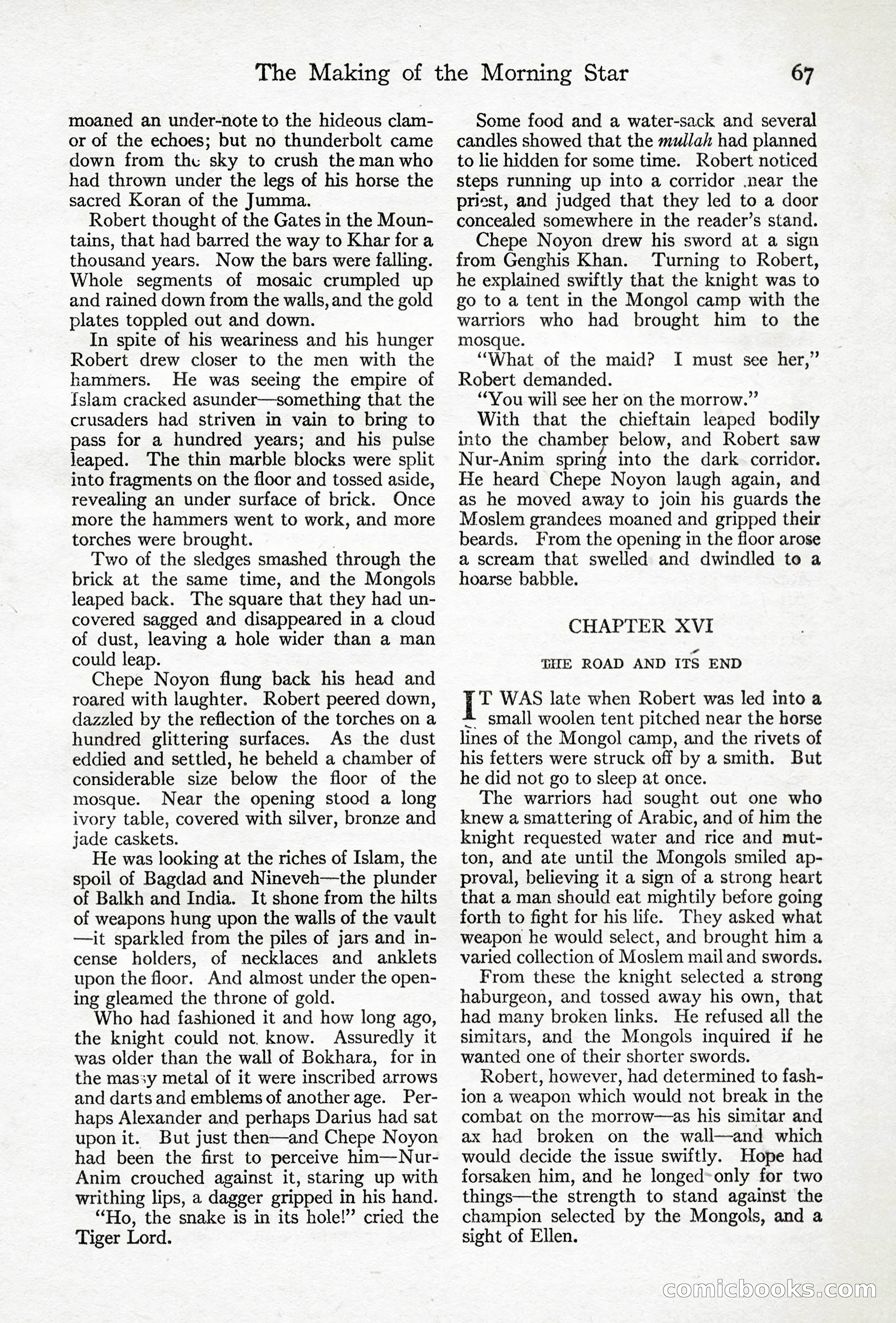
A restored page from Pulp Fiction, 1924. Page through the whole issue in the reader above.
📄 Transcribed text from this page (OCR, searchable)
Machine-transcribed from the original scan — historical spelling and the odd misread are preserved.
The Making of the Morning Star 67 moaned an under-note to the hideous clam- or of the echoes; but no thunderbolt came down from the sky to crush the man who had thrown under the legs of his horse the sacred Koran of the Jumma. Robert thought of the Gates in the Moun- tains, that had barred the way to Khar for a thousand years. Now the bars were falling. Whole segments of mosaic crumpled up and rained down from the walls, and the gold plates toppled out and down. In spite of his weariness and his hunger Robert drew closer to the men with the nammers. He was seeing the empire of Islam cracked asunder—something that the crusaders had striven in vain to bring to pass for a hundred years; and his pulse leaped. The thin marble blocks were split into fragments on the floor and tossed aside, revealing an under surface of brick. Once more the hammers went to work, and more torches were brought. | Two of the sledges smashed through the brick at the same time, and the Mongols leaped back. The square that they had un- covered sagged and disappeared in a cloud of dust, leaving a hole wider than a man could leap. Chepe Noyon flung back his head and roared with laughter. Robert peered down, dazzled by the reflection of the torches on a hundred glittering surfaces. As the dust eddied and settled, he beheld a chamber of considerable size below the floor of the mosque. Near the opening stood a long ivory table, covered with silver, bronze and jade caskets. He was looking at the riches of Islam, the spoil of Bagdad and Nineveh—the plunder of Balkh and India. It shone from the hilts of weapons hung upon the walls of the vault —it sparkled from the piles of jars and in- cense holders, of necklaces and anklets upon the floor. And almost under the open- ing gleamed the throne of gold. Who had fashioned it and how long ago, the knight could not. know. Assuredly it was older than the wall of Bokhara, for in the massy metal of it were inscribed arrows and darts and emblems of another age. Per- haps Alexander and perhaps Darius had sat upon it. But just then—and Chepe Noyon had been the first to perceive him—Nur- Anim crouched against it, staring up with writhing lips, a dagger gripped in his hand. “Ho, the snake is in its hole!” cried the Tiger Lord. Some food and a water-sack and several candles showed that the mullah had planned to lie hidden for some time. Robert noticed steps running up into a corridor .near the priest, and judged that they led to a door concealed somewhere in the reader’s stand. Chepe Noyon drew his sword at a sign from Genghis Khan. ‘Turning to Robert, he explained swiftly that the knight was to go to a tent in the Mongol camp with the warriors who had brought him to the mosque. “What of the maid? I must see her,” Robert demanded. “You will see her on the morrow.” With that the chieftain leaped bodily into the chamber below, and Robert saw Nur-Anim spring into the dark corridor. He heard Chepe Noyon laugh again, and as he moved away to join his guards the Moslem grandees moaned and gripped their beards. From the opening in the floor arose a scream that swelled and dwindled to a hoarse babble. CHAPTER XVI THE ROAD AND ITS END T WAS late when Robert was led into a 4 small woolen tent pitched near the horse lines of the Mongol camp, and the rivets of his fetters were struck off by a smith. But he did not go to sleep at once. The warriors had sought out one who knew a smattering of Arabic, and of him the knight requested water and rice and mut- ton, and ate until the Mongols smiled ap- proval, believing it a sign of a strong heart that a man should eat mightily before going forth to fight for his life. They asked what weapon he would select, and brought him a varied collection of Moslem mail and swords. From these the knight selected a strong haburgeon, and tossed away his own, that had many broken links. He refused all the simitars, and the Mongols inquired if he wanted one of their shorter swords. Robert, however, had determined to fash- ion a@ weapon which would not break in the combat on the morrow—as his simitar and ax had broken on the wall—and which would decide the issue swiftly. Hope had forsaken him, and he longed-only for two things—the strength to stand against the champion selected by the Mongols, and a sight of Ellen. GCoOmiGcdooksteo |