
Pulp Fiction, 1924 · page 7 of 196
Adventure Magazine, April 10, 1924 — page 7: what you’re looking at
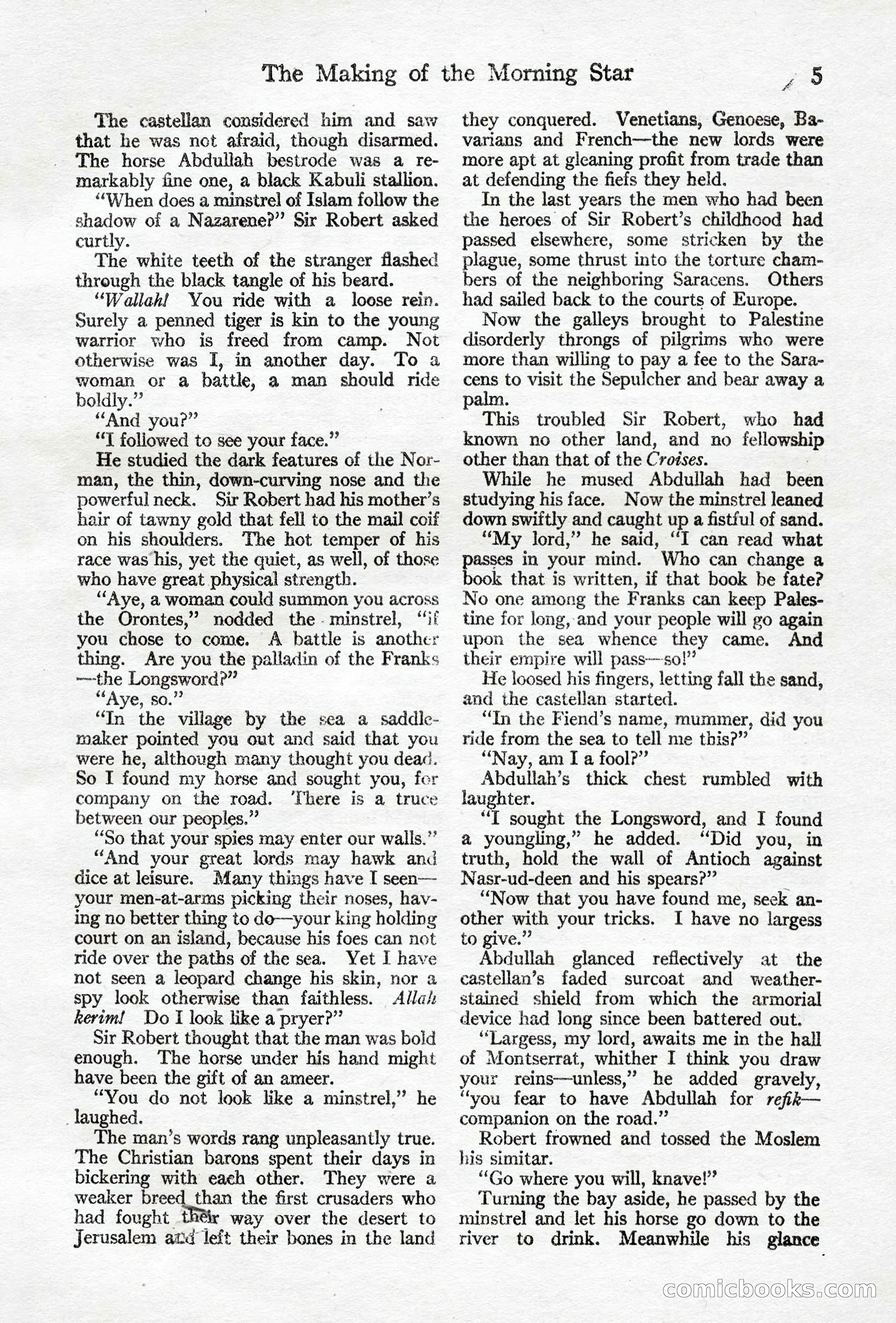
A restored page from Pulp Fiction, 1924. Page through the whole issue in the reader above.
📄 Transcribed text from this page (OCR, searchable)
Machine-transcribed from the original scan — historical spelling and the odd misread are preserved.
The Making of the Morning Star The castellan considered him and saw that he was not afraid, though disarmed. The horse Abdullah bestrode was a re- markably fine one, a black Kabuli stallion. “When does a minstrel of Islam follow the shadow of a Nazarene?” Sir Robert asked curtly. The white teeth of the stranger flashed through the black tangle of his beard. “Wallah! You ride with a loose rein. Surely a penned tiger is kin to the young warrior who is freed from camp. Not otherwise was I, in another day. To a woman or a battle, a man should ride boldly.” “And your” “T followed to see your face.” He studied the dark features of the Nor- man, the thin, down-curving nose and the powerful neck. Sir Robert had his mother’s hair of tawny gold that fell to the mail coif on his shoulders. The hot temper of his race was his, yet the quiet, as well, of those who have great physical strength. “Aye, &@ woman could summon you across the Orontes,” nodded the - minstrel, “if you chose to come. A battle is another thing. Are you the palladin of the Franks -~-the Longsword?” ‘““Aye, so.” “In the village by the sea a saddle- maker pointed you out and said that you were he, although many thought you dead. So I found my horse and sought you, fer company on the road. There is a truce between our peoples.” "30 that your spies may enter our walls.”’ “And your great lords may hawk and dice at leisure. Many things have I seen— your men-at-arms picking their noses, hav- ing no better thing to do—your king holding court on an island, because his foes can not ride over the paths of the sea. Yet I have not seen a leopard change his skin, nor a spy look otherwise than faithless. Allah kerim! Do I look like a pryer?” Sir Robert thought that the man was bold enough. The horse under his hand might have been the gift of an ameer. “You do not look like a minstrel,” he _laughed. The man’s words rang unpleasantly true. The Christian barons spent their days in bickering with each other. They were a weaker breed_than the first crusaders who had fought way over the desert to Jerusalem and left their bones in the land . 9 they conquered. Venetians, Genoese, Ba- varians and French—the new lords were more apt at gleaning profit from trade than at defending the fiefs they held. In the last years the men who had been the heroes of Sir Robert’s childhcod had passed elsewhere, some stricken by the plague, some thrust into the torture cham- bers of the neighboring Saracens. Others had sailed back to the courts of Europe. Now the galleys brought to Palestine disorderly throngs of pilgrims who were more than willing to pay a fee to the Sara- cens to visit the Sepulcher and bear away a palm. This troubled Sir Robert, who had known no other land, and no fellowship other than that of the Croises. While he mused Abdullah had been studying his face. Now the minstrel leaned down swiitly and caught up a fistful of sand. “My lord,” he said, “I can read what passes in your mind. Who can change a book that is written, if that book be fate? No one among the Franks can keep Pales- tine for long, and your people will go again upon the sea whence they came. And their empire will pass—so!”’ He loosed his fingers, letting fall the sand, and the castellan started. “In the Fiend’s name, mummer, did you ride from the sea to tell me this?” “Nay, am I a fool?” Abdullah’s thick chest rumbled with laughter. “T sought the Longsword, and I found a youngling,” he added. “Did you, in truth, hold the wall of Antioch against Nasr-ud-deen and his spears?” “Now that you have found me, seek an- other with your tricks. I have no largess to give.” Abdullah glanced reflectively at the castellan’s faded surcoat and weather- stained shield from which the armorial device had long since been battered out. ‘““Largess, my lord, awaits me in the hall of Montserrat, whither I think you draw your reins—unless,”’ he added gravely, “you fear to have Abdullah for refik— companion on the road.” Robert frowned and tossed the Moslem his simitar. “Go where you will, knave!”’ Turning the bay aside, he passed by the minstrel and let his horse go down to the river to drink. Meanwhile his glance COnmiclboooks G (©