
Pulp Fiction, 1924 · page 100 of 204
Adventure Magazine Cover — page 100: what you’re looking at
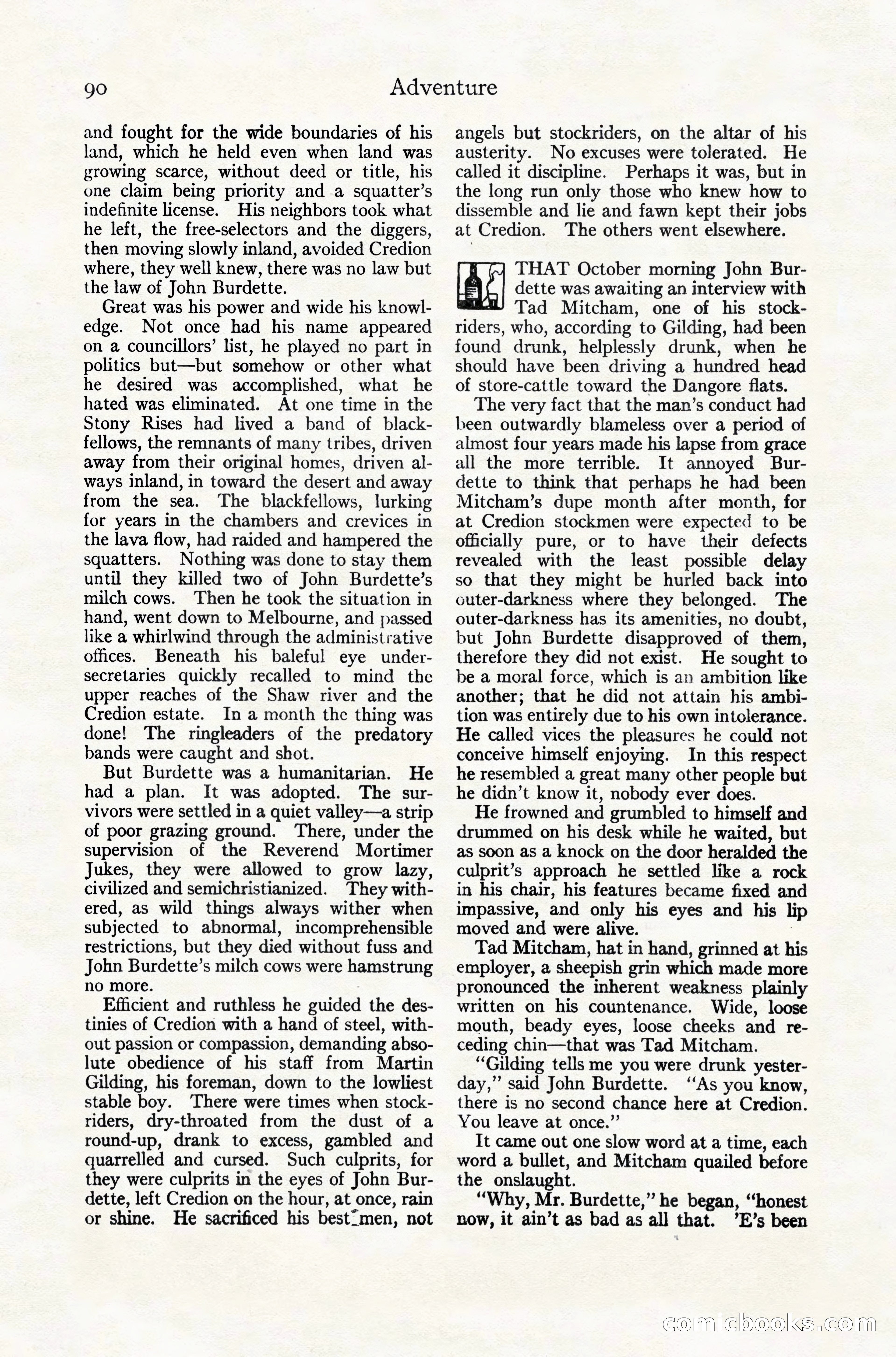
A restored page from Pulp Fiction, 1924. Page through the whole issue in the reader above.
📄 Transcribed text from this page (OCR, searchable)
Machine-transcribed from the original scan — historical spelling and the odd misread are preserved.
90 and fought for the wide boundaries of his land, which he held even when land was growing scarce, without deed or title, his one claim being priority and a squatter’s indefinite license. His neighbors took what he left, the free-selectors and the diggers, then moving slowly inland, avoided Credion where, they well knew, there was no law but the law of John Burdette. Great was his power and wide his knowl- edge. Not once had his name appeared on a councillors’ list, he played no part in politics but—but somehow or other what he desired was accomplished, what he hated was eliminated. At one time in the Stony Rises had lived a band of black- fellows, the remnants of many tribes, driven away from their original homes, driven al- ways inland, in toward the desert and away from the sea. The blackfellows, lurking for years in the chambers and crevices in the lava flow, had raided and hampered the squatters. Nothing was done to stay them until they killed two of John Burdette’s milch cows. Then he took the situation in hand, went down to Melbourne, and passed like a whirlwind through the administrative offices. Beneath his baleful eye under- secretaries quickly recalled to mind the upper reaches of the Shaw river and the Credion estate. In a month the thing was done! The ringleaders of the predatory bands were caught and shot. But Burdette was a humanitarian. He had a plan. It was adopted. The sur- vivors were settled in a quiet valley—a strip of poor grazing ground. There, under the supervision of the Reverend Mortimer Jukes, they were allowed to grow lazy, civilized and semichristianized. They with- ered, as wild things always wither when subjected to abnormal, incomprehensible restrictions, but they died without fuss and John Burdette’s milch cows were hamstrung no more. Efficient and ruthless he guided the des- tinies of Credion with a hand of steel, with- out passion or compassion, demanding abso- lute obedience of his staff from Martin Gilding, his foreman, down to the lowliest stable boy. There were times when stock- riders, dry-throated from the dust of a round-up, drank to excess, gambled and quarrelled and cursed. Such culprits, for they were culprits in the eyes of John Bur- dette, left Credion on the hour, at once, rain or shine. He sacrificed his best:men, not Adventure angels but stockriders, on the altar of his austerity. No excuses were tolerated. He called it discipline. Perhaps it was, but in the long run only those who knew how to dissemble and lie and fawn kept their jobs at Credion. The others went elsewhere. ria dette was awaiting an interview with Tad Mitcham, one of his stock- riders, who, according to Gilding, had been found drunk, helplessly drunk, when he should have been driving a hundred head of store-cattle toward the Dangore flats. The very fact that the man’s conduct had been outwardly blameless over a period of almost four years made his lapse from grace all the more terrible. It annoyed Bur- dette to think that perhaps he had been Mitcham’s dupe month after month, for at Credion stockmen were expected to be officially pure, or to have their defects revealed with the least possible delay so that they might be hurled back into outer-darkness where they belonged. The outer-darkness has its amenities, no doubt, but John Burdette disapproved of them, therefore they did not exist. He sought to be a moral force, which is an ambition like another; that he did not attain his ambi- tion was entirely due to his own intolerance. He called vices the pleasures he could not conceive himself enjoying. In this respect he resembled a great many other people but he didn’t know it, nobody ever does. He frowned and grumbled to himself and drummed on his desk while he waited, but as soon as a knock on the door heralded the culprit’s approach he settled like a rock in his chair, his features became fixed and impassive, and only his eyes and his lip moved and were alive. | Tad Mitcham, hat in hand, grinned at his employer, a sheepish grin which made more pronounced the inherent weakness plainly written on his countenance. Wide, loose mouth, beady eyes, loose cheeks and re- ceding chin—that was Tad Mitcham. “Gilding tells me you were drunk yester- day,” said John Burdette. “As you know, there is no second chance here at Credion. You leave at once.”’ It came out one slow word at a time, each word a bullet, and Mitcham quailed before the onslaught. “Why, Mr. Burdette,” he began, “honest now, it ain’t as bad as all that. ’E’s been THAT October morning John Bur- cCoOnmicloool< 1O)