
Pulp Fiction, 1924 · page 104 of 204
Adventure Magazine Cover — page 104: what you’re looking at
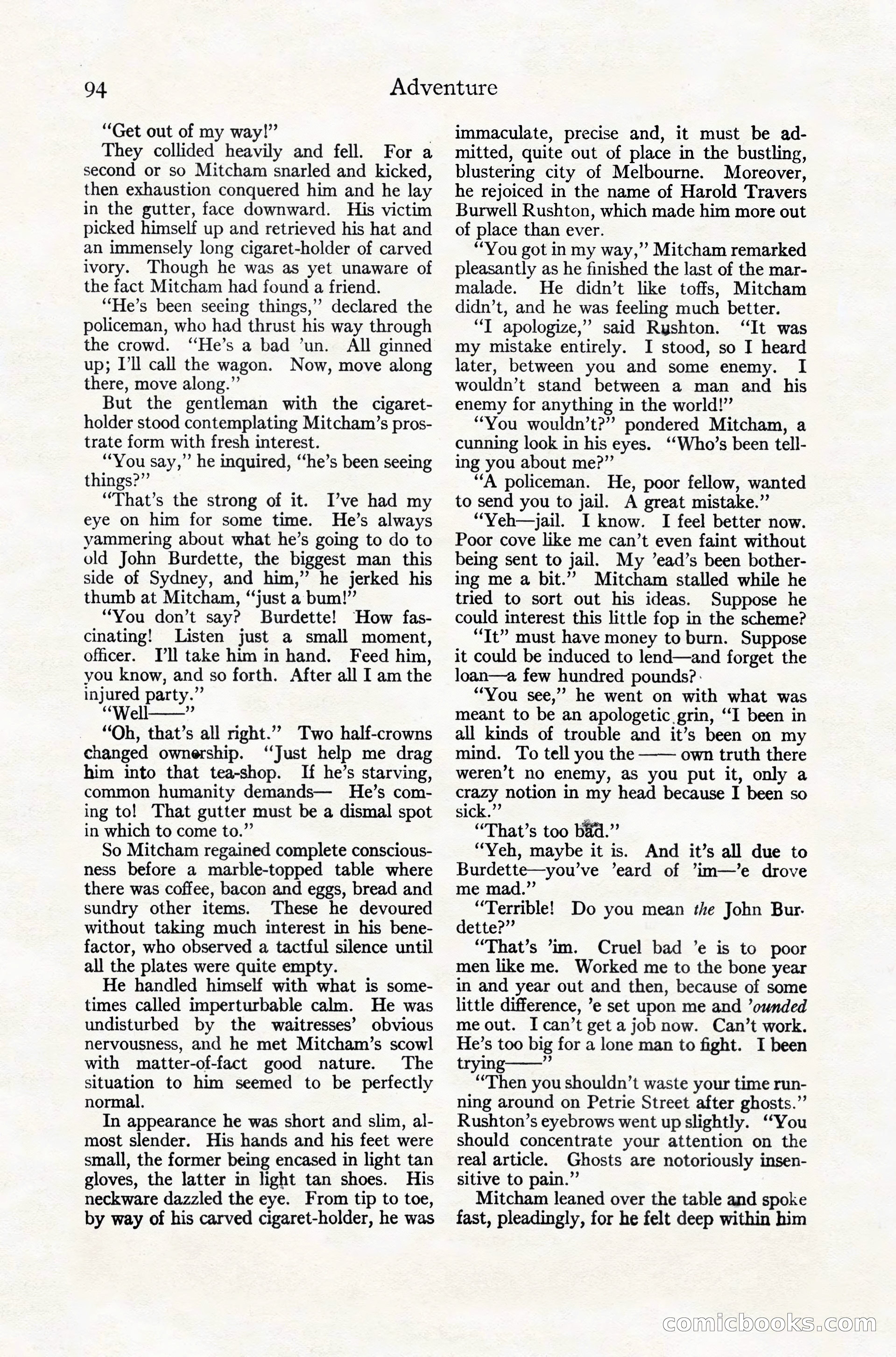
A restored page from Pulp Fiction, 1924. Page through the whole issue in the reader above.
📄 Transcribed text from this page (OCR, searchable)
Machine-transcribed from the original scan — historical spelling and the odd misread are preserved.
94 “Get out of my way!” , They collided heavily and fell. For a second or so Mitcham snarled and kicked, then exhaustion conquered him and he lay in the gutter, face downward. His victim picked himself up and retrieved his hat and an immensely long cigaret-holder of carved ivory. Though he was as yet unaware of the fact Mitcham had found a friend. ‘“‘He’s been seeing things,” declared the policeman, who had thrust his way through the crowd. ‘‘He’s a bad ’un. All ginned up; I'll call the wagon. Now, move along there, move along.”’ But the gentleman with the cigaret- holder stood contemplating Mitcham’s pros- trate form with fresh interest. “You say,’’ he inquired, ‘“‘he’s been seeing things?” “That’s the strong of it. Dve had my eye on him for some time. He’s always yammering about what he’s going to do to old John Burdette, the biggest man this side of Sydney, and him,” he jerked his thumb at Mitcham, “‘just a bum!”’ “You don’t say? Burdette! How fas- cinating! Listen just a small moment, officer. Jl take him in hand. Feed him, you know, and so forth. After all I am the injured party.” ‘W/e]|-———” “Oh, that’s all mght.”” Two half-crowns changed ownership. “Just help me drag him into that tea-shop. If he’s starving, common humanity demands— He’s com- ing to! That gutter must be a dismal spot in which to come to.” So Mitcham regained complete conscious- ness before a marble-topped table where there was coffee, bacon and eggs, bread and sundry other items. These he devoured without taking much interest in his bene- factor, who observed a tactful silence until all the plates were quite empty. He handled himself with what is some- times called imperturbable calm. He was undisturbed by the waitresses’ obvious nervousness, and he met Mitcham’s scowl with matter-of-fact good nature. The situation to him seemed to be perfectly normal. In appearance he was short and slim, al- most slender. His hands and his feet were small, the former being encased in light tan gloves, the latter in light tan shoes. His neckware dazzled the eye. From tip to toe, by way of his carved cigaret-holder, he was Adventure immaculate, precise and, it must be ad- mitted, quite out of place in the bustling, blustering city of Melbourne. Moreover, he rejoiced in the name of Harold Travers Burwell Rushton, which made him more out of place than ever. “You got in my way,’’ Mitcham remarked pleasantly as he finished the last of the mar- malade. He didn’t like toffs, Mitcham didn’t, and he was feeling much better. “I apologize,” said Ryshton. “It was my mistake entirely. I stood, so I heard later, between you and some enemy. I wouldn’t stand between a man and his enemy for anything in the world!” ‘You wouldn’t?” pondered Mitcham, a cunning look in his eyes. ‘‘Who’s been tell- ing you about me?” ‘“‘A policeman. He, poor fellow, wanted to send you to jail. A great mistake.” “VYeh—jail. I know. I feel better now. Poor cove like me can’t even faint without being sent to jail. My ’ead’s been bother- ing me a bit.” Mitcham stalled while he tried to sort out his ideas. Suppose he could interest this little fop in the scheme? “It” must have money to burn. Suppose it could be induced to lend—and forget the loan—a few hundred pounds? : “You see,” he went on with what was meant to be an apologetic grin, “I been in all kinds of trouble and it’s been on my mind. To tell you the —— own truth there weren’t no enemy, as you put it, only a crazy notion in my head because I been so sick.”’ “That’s too bad.” “Yeh, maybe it is. And it’s all due to Burdette—you’ve ’eard of ’im—’e drove me mad.” “Terrible! Do you mean the John Bur. dette?”’ “That’s ’im. Cruel bad ’e is to poor men like me. Worked me to the bone year in and year out and then, because of some little difference, ’e set upon me and ’ounded me out. I can’t get a job now. Can’t work. He’s too big for a lone man to fight. I been ing 23 “Then you shouldn’t waste your time run- ning around on Petrie Street after ghosts.”’ Rushton’s eyebrows went up slightly. “You should concentrate your attention on the real article. Ghosts are notoriously insen- sitive to pain.” Mitcham leaned over the table and spoke fast, pleadingly, for he felt deep within him GO NOOK 1O)