
Pulp Fiction, 1924 · page 135 of 204
Adventure Magazine Cover — page 135: what you’re looking at
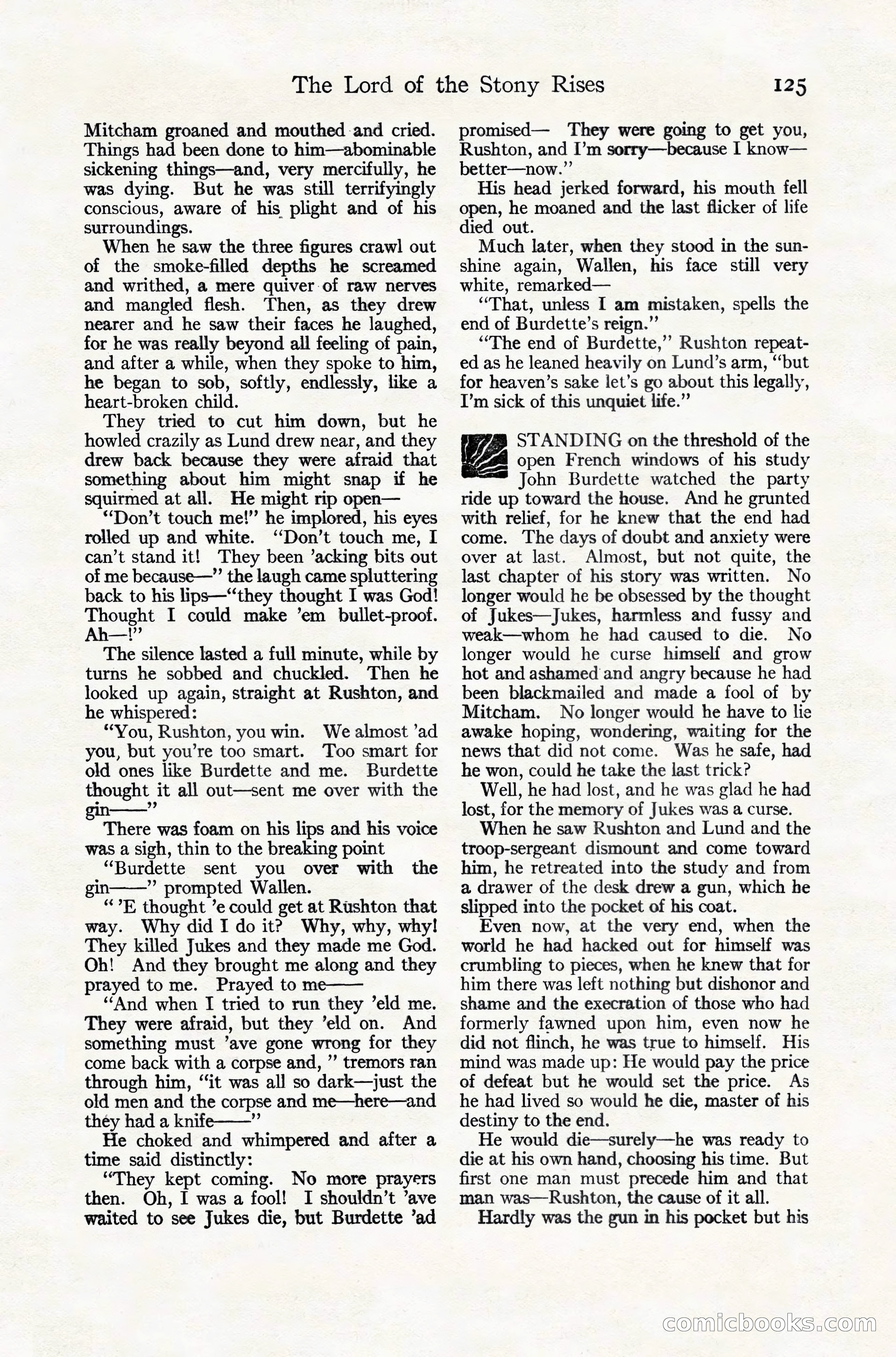
A restored page from Pulp Fiction, 1924. Page through the whole issue in the reader above.
📄 Transcribed text from this page (OCR, searchable)
Machine-transcribed from the original scan — historical spelling and the odd misread are preserved.
The Lord of the Stony Rises Mitcham groaned and mouthed and cried. Things had been done to him—abominable sickening things—and, very mercifully, he was dying. But he was still terrifyingly conscious, aware of his plight and of his surroundings. When he saw the three figures crawl out of the smoke-filled depths he screamed and writhed, a mere quiver of raw nerves and mangled flesh. Then, as they drew nearer and he saw their faces he laughed, for he was really beyond all feeling of pain, and after a while, when they spoke to him, he began to sob, softly, endlessly, like a heart-broken child. They tried to cut him down, but he howled crazily as Lund drew near, and they drew back because they were afraid that something about him might snap if he squirmed at all. He might rip open— “Don’t touch me!” he implored, his eyes rolled up and white. ‘Don’t touch me, I can’t stand it! They been ’acking bits out of me because—”’ the laugh came spluttering back to his lips—“they thought I was God! Thought I could make ’em bullet-proof. Ah—! 9 The silence lasted a full minute, while by turns he sobbed and chuckled. Then he looked up again, straight at Rushton, and he whispered: “You, Rushton, you win. We almost ’ad you, but you’re too smart. Too smart for old ones like Burdette and me. Burdette thought it all out—sent me over with the There was foam on his lips and his voice was a sigh, thin to the breaking point “Burdette sent you over with the gin——”’ prompted Wallen. “°F thought ’e could get at Rushton that way. Why did I doit? Why, why, why! They killed Jukes and they made me God. Oh! And they brought me along and they prayed tome. Prayed to me—— ‘‘And when I tried to run they ’eld me. They were afraid, but they ’eld on. And something must ’ave gone wrong for they come back with a corpse and, ” tremors ran through him, “it was all so dark—just the old men and the corpse and me—here—and they had a knife——”’ He choked and whimpered and after a time said distinctly: “They kept coming. No more prayers then. Oh, I was a fool! I shouldn’t ’ave waited to see Jukes die, but Burdette ’ad 125 promised— They were going to get you, Rushton, and I’m sorry—because I know— better—now.”’ His head jerked forward, his mouth fell open, he moaned and the last flicker of life died out. Much later, when they stood in the sun- shine again, Wallen, his face still very white, remarked— “That, unless [ am mistaken, spells the end of Burdette’s reign.” “The end of Burdette,’’ Rushton repeat- ed as he leaned heavily on Lund’s arm, “but for heaven’s sake let’s go about this legally, I’m sick of this unquiet life.” WZ open French windows of his study John Burdette watched the party ride up toward the house. And he grunted with relief, for he knew that the end had come. The days of doubt and anxiety were over at last. Almost, but not quite, the last chapter of his story was written. No longer would he be obsessed by the thought of Jukes—Jukes, harmless and fussy and weak—whom he had caused to die. No longer would he curse himself and grow hot and ashamed and angry because he had been blackmailed and made a fool of by Mitcham. No longer would he have to lie awake hoping, wondering, waiting for the news that did not come. Was he safe, had he won, could he take the last trick? Well, he had lost, and he was glad he had lost, for the memory of Jukes was a curse. When he saw Rushton and Lund and the troop-sergeant dismount and come toward him, he retreated into the study and from a drawer of the desk drew a gun, which he slipped into the pocket of his coat. Even now, at the very end, when the world he had hacked out for himself was crumbling to pieces, when he knew that for him there was left nothing but dishonor and shame and the execration of those who had formerly fawned upon him, even now he did not flinch, he was true to himself. His mind was made up: He would pay the price of defeat but he would set the price. As he had lived so would he die, master of his destiny to the end. He would die—surely—he was ready to die at his own hand, choosing his time. But first one man must precede him and that man was—Rushton, the cause of it all. Hardly was the gun in his pocket but his STANDING on the threshold of the Go DOOK 1 @)