
Pulp Fiction, 1924 · page 15 of 204
Adventure Magazine Cover — page 15: what you’re looking at
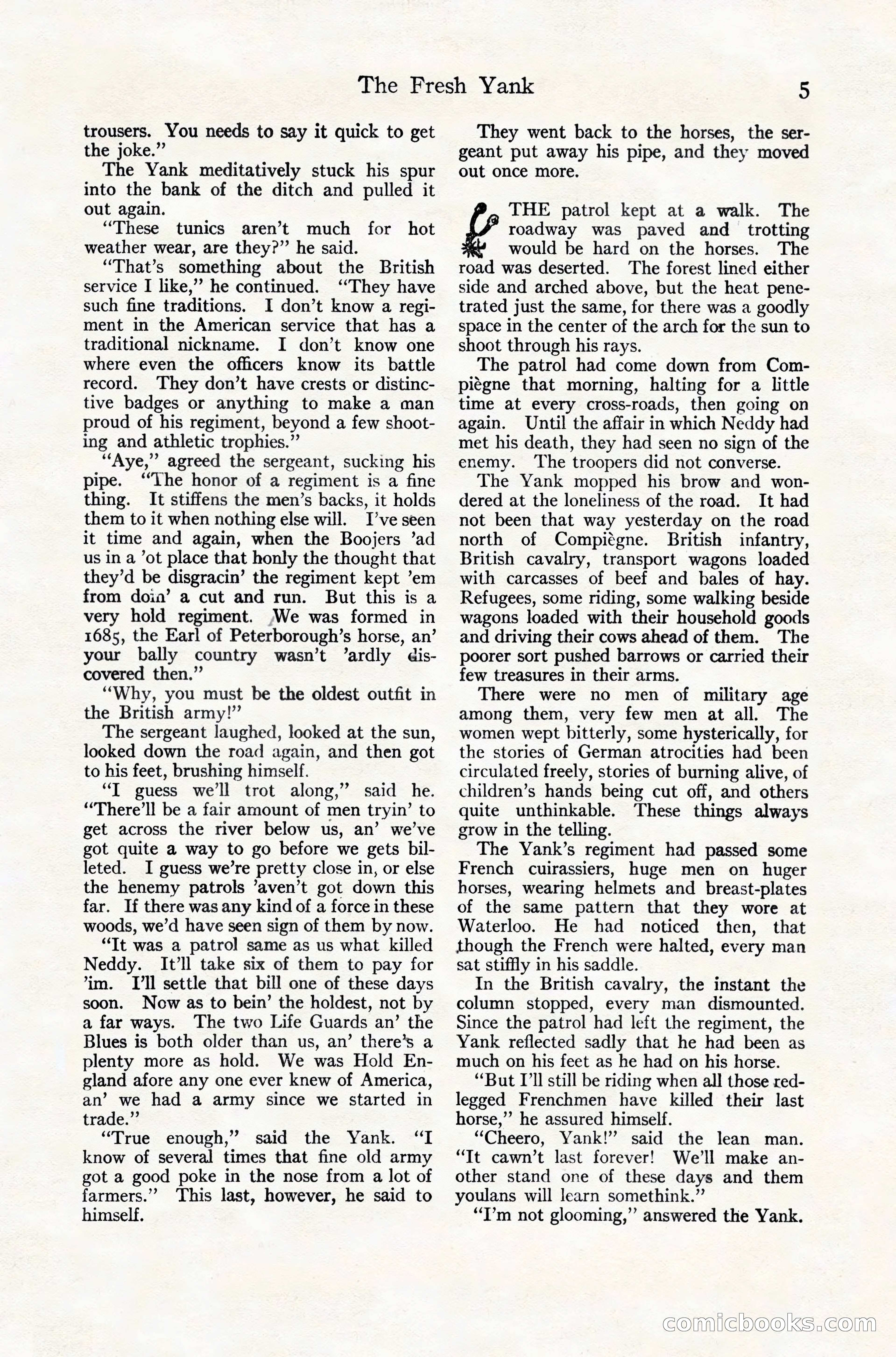
A restored page from Pulp Fiction, 1924. Page through the whole issue in the reader above.
📄 Transcribed text from this page (OCR, searchable)
Machine-transcribed from the original scan — historical spelling and the odd misread are preserved.
The Fresh Yank 5 trousers. You needs to say it quick to get the joke.” The Yank meditatively stuck his spur into the bank of the ditch and pulled it out again. “These tunics aren’t much for hot weather wear, are they?” he said. “That’s something about the British service I like,” he continued. ‘They have such fine traditions. I don’t know a regi- ment in the American service that has a traditional nickname. I don’t know one where even the officers know its battle record. They don’t have crests or distinc- tive badges or anything to make a man proud of his regiment, beyond a few shoot- ing and athletic trophies.”’ “Aye,” agreed the sergeant, sucking his pipe. ‘Lhe honor of a regiment is a fine thing. It stiffens the men’s backs, it holds them to it when nothing else will. I’ve seen it time and again, when the Boojers ’ad us in a ’ot place that honly the thought that they’d be disgracin’ the regiment kept ’em from doia’ a cut and run. But this is a very hold regiment. We was formed in 1685, the Earl of Peterborough’s horse, an’ your bally country wasn’t ’ardly dis- covered then.” “Why, you must be the oldest outfit in the British army!” The sergeant laughed, looked at the sun, looked down the road again, and then got to his feet, brushing himself. “T guess we'll trot along,” said he. “There'll be a fair amount of men tryin’ to get across the river below us, an’ we’ve got quite a way to go before we gets bil- leted. I guess we’re pretty close in, or else the henemy patrols ’aven’t got down this far. If there was any kind of a force in these woods, we’d have seen sign of them by now. “It was a patrol same as us what killed Neddy. It'll take six of them to pay for im. I'll settle that bill one of these days soon. Now as to bein’ the holdest, not by a far ways. The two Life Guards an’ the Blues is both older than us, an’ there’s a plenty more as hold. We was Hold En- gland afore any one ever knew of America, an’ we had a army since we started in trade.” “True enough,” said the Yank. “I know of several times that fine old army got a good poke in the nose from a lot of farmers.” This last, however, he said to himself. They went back to the horses, the ser- geant put away his pipe, and they moved out once more. £ roadway was paved and _ trotting would be hard on the horses. The road was deserted. The forest lined either side and arched above, but the heat pene- trated just the same, for there was a goodly space in the center of the arch for the sun to shoot through his rays. The patrol had come down from Com- piégne that morning, halting for a little time at every cross-roads, then going on again. Until the affair in which Neddy had met his death, they had seen no sign of the enemy. ‘The troopers did not converse. The Yank mopped his brow and won- dered at the loneliness of the road. It had not been that way yesterday on the road north of Compiégne. British infantry, British cavalry, transport wagons loaded with carcasses of beef and bales of hay. Refugees, some riding, some walking beside wagons loaded with their household goods and driving their cows ahead of them. The poorer sort pushed barrows or carried their few treasures in their arms. There were no men of military age among them, very few men at all. The women wept bitterly, some hysterically, for the stories of German atrocities had been circulated freely, stories of burning alive, of children’s hands being cut off, and others quite unthinkable. These things always grow in the telling. The Yank’s regiment had passed some French cuirassiers, huge men on huger horses, wearing helmets and breast-plates of the same pattern that they wore at Waterloo. He had noticed then, that though the French were halted, every man sat stiffly in his saddle. In the British cavalry, the instant the column stopped, every man dismounted. Since the patrol had left the regiment, the Yank reflected sadly that he had been as much on his feet as he had on his horse. “But [ll still be riding when all those red- legged Frenchmen have killed their last horse,” he assured himself. “Cheero, Yank!” said the lean man. “It cawn’t last forever! We'll make an- other stand one of these days and them youlans will learn somethink.” “I’m not glooming,” answered the Yank. THE patrol kept at a walk. The Go NOOK 1 @)