
Pulp Fiction, 1924 · page 173 of 204
Adventure Magazine Cover — page 173: what you’re looking at
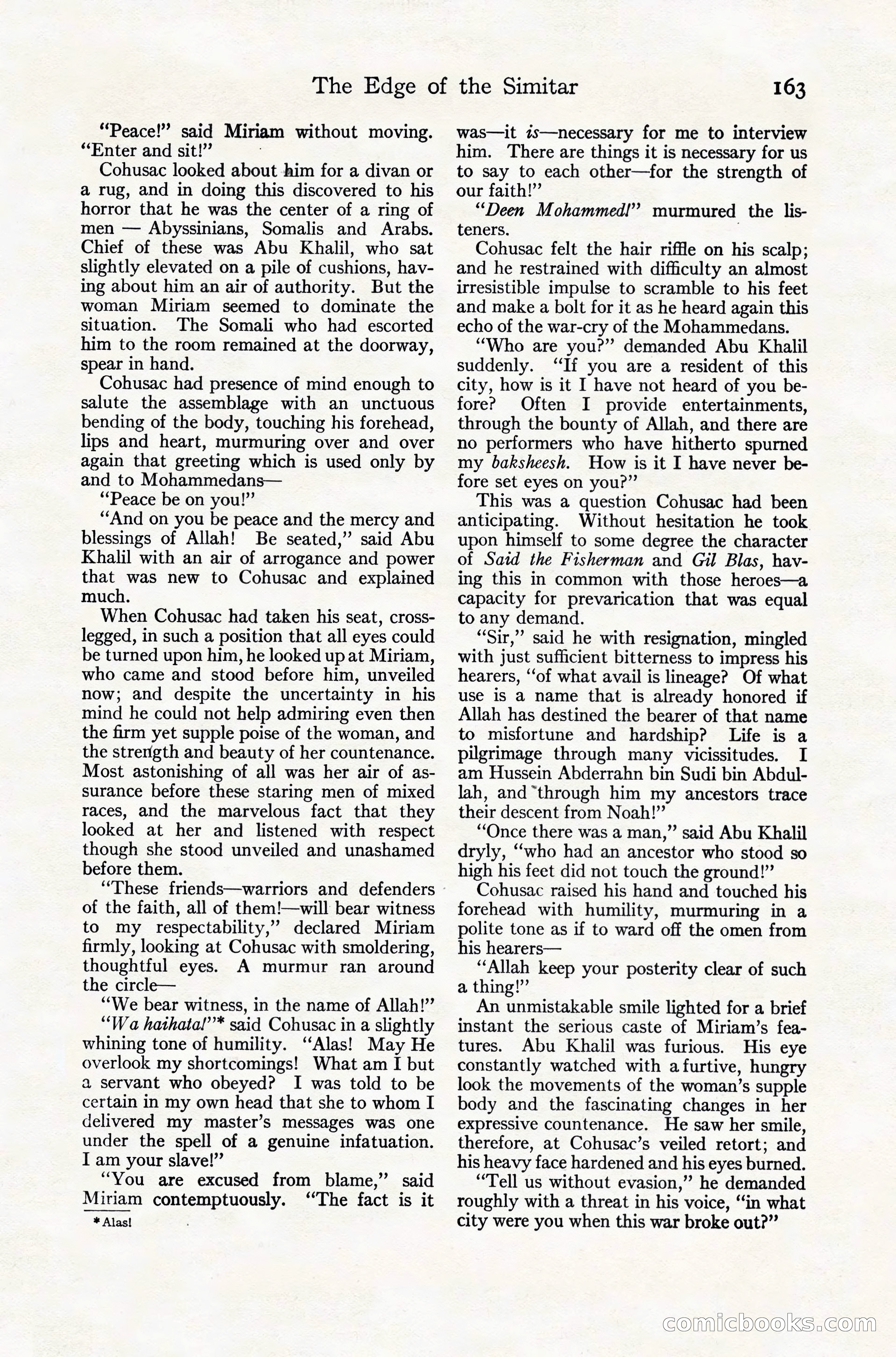
A restored page from Pulp Fiction, 1924. Page through the whole issue in the reader above.
📄 Transcribed text from this page (OCR, searchable)
Machine-transcribed from the original scan — historical spelling and the odd misread are preserved.
The Edge of the Simitar “Peace!”’ said Miriam without moving. “Enter and sit!” Cohusac looked about him for a divan or a rug, and in doing this discovered to his horror that he was the center of a ring of men — Abyssinians, Somalis and Arabs. Chief of these was Abu Khalil, who sat slightly elevated on a pile of cushions, hav- ing about him an air of authority. But the woman Miriam seemed to dominate the situation. The Somali who had escorted him to the room remained at the doorway, spear in hand. Cohusac had presence of mind enough to salute the assemblage with an unctuous bending of the body, touching his forehead, lips and heart, murmuring over and over again that greeting which is used only by and to Mohammedans— “‘Peace be on you!”’ ‘“‘And on you be peace and the mercy and blessings of Allah! Be seated,” said Abu Khalil with an air of arrogance and power that was new to Cohusac and explained much. When Cohusac had taken his seat, cross- legged, in such a position that all eyes could be turned upon him, he looked up at Miriam, who came and stood before him, unveiled now; and despite the uncertainty in his mind he could not help admiring even then the firm yet supple poise of the woman, and the strength and beauty of her countenance. Most astonishing of all was her air of as- surance before these staring men of mixed races, and the marvelous fact that they looked at her and listened with respect though she stood unveiled and unashamed before them. ‘These friends—warriors and defenders of the faith, all of them!—will bear witness to my respectability,” declared Miriam firmly, looking at Cohusac with smoldering, thoughtful eyes. A murmur ran around the circle— ‘We bear witness, in the name of Allah!” “Wa hathatal’* said Cohusac in a slightly whining tone of humility. ‘Alas! May He overlook my shortcomings! What am I but a servant who obeyed? I was told to be certain in my own head that she to whom I delivered my master’s messages was one under the spell of a genuine infatuation. I am your slave!”’ “You are excused from blame,’ said Miriam contemptuously. ‘The fact is it * Alas! 163 was—it zs—necessary for me to interview him. There are things it is necessary for us to say to each other—for the strength of our faith!” “Deen Mohammed!’ murmured the lis- teners. . Cohusac felt the hair riffle on his scalp; and he restrained with difficulty an almost irresistible impulse to scramble to his feet and make a bolt for it as he heard again this echo of the war-cry of the Mohammedans. ‘“‘Who are you?” demanded Abu Khalil suddenly. “If you are a resident of this city, how is it I have not heard of you be- fore? Often I provide entertainments, through the bounty of Allah, and there are no performers who have hitherto spurned my baksheesh. How is it I have never be- fore set eyes on your” This was a question Cohusac had been anticipating. Without hesitation he took upon himself to some degree the character of Satd the Fisherman and Gil Blas, hav- ing this in common with those heroes—a capacity for prevarication that was equal to any demand. “Sir,” said he with resignation, mingled with just sufficient bitterness to impress his hearers, “of what avail is lineage? Of what use 1s a name that is already honored if Allah has destined the bearer of that name to misfortune and hardship? Life is a pilgrimage through many vicissitudes. I am Hussein Abderrahn bin Sudi bin Abdul- lah, and “through him my ancestors trace their descent from Noah!” “Once there was a man,” said Abu Khalil dryly, “who had an ancestor who stood so high his feet did not touch the ground!” Cohusac raised his hand and touched his forehead with humility, murmuring in a polite tone as if to ward off the omen from his hearers— ‘Allah keep your posterity clear of such a thing!” An unmistakable smile lighted for a brief instant the serious caste of Miriam’s fea- tures. Abu Khalil was furious. His eye constantly watched with a furtive, hungry look the movements of the woman’s supple body and the fascinating changes in her expressive countenance. He saw her smile, therefore, at Cohusac’s veiled retort; and his heavy face hardened and his eyes burned. ‘Tell us without evasion,” he demanded roughly with a threat in his voice, ‘‘in what city were you when this war broke out?”’ GO DOOK 1 O)