
Pulp Fiction, 1924 · page 180 of 204
Adventure Magazine Cover — page 180: what you’re looking at
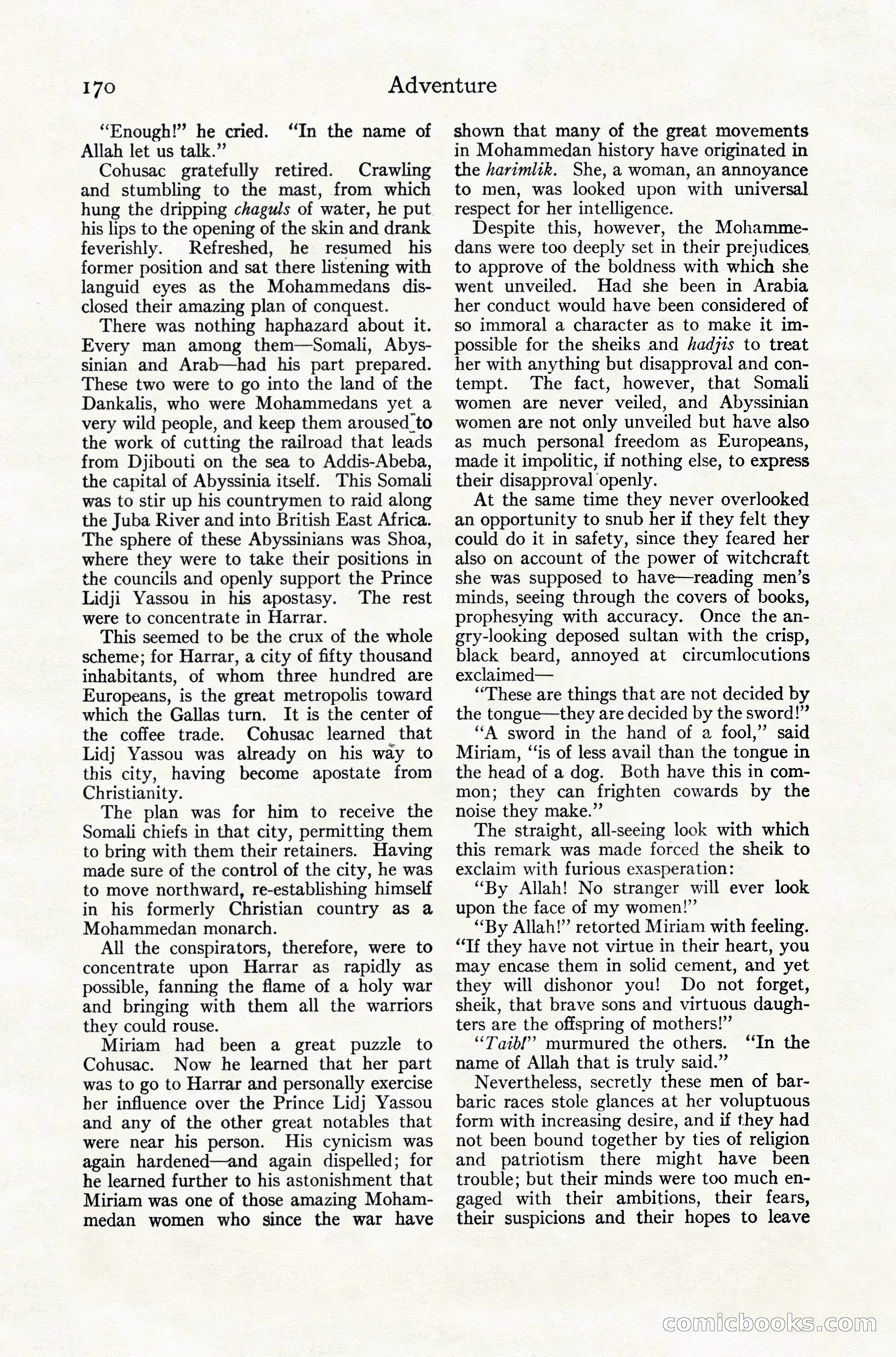
A restored page from Pulp Fiction, 1924. Page through the whole issue in the reader above.
📄 Transcribed text from this page (OCR, searchable)
Machine-transcribed from the original scan — historical spelling and the odd misread are preserved.
170 “Enough!” he cried. “In the name of Allah let us talk.” Cohusac gratefully retired. Crawling and stumbling to the mast, from which hung the dripping chaguls of water, he put his lips to the opening of the skin and drank feverishly. Refreshed, he resumed his former position and sat there listening with languid eyes as the Mohammedans dis- closed their amazing plan of conquest. There was nothing haphazard about it. Every man among them—Somali, Abys- sinian and Arab—had his part prepared. These two were to go into the land of the Dankalis, who were Mohammedans yet a very wild people, and keep them aroused to the work of cutting the railroad that leads from Djibouti on the sea to Addis-Abeba, the capital of Abyssinia itself. This Somali was to stir up his countrymen to raid along the Juba River and into British East Africa. The sphere of these Abyssinians was Shoa, where they were to take their positions in the councils and openly support the Prince Lidji Yassou in his apostasy. The rest were to concentrate in Harrar. This seemed to be the crux of the whole scheme; for Harrar, a city of fifty thousand inhabitants, of whom three hundred are Europeans, is the great metropolis toward which the Gallas turn. It is the center of the coffee trade. Cohusac learned that Lidj Yassou was already on his way to this city, having become apostate from Christianity. The plan was for him to receive the Somali chiefs in that city, permitting them to bring with them their retainers. Having made sure of the control of the city, he was to move northward, re-establishing himself in his formerly Christian country as a Mohammedan monarch. All the conspirators, therefore, were to concentrate upon Harrar as rapidly as possible, fanning the flame of a holy war and bringing with them all the warriors they could rouse. Miriam had been a great puzzle to Cohusac. Now he learned that her part was to go to Harrar and personally exercise ber influence over the Prince Lidj Yassou and any of the other great notables that were near his person. His cynicism was again hardened—and again dispelled; for he learned further to his astonishment that Miriam was one of those amazing Moham- medan women who since the war have Adventure shown that many of the great movements in Mohammedan history have originated in the harimlik. She, a woman, an annoyance to men, was looked upon with universal respect for her intelligence. Despite this, however, the Mohamme- dans were too deeply set in their prejudices to approve of the boldness with which she went unveiled. Had she been in Arabia her conduct would have been considered of so immoral a character as to make it im- possible for the sheiks and hadj1s to treat her with anything but disapproval and con- tempt. The fact, however, that Somali women are never veiled, and Abyssinian women are not only unveiled but have also as much personal freedom as Europeans, made it impolitic, if nothing else, to express their disapproval openly. At the same time they never overlooked an opportunity to snub her if they felt they could do it in safety, since they feared her also on account of the power of witchcraft she was supposed to have—reading men’s minds, seeing through the covers of books, prophesying with accuracy. Once the an- gry-looking deposed sultan with the crisp, black beard, annoyed at circumlocutions exclaimed— ‘“‘These are things that are not decided by the tongue—they are decided by the sword!” “‘A sword in the hand of a fool,” said Miriam, ‘‘is of less avail than the tongue in the head of a dog. Both have this in com- mon; they can frighten cowards by the noise they make.”’ The straight, all-seeing look with which this remark was made forced the sheik to exclaim with furious exasperation: “By Allah! No stranger will ever look upon the face of my women!” “By Allah!’ retorted Miriam with feeling. “Tf they have not virtue in their heart, you may encase them in solid cement, and yet they will dishonor you! Do not forget, sheik, that brave sons and virtuous daugh- ters are the offspring of mothers!’ “Taibl?’” murmured the others. name of Allah that is truly said.” Nevertheless, secretly these men of bar- baric races stole glances at her voluptuous form with increasing desire, and if they had not been bound together by ties of religion and patriotism there might have been trouble; but their minds were too much en- gaged with their ambitions, their fears, their suspicions and their hopes to leave “In the Go DOOK 1 @)