
Pulp Fiction, 1924 · page 191 of 204
Adventure Magazine Cover — page 191: what you’re looking at
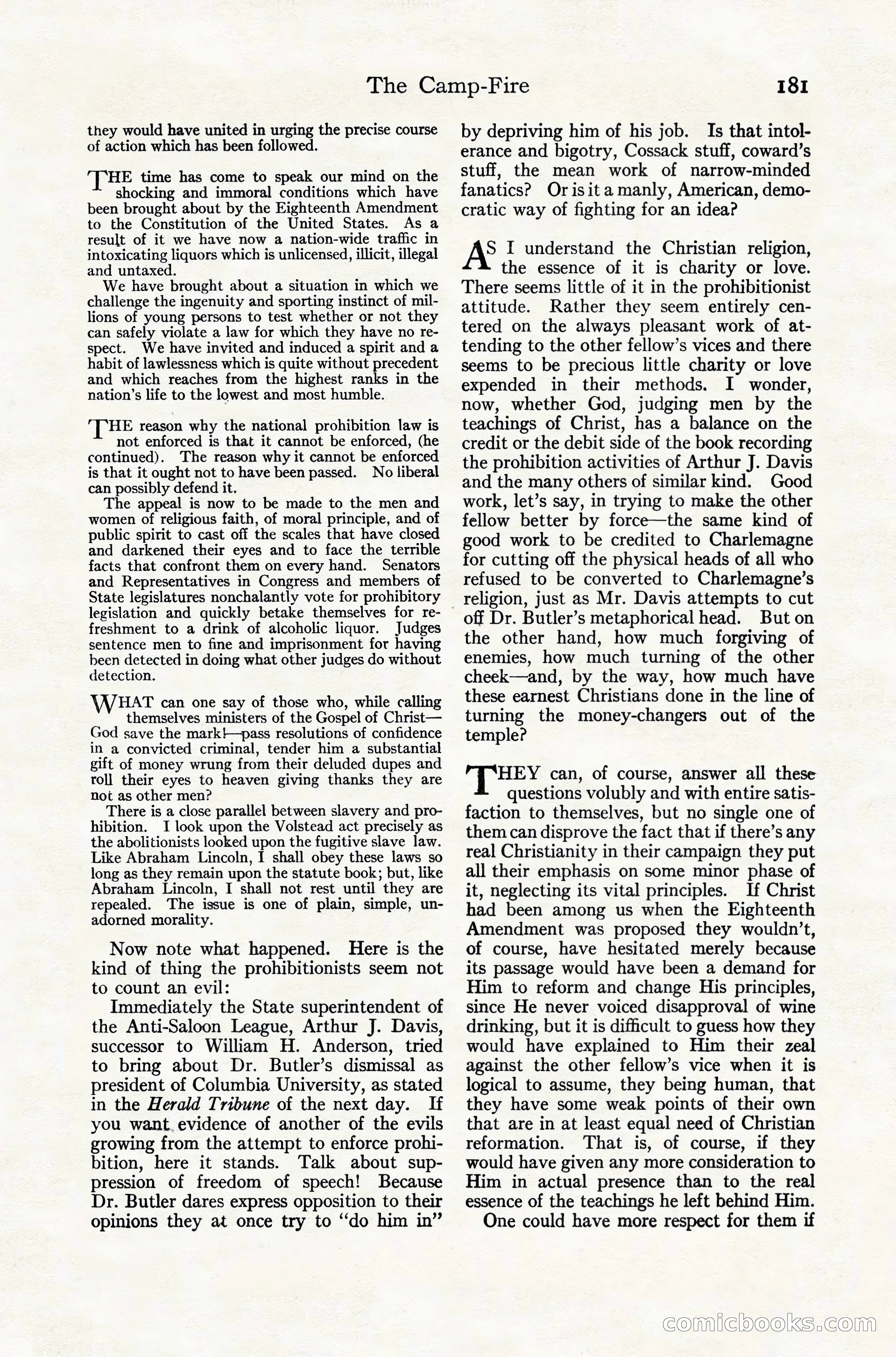
A restored page from Pulp Fiction, 1924. Page through the whole issue in the reader above.
📄 Transcribed text from this page (OCR, searchable)
Machine-transcribed from the original scan — historical spelling and the odd misread are preserved.
The Camp-Fire they would have united in urging the precise course of action which has been followed. ‘THE time has come to speak our mind on the shocking and immoral conditions which have been brought about by the Eighteenth Amendment to the Constitution of the United States. As a result of it we have now a nation-wide traffic in intoxicating liquors which is unlicensed, illicit, illegal and untaxed. We have brought about a situation in which we challenge the ingenuity and sporting instinct of mil- lions of young persons to test whether or not they can safely violate a law for which they have no re- spect. We have invited and induced a spirit and a habit of lawlessness which is quite without precedent and which reaches from the highest ranks in the nation’s life to the lowest and most humble. ‘THE reason why the national prohibition law is not enforced is that it cannot be enforced, (he continued). The reason why it cannot be enforced is that it ought not to have been passed. No liberal can possibly defend it. The appeal is now to be made to the men and women of religious faith, of moral principle, and of public spirit to cast off the scales that have closed and darkened their eyes and to face the terrible facts that confront them on every hand. Senators and Representatives in Congress and members of State legislatures nonchalantly vote for prohibitory legislation and quickly betake themselves for re- freshment to a drink of alcoholic liquor. Judges sentence men to fine and imprisonment for having been detected in doing what other judges do without detection. HAT can one say of those who, while calling themselves ministers of the Gospel of Christ— God save the mark!—pass resolutions of confidence in a convicted criminal, tender him a substantial gift of money wrung from their deluded dupes and roll their eyes to heaven giving thanks they are noi as other men? There is a close parallel between slavery and pro- hibition. I look upon the Volstead act precisely as the abolitionists looked upon the fugitive slave law. Like Abraham Lincoln, I shall obey these laws so long as they remain upon the statute book; but, like Abraham Lincoln, I shall not rest until they are repealed. The issue is one of plain, simple, un- adorned morality. Now note what happened. Here is the kind of thing the prohibitionists seem not to count an evil: Immediately the State superintendent of the Anti-Saloon League, Arthur J. Davis, successor to William H. Anderson, tried to bring about Dr. Butler’s dismissal as president of Columbia University, as stated in the Herald Tribune of the next day. If you want. evidence of another of the evils growing from the attempt to enforce prohi- bition, here it stands. Talk about sup- pression of freedom of speech! Because Dr. Butler dares express opposition to their opinions they at once try to ‘do him in” 181 by depriving him of his job. Is that intol- erance and bigotry, Cossack stuff, coward’s stuff, the mean work of narrow-minded fanatics? Orisita manly, American, demo- cratic way of fighting for an idea? Ae I understand the Christian religion, the essence of it is charity or love. There seems little of it in the prohibitionist attitude. Rather they seem entirely cen- tered on the always pleasant work of at- tending to the other fellow’s vices and there seems to be precious little charity or love expended in their methods. I wonder, now, whether God, judging men by the teachings of Christ, has a balance on the credit or the debit side of the book recording the prohibition activities of Arthur J. Davis and the many others of similar kind. Good work, let’s say, in trying to make the other fellow better by force—the same kind of good work to be credited to Charlemagne for cutting off the physical heads of all who refused to be converted to Charlemagne’s religion, just as Mr. Davis attempts to cut off Dr. Butler’s metaphorical head. But on the other hand, how much forgiving of enemies, how much turning of the other cheek—and, by the way, how much have these earnest Christians done in the line of turning the money-changers out of the temple? HEY can, of course, answer all these questions volubly and with entire satis- faction to themselves, but no single one of them can disprove the fact that if there’s any real Christianity in their campaign they put all their emphasis on some minor phase of it, neglecting its vital principles. If Christ had been among us when the Eighteenth Amendment was proposed they wouldn't, of course, have hesitated merely because its passage would have been a demand for Him to reform and change His principles, since He never voiced disapproval of wine drinking, but it is difficult to guess how they would have explained to Him their zeal against the other fellow’s vice when it is logical to assume, they being human, that they have some weak points of their own that are in at least equal need of Christian reformation. ‘That is, of course, if they would have given any more consideration to Him in actual presence than to the real essence of the teachings he left behind Him. One could have more respect for them if TOO So C©@