
Pulp Fiction, 1924 · page 199 of 204
Adventure Magazine Cover — page 199: what you’re looking at
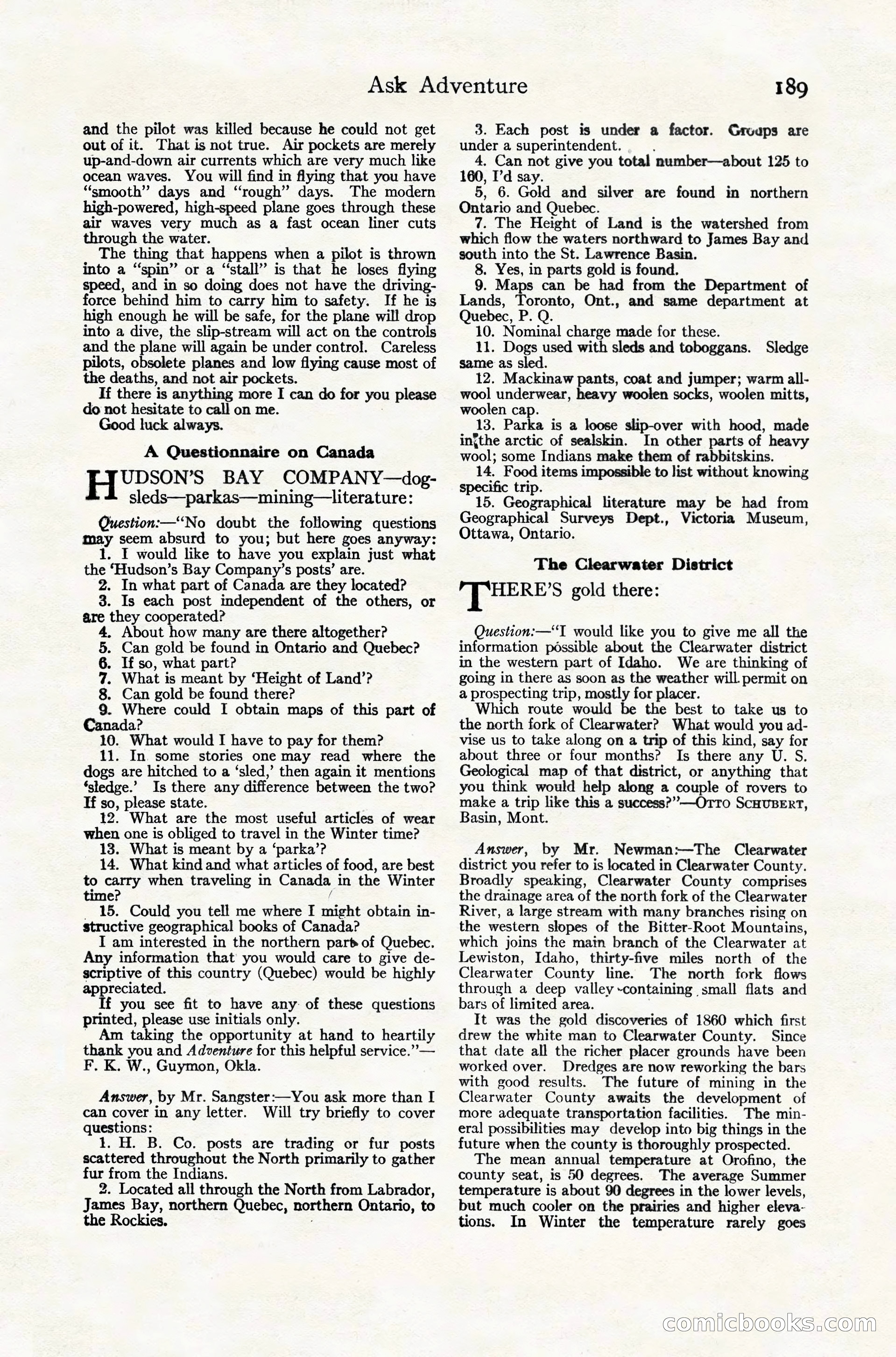
A restored page from Pulp Fiction, 1924. Page through the whole issue in the reader above.
📄 Transcribed text from this page (OCR, searchable)
Machine-transcribed from the original scan — historical spelling and the odd misread are preserved.
Ask Adventure and the pilot was killed because he could not get out of it. That is not true. Air pockets are merely up-and-down air currents which are very much like ocean waves. You will find in flying that you have “smooth” days and “rough” days. The modern high-powered, high-speed plane goes through these air waves very much as a fast ocean liner cuts through the water. The thing that happens when a pilot is thrown into a “spin” or a “stall” is that he loses flying speed, and in so doing does not have the driving- force behind him to carry him to safety. If he is high enough he will be safe, for the plane will drop into a dive, the slip-stream will act on the controls and the plane will again be under control. Careless pilots, obsolete planes and low flying cause most of the deaths, and not air pockets. If there is anything more I can do for you please do not hesitate to call on me. Good luck always. A Questionnaire on Canada UDSON’S BAY COMPANY—dog- sleds—parkas—mining—literature: Question:—“No doubt the following questions may seem absurd to you; but here goes anyway: 1. I would like to have you explain just what the ‘Hudson’s Bay Company’s posts’ are. 2. In what part of Canada are they located? 3. Is each post independent of the others, or are they cooperated? 4, About how many are there altogether? 5. Can gold be found in Ontario and Quebec? 6. If so, what part? 7. What is meant by ‘Height of Land’? 8. Can gold be found there? 9. Where could I obtain maps of this part of Canada? 10. What would I have to pay for them? 11. In some stories one may read where the dogs are hitched to a ‘sled,’ then again it mentions ‘sledge.’ Is there any difference between the two? If so, please state. 12. What are the most useful articles of wear when one is obliged to travel in the Winter time? 13. What is meant by a ‘parka’? 14. What kind and what articles of food, are best to carry when traveling in Canada i in the Winter time? _ 15. Could you tell me where I at obtain in- structive geographical books of Canada? I am interested in the northern part of Quebec. Any information that you would care to give de- scriptive of this country (Quebec) would be highly appreciated. If you see fit to have any of these questions printed, please use initials only. - Am taking the opportunity at hand to heartily thank you and Adventure for this helpful service.” — F. K. W., Guymon, Okla. Answer, by Mr. Sangster:—You ask more than I can cover in any letter. Will try briefly to cover questions: 1. H. B. Co. posts are trading or fur posts scattered throughout the North primarily to gather fur from the Indians. 2. Located all through the North from Labrador, James Bay, northern Quebec, northern Ontario, to the Rockies. 189 3. Each post is under a factor. under a superintendent. 4. Can not give you total number—about 125 to 160, I’d say. 5, 6. Gold and silver are found in northern Ontario and Quebec. 7. The Height of Land is the watershed from which flow the waters northward to James Bay and south into the St. Lawrence Basin. 8. Yes, in parts gold is found. 9. Maps can be had from the Department of Lands, oe Ont., and same department at Quebec 10. N Se charge made for these. 11. Dogs used with sleds and toboggans. same as sled. 12. Mackinaw pants, coat and jumper; warm all- wool underwear, heavy woolen socks, woolen mitts, woolen cap. 13. Parka is a loose slip-over with hood, made in{the arctic of sealskin. In other parts of heavy ool ; some Indians make them of rabbitskins. 14. Food items impossible to list without knowing specific trip. 15. Geographical literature may be had from Geographical Surveys Dept., Victoria Museum, Ottawa, Ontario. The Clearwater District [HERE'S gold there: Groups are Sledge Question:—“T would like you to give me all the information possible about the Clearwater district in the western part of Idaho. We are thinking of going in there as soon as the weather will permit on a prospecting trip, mostly for placer. Which route would be the best to take us to the north fork of Clearwater? What would you ad- vise us to take along on a trip of this kind, say for about three or four months? Is there any U. S. Geological map of that district, or anything that you think would help along a couple of rovers to make a trip like this a success?” —OTTo SCHUBERT, Basin, Mont. Answer, by Mr. Newman:—The Clearwater district you refer to is located in Clearwater County. Broadly speaking, Clearwater County comprises the drainage area of the north fork of the Clearwater River, a large stream with many branches rising on the western slopes of the Bitter-Root Mountains, which joins the main branch of the Clearwater at Lewiston, Idaho, thirty-five miles north of the Clearwater County line. The north fork flows through a deep valley “containing small flats and bars of limited area. It was the gold discoveries of 1860 which first drew the white man to Clearwater County. Since that date all the richer placer grounds have been worked over. Dredges are now reworking the bars with good results. The future of mining in the Clearwater County awaits the development of more adequate transportation facilities. The min- eral possibilities may develop into big things in the future when the county is thoroughly prospected. The mean annual temperature at Orofino, the county seat, is 50 degrees. The average Summer temperature is about 90 degrees in the lower levels, but much cooler on the prairies and higher eleva- tions. In Winter the temperature rarely goes Giook (C©