
Pulp Fiction, 1924 · page 201 of 204
Adventure Magazine Cover — page 201: what you’re looking at
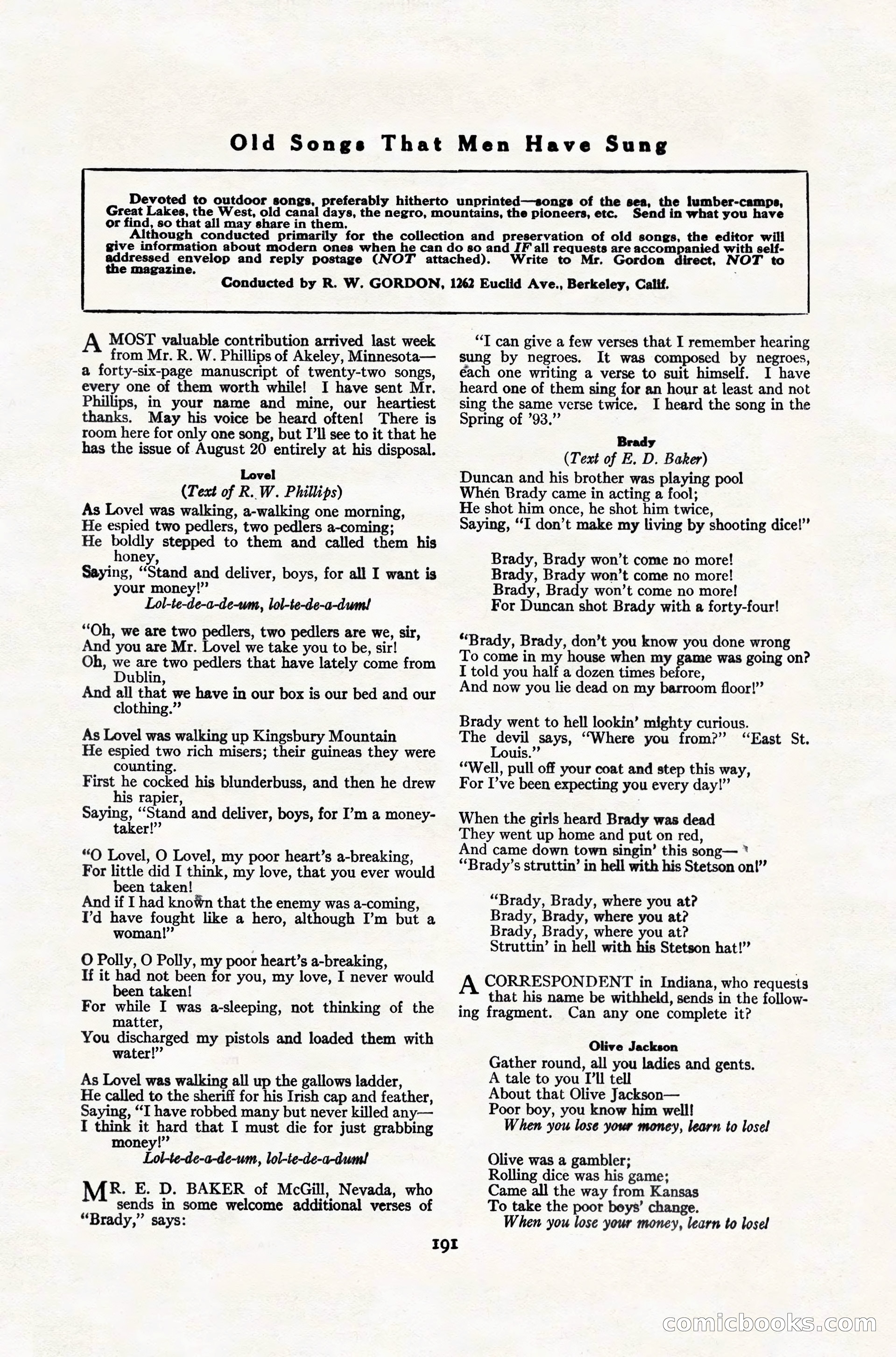
A restored page from Pulp Fiction, 1924. Page through the whole issue in the reader above.
📄 Transcribed text from this page (OCR, searchable)
Machine-transcribed from the original scan — historical spelling and the odd misread are preserved.
Old Songs That Men Have Sung Devoted to outdoor songs, preferably hitherto unprinted—songs of the sea, the lumber-camps, Great Lakes, the West, old canal days, the negro, mountains, the pioneers, etc. Send in what you have or find, so that all may share in them. Although conducted primarily for the collection and preservation of old songs, the editor will give information about modern ones when he can do so and IF all requests are accompanied with self- addressed envelop and reply postage (NOT attached). the magazine. Write to Mr. Gordon direct, NOT to Conducted by R. W. GORDON, 1262 Euclid Ave., Berkeley, Calif. A MOST valuable contribution arrived last week from Mr. R. W. Phillips of Akeley, Minnesota— a forty-six-page manuscript of twenty-two songs, every one of them worth while! I have sent Mr. Phillips, in your name and mine, our heartiest thanks. May his voice be heard often! There is room here for only one song, but I’ll see to it that he has the issue of August 20 entirely at his disposal. Lovel (Text of R. W. Phillips) As Lovel was walking, a-walking one morning, He espied two pedlers, two pedlers a-coming; He peels stepped to them and called them his oney, Saying, “Stand and deliver, boys, for all I want is your money!” Lol-te-de-a-de-wm, lol-te-de-a-duml “Oh, we are two pedlers, two pedlers are we, sir, And you are Mr. Lovel we take you to be, sir! Oh, we are two pedlers that have lately come from Dublin, And all that we have in our box is our bed and our clothing.”’ As Lovel was walking up Kingsbury Mountain He espied two rich misers; their guineas they were counting. First he cocked his blunderbuss, and then he drew his rapier, seme, ene and deliver, boys, for I’m a money- taker!” “O Lovel, O Lovel, my poor heart’s a-breaking, For little did I think, my love, that you ever would been taken! And if I had knoWn that the enemy was a-coming, I'd have fought like a hero, although I’m but a woman!’’ O Polly, O Polly, my poor heart’s a-breaking, If it had not been for you, my love, I never would been taken! For while I was a-sleeping, not thinking of the matter, You discharged my pistols and loaded them with water!”’ As Lovel was walking all up the gallows ladder, He called to the sheriff for his Irish cap and feather, Saying, “I have robbed many but never killed any— I think it hard that I must die for just grabbing money!”’ Lol-te-de-a-de-um, lol-ie-de-a-duml R. E. D. BAKER of McGill, Nevada, who sends in some welcome additional verses of “Brady,” says: “IT can give a few verses that I remember hearing sung by negroes, It was composed by negroes, each one writing a verse to suit himself. I have heard one of them sing for an hour at least and not sing the same verse twice. I heard the song in the Spring of ’93.” Brady (Text of E. D. Baker) Duncan and his brother was playing pool When Brady came in acting a fool; He shot him once, he shot him twice, Saying, “I don’t make my living by shooting dice!”’ Brady, Brady won’t come no more! Brady, Brady won’t come no more! Brady, Brady won’t come no more! For Duncan shot Brady with a forty-four! “Brady, Brady, don’t you know you done wrong To come in my house when my game was going on? I told you half a dozen times before, And now you lie dead on my barroom floor!” Brady went to hell lookin’ mighty curious. The devil says, “Where you from?” “East St. Louis.” “Well, pull off your coat and step this way, For I’ve been expecting you every day!” When the girls heard Brady was dead They went up home and put on red, And came down town singin’ this song— * “Brady’s struttin’ in hell with his Stetson on!” “Brady, Brady, where you at? Brady, Brady, where you at? Brady, Brady, where you at? Struttin’ in hell with his Stetson hat!’’ A CORRESPONDENT in Indiana, who requests that his name be withheld, sends in the follow- ing fragment. Can any one complete it? Olive Jackson Gather round, all you ladies and gents. A tale to you I’ll tell About that Olive Jackson— Poor boy, you know him well! When you lose your money, learn to losel Olive was a gambler; Rolling dice was his game; Came all the way from Kansas To take the poor boys’ change. When you lose your money, learn to losel IOI OOOLK C©