
Pulp Fiction, 1924 · page 44 of 204
Adventure Magazine Cover — page 44: what you’re looking at
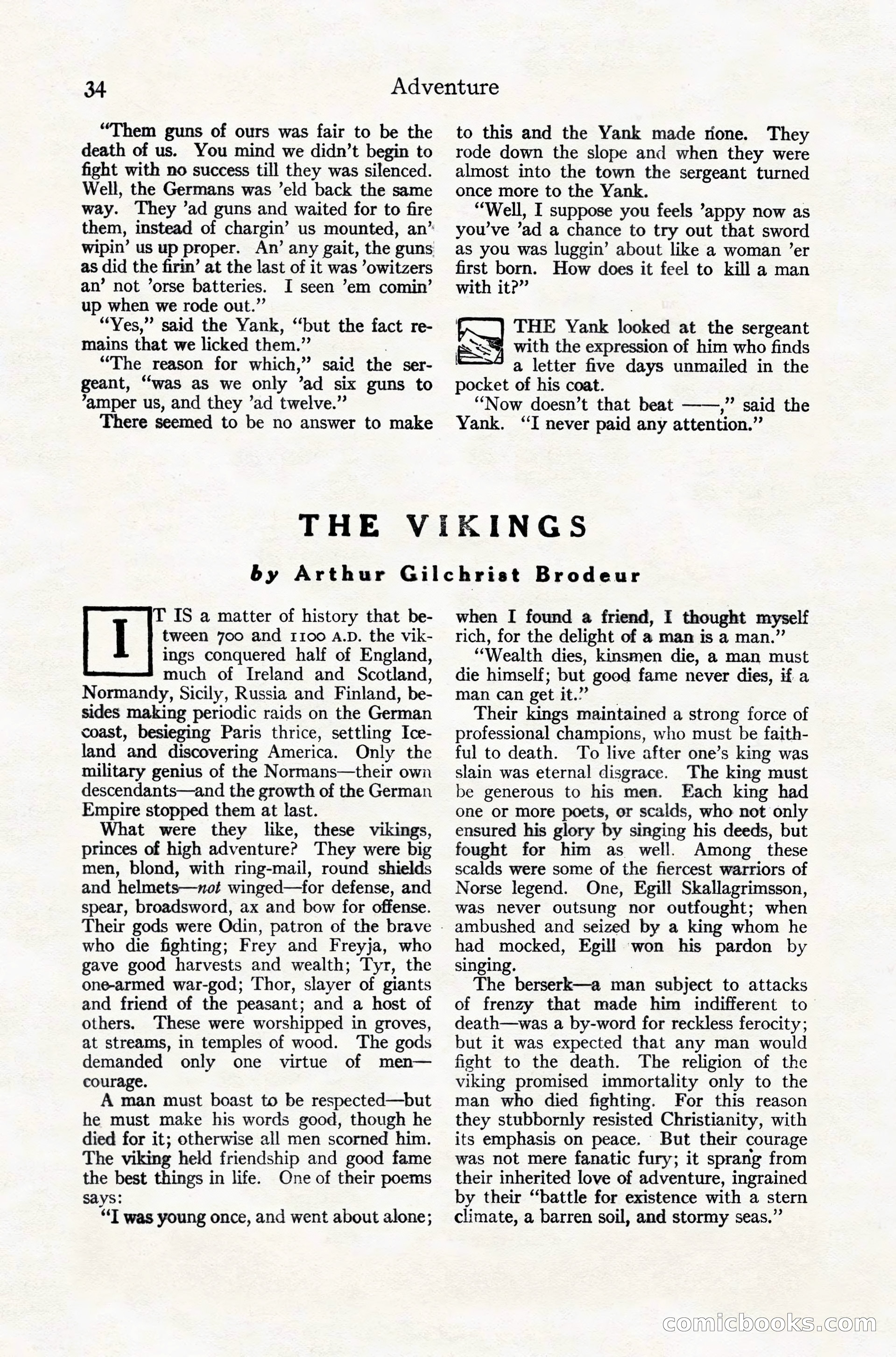
A restored page from Pulp Fiction, 1924. Page through the whole issue in the reader above.
📄 Transcribed text from this page (OCR, searchable)
Machine-transcribed from the original scan — historical spelling and the odd misread are preserved.
34 “Them guns of ours was fair to be the death of us. You mind we didn’t begin to fight with no success till they was silenced. Well, the Germans was ’eld back the same way. They ’ad guns and waited for to fire them, instead of chargin’ us mounted, an’ wipin’ us up proper. An’ any gait, the guns as did the firin’ at the last of it was ’owitzers an’ not ’orse batteries. I seen ’em comin’ up when we rode out.” “Yes,” said the Yank, “but the fact re- mains that we licked them. a8 “The reason for which,” said the ser- geant, “was as we only ad six guns to ’amper us, and they ’ad twelve.” There seemed to be no answer to make Adventure to this and the Yank made rione. They rode down the slope and when they were almost into the town the sergeant turned once more to the Yank. “Well, I suppose you feels ’appy now as you’ve ’ad a chance to try out that sword as you was luggin’ about like a woman ’er first born. How does it feel to kill a man with it?” THE Yank looked at the sergeant pss with the expression of him who finds a letter five days unmailed in the pocket of his coat. “Now doesn’t that beat ——,” said the Yank. “I never paid any attention.” THE ViKINGS by Arthur Gilchrist Brodeur T IS a matter of history that be- tween 700 and 1100 A.D. the vik- ings conquered half of England, much of Ireland and Scotland, Normandy, Sicily, Russia and Finland, be- sides making periodic raids on the German coast, besieging Paris thrice, settling Ice- land and discovering America. Only the military genius of the Normans—their own descendants—and the growth of the German Empire stopped them at last. What were they like, these vikings, princes of high adventure? They were big men, blond, with ring-mail, round shields and helmets—not winged—for defense, and spear, broadsword, ax and bow for offense. Their gods were Odin, patron of the brave - who die fighting; Frey and Freyja, who gave good harvests and wealth; Tyr, the one-armed war-god; Thor, slayer of giants and friend of the peasant; and a host of others. ‘These were worshipped in groves, at streams, in temples of wood. The gods demanded only one virtue of men— courage. A man must boast to be respected—but he must make his words good, though he died for it; otherwise all men scorned him. The viking held friendship and good fame the best things in life. One of their poems says: “T was young once, and went about alone; when I found a friend, I thought myself rich, for the delight of a man is a man.” “Wealth dies, kinsmen die, a man must die himself; but good fame never dies, if a man can get it.?? Their kings maintained a strong force of professional champions, who must be faith- ful to death. ‘To live after one’s king was slain was eternal disgrace. The king must be generous to his men. Each king had one or more poets, or scalds, who not only ensured his glory by singing his deeds, but fought for him as well. Among these scalds were some of the fiercest warriors of Norse legend. One, Egill Skallagrimsson, was never outsung nor outfought; when ambushed and seized by a king whom he had mocked, Eg ‘won his pardon by singing. The berserk—a man subject to attacks of frenzy that made him indifferent to death—was a by-word for reckless ferocity; but it was expected that any man would fight to the death. The religion of the viking promised immortality only to the man who died fighting. For this reason they stubbornly resisted Christianity, with its emphasis on peace. But their courage was not mere fanatic fury; it sprang from their inherited love of adventure, ingrained by their “battle for existence with a stern climate, a barren soil, and stormy seas.” GomG nooks (C@