
Pulp Fiction, 1924 · page 60 of 204
Adventure Magazine Cover — page 60: what you’re looking at
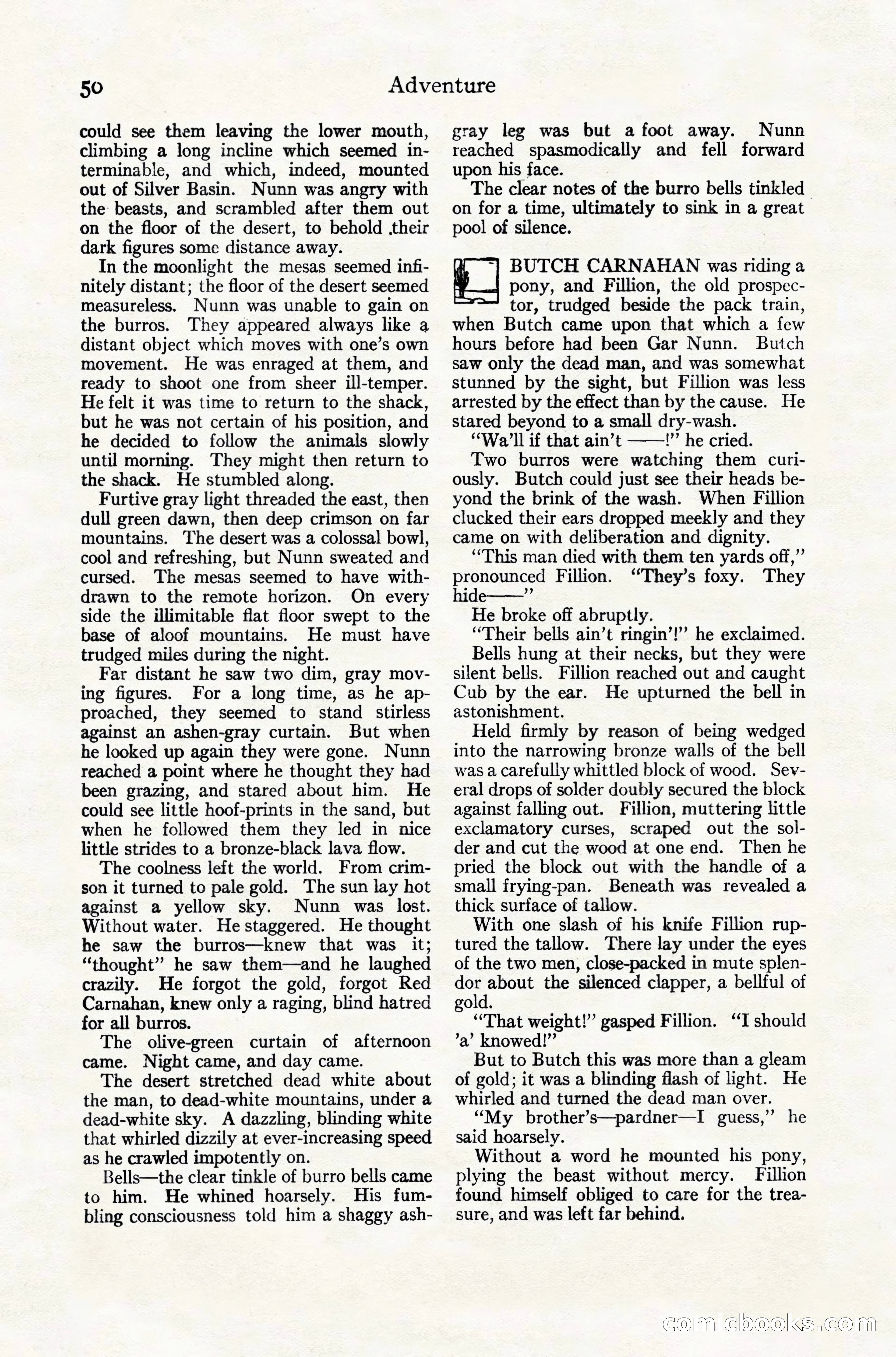
A restored page from Pulp Fiction, 1924. Page through the whole issue in the reader above.
📄 Transcribed text from this page (OCR, searchable)
Machine-transcribed from the original scan — historical spelling and the odd misread are preserved.
50 could see them leaving the lower mouth, climbing a long incline which seemed in- terminable, and which, indeed, mounted out of Silver Basin. Nunn was angry with the beasts, and scrambled after them out on the floor of the desert, to behold .their dark figures some distance away. In the moonlight the mesas seemed infi- nitely distant; the floor of the desert seemed measureless. Nunn was unable to gain on the burros. They appeared always like a distant object which moves with one’s own movement. He was enraged at them, and ready to shoot one from sheer ill-temper. He felt it was time to return to the shack, but he was not certain of his position, and he decided to follow the animals slowly until morning. They might then return to the shack. He stumbled along. Furtive gray light threaded the east, then dull green dawn, then deep crimson on far mountains. The desert was a colossal bowl, cool and refreshing, but Nunn sweated and cursed. The mesas seemed to have with- drawn to the remote horizon. On every side the illimitable flat floor swept to the base of aloof mountains. He must have trudged miles during the night. Far distant he saw two dim, gray mov- ing figures. For a long time, as he ap- proached, they seemed to stand stirless against an ashen-gray curtain. But when he looked up again they were gone. Nunn reached a point where he thought they had been grazing, and stared about him. He could see little hoof-prints in the sand, but when he followed them they led in nice little strides to a bronze-black lava flow. The coolness left the world. From crim- son it turned to pale gold. The sun lay hot against a yellow sky. Nunn was lost. Without water. Hestaggered. He thought he saw the burros—knew that was it; “thought” he saw them—and he laughed crazily. He forgot the gold, forgot Red Carnahan, knew only a raging, blind hatred for all burros. The olive-green curtain of afternoon came. Night came, and day came. The desert stretched dead white about the man, to dead-white mountains, under a dead-white sky. A dazzling, blinding white that whirled dizzily at ever-increasing speed as he crawled impotently on. Bells—the clear tinkle of burro bells came to him. He whined hoarsely. His fum- bling consciousness told him a shaggy ash- Adventure gray leg was but afoot away. Nunn reached spasmodically and fell forward upon his face. The clear notes of the burro bells tinkled on for a time, ultimately to sink in a great pool of silence. 3 BUTCH CARNAHAN was riding a F_.4 pony, and Fillion, the old prospec- tor, trudged beside the pack train, when Butch came upon that which a few hours before had been Gar Nunn. Butch saw only the dead man, and was somewhat stunned by the sight, but Fillion was less arrested by the effect than by the cause. He stared beyond to a small dry-wash. “Wall if that ain’t ——!” he cried. Two burros were watching them curi- ously. Butch could just see their heads be- yond the brink of the wash. When Fillion clucked their ears dropped meekly and they came on with deliberation and dignity. ‘This man died with them ten yards off,” pronounced Fillion. ‘“They’s foxy. They hide——” He broke off abruptly. “Their bells ain’t ringin’!’ he exclaimed. Bells hung at their necks, but they were silent bells. Fillion reached out and caught Cub by the ear. He upturned the bell in astonishment. Held firmly by reason of being wedged into the narrowing bronze walls of the bell was a carefully whittled block of wood. Sev- eral drops of solder doubly secured the block against falling out. Fillion, muttering little exclamatory curses, scraped out the sol- der and cut the wood at one end. Then he pried the block out with the handle of a small frying-pan. Beneath was revealed a thick surface of tallow. With one slash of his knife Fillion rup- tured the tallow. There lay under the eyes of the two men, close-packed in mute splen- dor about the silenced clapper, a bellful of gold. “That weight!” gasped Fillion. “TI should ’a’ knowed!”’ But to Butch this was more than a gleam of gold; it was a blinding flash of light. He whirled and turned the dead man over. “My brother’s—pardner—I guess,” he said hoarsely. Without a word he mounted his pony, plying the beast without mercy. Fillion found himself obliged to care for the trea- sure, and was left far behind. DOOK 1@)