
Pulp Fiction, 1924 · page 77 of 204
Adventure Magazine Cover — page 77: what you’re looking at
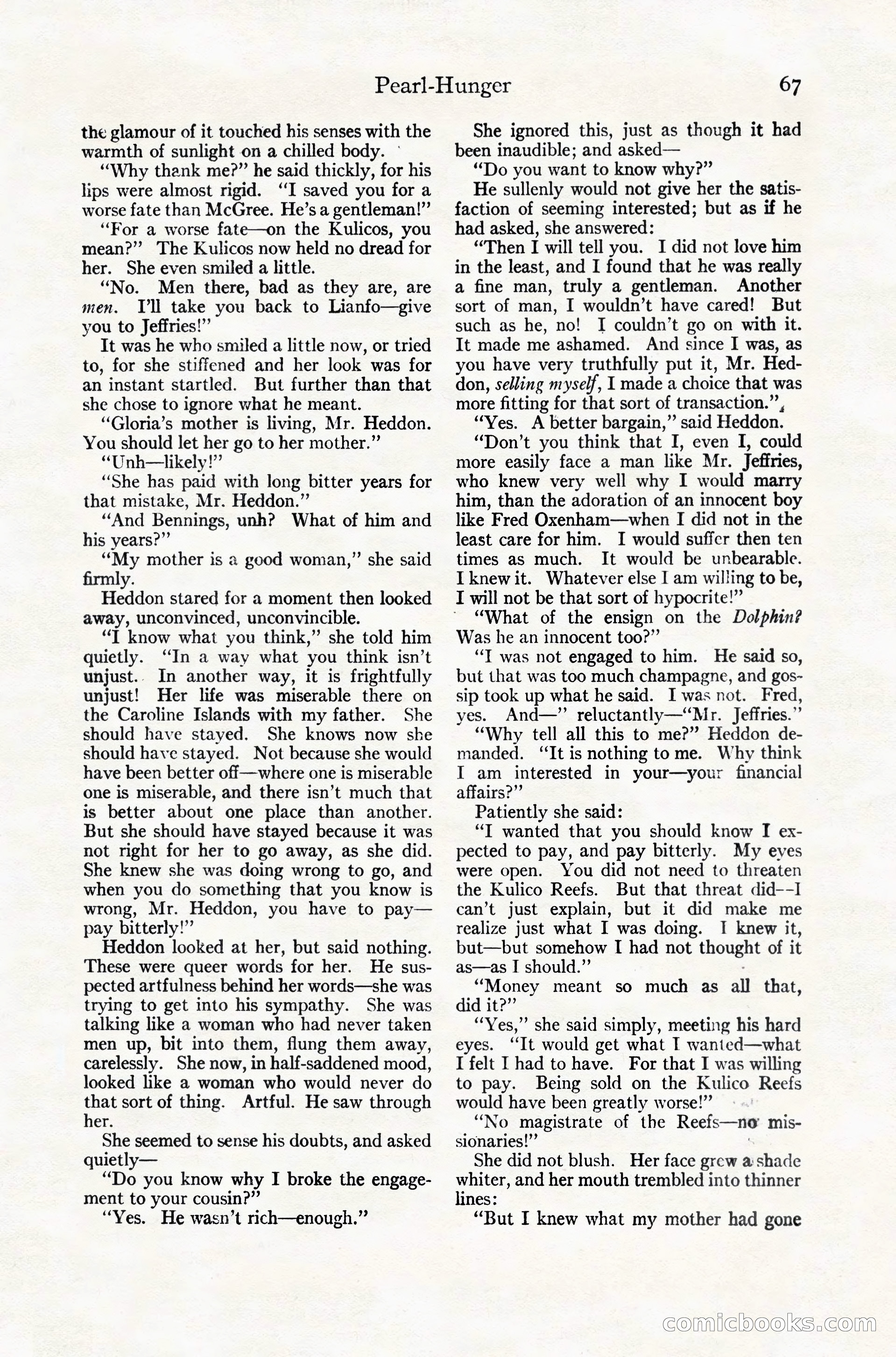
A restored page from Pulp Fiction, 1924. Page through the whole issue in the reader above.
📄 Transcribed text from this page (OCR, searchable)
Machine-transcribed from the original scan — historical spelling and the odd misread are preserved.
Pearl-Hunger the glamour of it touched his senses with the warmth of sunlight on a chilled body. — “Why thank me?” he said thickly, for his lips were almost rigid. “I saved you for a worse fate than McGree. He’s a gentleman!”’ “For a worse fate—on the Kulicos, you mean?” The Kulicos now held no dread for her. She even smiled a little. “No. Men there, bad as they are, are men. I'll take you back to Lianfo—give you to Jeffries!” It was he who smiled a little now, or tried to, for she stiffened and her look was for an instant startled. But further than that she chose to ignore what he meant. “Gloria’s mother is living, Mr. Heddon. You should let her go to her mother.”’ “Unh—likely!”’ “She has paid with long bitter years for that mistake, Mr. Heddon.” “And Bennings, unh? What of him and his years?”’ ‘““My mother is a good woman,” she said firmly. Heddon stared for a moment then looked away, unconvinced, unconvincible. “T know what you think,” she told him quietly. “In a way what you think isn’t unjust.. In another way, it is frightfully unjust! Her life was miserable there on the Caroline Islands with my father. She should have stayed. She knows now she should have stayed. Not because she would have been better off—where one is miserable one is miserable, and there isn’t much that is better about one place than another. But she should have stayed because it was not right for her to go away, as she did. She knew she was doing wrong to go, and when you do something that you know is wrong, Mr. Heddon, you have to pay— pay bitterly!” Heddon looked at her, but said nothing. These were queer words for her. He sus- pected artfulness behind her words—she was trying to get into his sympathy. She was talking like a woman who had never taken men up, bit into them, flung them away, carelessly. She now, in half-saddened mood, looked like a woman who would never do that sort of thing. Artful. He saw through her. She seemed to sense his doubts, and asked quietly— “Do you know why I broke the engage- ment to your cousin?” “Yes. He wasn’t nch—enough.” 67 She ignored this, just as though it had been inaudible; and asked— “Do you want to know why?” He sullenly would not give her the satis- faction of seeming interested; but as if he had asked, she answered: “Then I will tell you. I did not love him in the least, and I found that he was really a fine man, truly a gentleman. Another sort of man, I wouldn’t have cared! But such as he, no! I couldn’t go on with it. It made me ashamed. And since I was, as you have very truthfully put it, Mr. Hed- don, selling myself, I made a choice that was more fitting for that sort of transaction.”, “Yes. A better bargain,” said Heddon. “Don’t you think that I, even I, could more easily face a man like Mr. Jeffries, who knew very well why I would marry him, than the adoration of an innocent boy like Fred Oxenham—when I did not in the least care for him. I would suffer then ten times as much. It would be unbearable. I knew it. Whatever else I am willing to be, I will not be that sort of hypocrite!” “What of the ensign on the Dolphin? Was he an innocent too?” “T was not engaged to him. He said so, but that was too much champagne, and gos- sip took up what he said. I was not. Fred, yes. And—”’ reluctantly—‘Mr. Jeffries.” “Why tell all this to me?” Heddon de- manded. “It is nothing tome. Why think I am interested in your—your financial affairs?” Patiently she said: “T wanted that you should know I ex- pected to pay, and pay bitterly. My eves were open. You did not need to threaten the Kulico Reefs. But that threat did—-I can’t just explain, but it did make me realize just what I was doing. I knew it, but—but somehow I had not thought of it as—as I should.” “Money meant so much as all that, did it?” “Yes,” she said simply, meeting his hard eyes. “It would get what I wanted—what I felt I had to have. For that I was willing to pay. Being sold on the Kulico Reefs would have been greatly worse!” “No magistrate of the Reefs—no mis- slonaries!”’ 3 She did not blush. Her face grew a shade whiter, and her mouth trembled into thinner lines: “But I knew what my mother had gone Go DOOK 1 @)